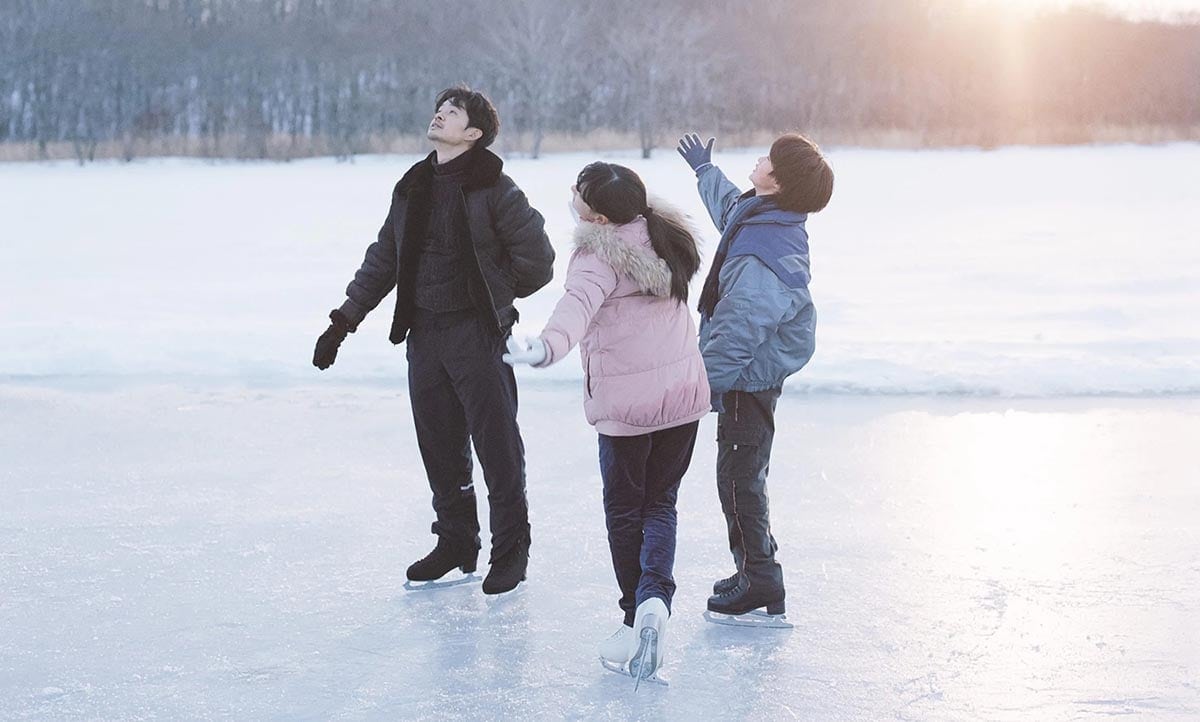
One of the first things we see in writer-director Okuyama Hiroshi’s My Sunshine is a boy gazing skyward. Takuya (Koshiyama Keitatsu) is in the middle of playing outfield in a baseball game, but he’s more interested in the snow that’s beginning to fall, the first of the season. Soon the children of the small Japanese town where the film takes place will have to try their hand at ice hockey or figure skating—and as Okuyama sees it, this tending to a new pastime, and in a place where it seems as if phones, video games, and the internet don’t play a significant role in people’s lives, has the potential to transform a kid’s world.
Okuyama has a keen eye for the stillness of the film’s locale, with his expressively composed snapshots of domestic and bucolic serenity, framed in a 1:33 aspect ratio, spinning visual poetry from seemingly inconsequential moments. No less economical is the story, which revolves around Tada, a sweet wallflower with a stutter and no apparent aptitude for sports, and the solace he derives from figure skating after catching sight of Sakura (Takanashi Kiara) on the ice. After Sakura’s coach, Arakawa (Ikematsu Sosuke), observes how Tada’s interested is piqued by figure skating and gifts the boy a pair of skates, the trio form a bond that’s tenuous but palpable, with Arakawa and Sakura wondering if they can train Tada to be competition-ready.
My Sunshine is a tapestry of stares, with seemingly every pivotal moment hinging on a character looking at something, or someone, for a little too long. In one scene, Takuya intently watches on as Sakura skates, and Arakawa observes them both. In another, Arakawa peers at the town from his balcony alongside his boyfriend (Wakaba Ryûya) and wonders if it’s the place for him.
The film seems to be asking, “What’s in a blank-faced stare?” Okuyama sees in his characters a voyeuristic impulse that’s sometimes curious, sometimes judgmental, sometimes both. Given that this is an intensely cinematic film that’s alive to the characters’ fascination with seeing, it’s as if Okuyama is reminding us of why we watch movies in the first place.
The voyeuristic quality of the characters’ gazes often pushes past the point of social acceptability, giving My Sunshine a disquieting charge that feels like a relief from characterizations that can border on a sticky sentimentalism redolent of Kore-eda Hirokazu, with whom Okuyama worked on the Netflix series The Makanai: Cooking for the Maiko House. Okuyama brings a winsome, light touch to especially the scenes set within the characters’ homes. He lets “Claire de Lune” and Little Anthony and the Imperials’s “Goin’ Out of My Head” do some emotional heavy lifting but otherwise lets the power of his images and the naturalism of the setting and the largely improvised scenarios speak for themselves.
Since 2001, we've brought you uncompromising, candid takes on the world of film, music, television, video games, theater, and more. Independently owned and operated publications like Slant have been hit hard in recent years, but we’re committed to keeping our content free and accessible—meaning no paywalls or fees.
If you like what we do, please consider subscribing to our Patreon or making a donation.