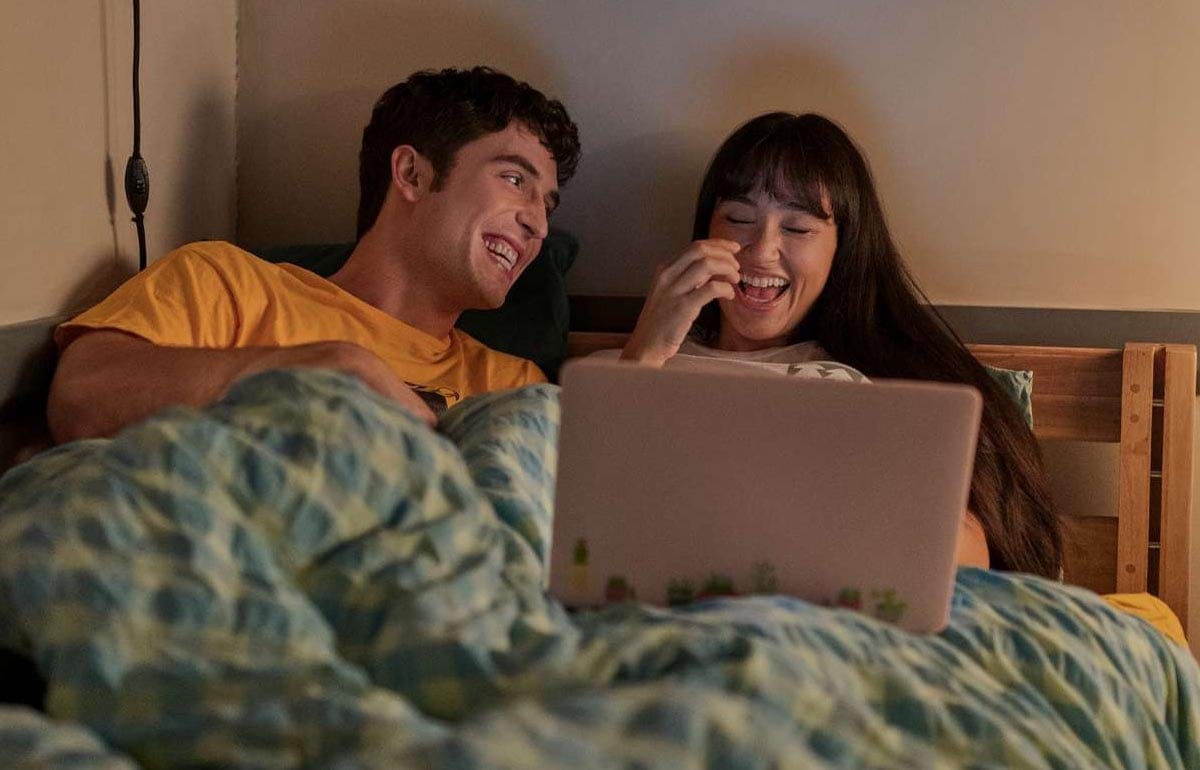
In the highly anticipated Overcompensating, comedian and actor Benito Skinner, best known for his online persona Benny Drama, stars as Benny, a closeted former football player and homecoming king who finds himself torn between pleasing everyone else or being himself after heading to college. The series, co-produced by A24 and Amazon MGM Studios, also marks the acting debut of stand-up comedian and writer Wally Baram, who stars as Carmen, Benny’s best friend and an outsider still grieving the loss of her brother.
The heart of Overcompensating, which premieres on Amazon Prime on May 15, is that friendship between Skinner and Baram’s characters, which blossoms into something profound and healing after they initially make some very awkward attempts at dating. Also of note, the series features plenty of music, new and old, by Charli XCX, who appears as herself in one episode where she, natch, brattily performs at the college at the center of the show.
I recently sat down with Skinner and Baram to discuss coming out, sex on campus, the differences between making content and spearheading a narrative series, and how everyone can relate to doing too much when you feel like you’re not enough.
Benito, Overcompensating is very autobiographical for you. Where did you draw the line between sharing and inventing?
Benny Skinner: Sharing is such a perfect way to say it! I wanted to share experiences that happened to me as I came out and experiences I had where I started to overcompensate less, [but] I feel like I wanted to develop characters, and I don’t think just pulling directly from my life was going to inspire me or make for good TV. It was a mix, and once we were in the writers’ room and Wally was writing this with us, I feel like that’s when I opened up. I was strict [in depicting my] coming out because I really wanted to tell that in the most honest way possible to me. But everything else, it was like, “Let’s hear everyone’s college stories.” Let’s find a way for this to be a universal experience where anyone can watch this, whether you’re in college now or 20 years ago, and be like, “Holy shit, that’s what that felt like.”
Why is this the story you needed to tell right now?
BS: I’m still finding that I’m overcompensating. I feel like there’s an epidemic of people feeling unlovable, and it’s about finding people that love you. They exist. You just have to really claw for it. I wish it was a little bit easier. Also, what better time to give people a four-and-a-half-hour break from a really scary reality and let them know that there are people out there that feel the same way they do—unlovable and strange in their bodies and in their minds?
Wally, this is an exciting project for you because you come from a writing and stand-up background. What was it like making the jump to acting opposite Benito?
Wally Baram: Magical, surreal, incredible. I think our relationship really mirrors a lot of what you see on the show, where I really feel like I’m working across from this person that sees me in a way that I’ve never been seen before. This is the first thing I’ve ever been cast in, and no one else has ever seen me in that way or thought that I could do that.
Beyond that, I’ve worked in a lot of season-one writers’ rooms where the instinct is for the showrunner to be precious about how the room is run, their ideas, and getting it just right so they get that season two. [But] Benny was so welcoming to ideas and nonprecious and really trusted everyone that he brought into the room. And then, when we went into production, we worked with such great directors, and it was an environment that was conducive to me learning how to be in that environment. It felt like such a safe education on what it means to be a co-lead.
Benito, you’re best known for your short-form social media content. How did you go about adapting your comedic voice to a more traditional narrative series?
BS: I feel like I was naturally headed toward more episodic [storytelling] in my sketches. I started making Kardashian sketches that were five minutes long, and my agent was like, “That last one feels like you should just write TV. You don’t have to edit these and do it all yourself. You should write something.” [But] everyone taught me things in the writers’ room.
We brought on Scott King to show-run, and that has fully changed my life. He’s such a genius, and to be mentored by this man who’s made some of my favorite TV of all time has been the greatest honor. And he’s pushed me. I’ve sent scripts to him, and he’s like, “I know what you’re trying to say. Say it like this.” And, “This is how you make good TV.” It’s not just about telling my story or making sure that there are all these jokes. Those jokes won’t amount to anything if you’re not raising stakes. And we made sure that every person who was in that writers’ room was someone that I think I was really inspired by and felt comfortable with and was ready to share really personal things about our college experiences.

Wally, was it interesting for you to see Benito go through this journey in a traditional writers room?
WB: That’s a good question. So often, the question is always “What is it like to go from someone that makes content from the internet to someone making a TV show?” Working with Benny, I didn’t feel like that’s who I was working with. I don’t feel like this is someone who’s just a short-form content star who was given the reins to TV. I know he went to film school and he’s always asking the right questions, like, “What are the stakes of this scene?” He’s talking about the emotional composition of characters and what that’s driving them to do, and different payoffs. His writing brain is geared toward [what we’re doing with Overcompensating].
So, I hope that, [regardless] of the outcome of the show, what doesn’t get overlooked is Benito Skinner, the writer. Because I think that Benito Skinner, the writer, brought so much to this. I’ve worked with a lot of first-time show runners, and I’m sure you he was learning and keeping certain things internal, but he had a lot of the tools coming in. I don’t think I ever felt like I was in the room with someone that didn’t know what they were in for.
So, what you’re saying is that he wasn’t overcompensating?
WB: Yeah!
BS: Yeah. My panic attacks were in private, I guess.
Media in general is very sex negative right now. Of course, it’s the nature of a college show that students would be focused on sex, but how much thought did you put into the show’s approach to sex and its overall attitude toward it?
BS: I think when it felt true, we were going to do it. That was something we talked about a lot. The first intimate scene in the pilot between Benny and Carmen—that’s something that I haven’t really seen on screen, and that was something that we talked a lot about with our intimacy coordinator. Daniel Longino, the director of that episode, is so brilliant and knew that this scene needed to be funny, but also it’s kind of an emotional scene. It’s this very private moment between these two people that have almost been forced into this, but also really love spending time with each other. And so they go, “Well, you’re a boy, I’m a girl. Okay, then, I guess we have to do this at college.” You get to college, and sex is the first thing people bring up. “What’s your body count?” It’s a currency there. I’m proud that those scenes, even if they feel uncomfortable to us and were scary to shoot or scary to write even, if they felt real, that’s what we wanted.
WB: The commodification of sex on college campuses—it feels like you can’t tell this story in the awkward, raw way that we wanted to tell it without talking about that exchange. And I think every time you do see sex, more often than not we’re playing it either for a little bit of comedy or a lot of it. But we’re always playing it for a plot device and a character device, which is critical.
It’s very cool to not just hear Charli XCX’s familiar songs throughout but that she provided music for the score. Was it a very collaborative process with her, or did you give her free reign to do what she wanted?
BS: I definitely gave free reign. She assembled this team: Alex Somers, who composed Nickel Boys, [her partner] George Daniel from the 1975, and Amber Bain from the Japanese House. Charli, Amber, and George would work together and send things to Alex, who would weave in a lot of the sounds and a lot of the elements and beats they were sending into the score. It was this unbelievable egoless process of making everything sonically cohesive throughout the show.
I really am so proud of how it feels both nostalgic and modern. We wanted to make people feel like this college could kind of exist at any time. I’m not relating us to this, because this is an iconic work of art, but Mean Girls is just high school, period. The skirts are 2003, but I think in general it’s like, “This is a feeling.” And that was something that the whole music team knew we were doing, and Charli knew exactly what this needed to sound like. She has been a part of the project even before we pitched it. We would send playlists back and forth for years before this.
Did I know that she was going to be the busiest human being on Earth this past year? No, but I love that she was. I tell my boyfriend [digital strategist and photographer Terrence O’Connor] every day, “Fuck you for that.” No, I’m kidding. I love all of it. I’m so excited that she’s finally getting her flowers. She came from her Sweat Tour straight to set and filmed her scenes, did a concert sequence, and was in those meetings. And the team that she brought to this, she knew exactly what it needed to be. And so it was collaborative, yes, as in I got to be there and watch my heroes and my favorite musicians add score to my favorite actors and my favorite thing I’ve ever done. Anything she gave us, I was like, “Put it in. Love it. Perfect.”
What are your hopes for Overcompensating, and what do you hope viewers take away from it?
BS: I hope that people see a common thread in that this idea of overcompensating extends to all the character in the show, and that maybe there’s one thing linking human beings. I think that there’s a sense of [fearing] even the smallest rejection and trying to make up for the one thing you think is wrong about you nonstop. And that will live with you in college and probably after as well. But I also just desperately want people to really enjoy watching a TV show with their friends. I just think that that would be so nice.
WB: I want them to have fun. And in having fun, I think you hopefully do see yourself. You see yourself during a time in which you were overcompensating and not stoked about who you were, and then not stoked about who you were trying to be, which is even worse. I hope that fun sheds the shame of whatever you’re carrying, and that they’re able to really look at all the characters and all the ways they’re overcompensating and get something from all of that.
Since 2001, we've brought you uncompromising, candid takes on the world of film, music, television, video games, theater, and more. Independently owned and operated publications like Slant have been hit hard in recent years, but we’re committed to keeping our content free and accessible—meaning no paywalls or fees.
If you like what we do, please consider subscribing to our Patreon or making a donation.