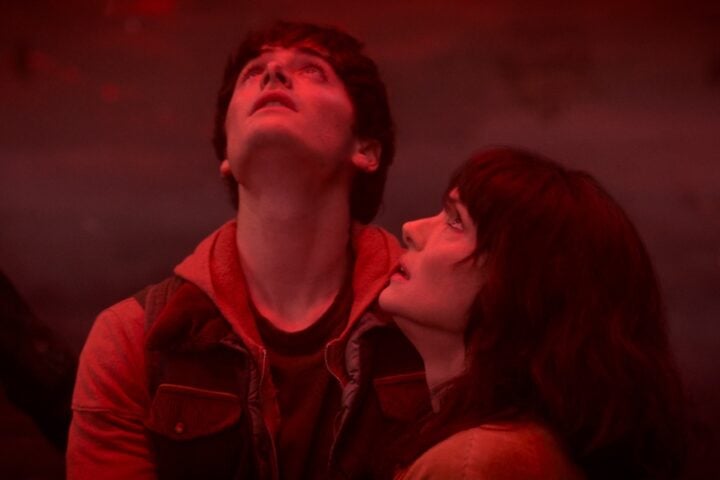
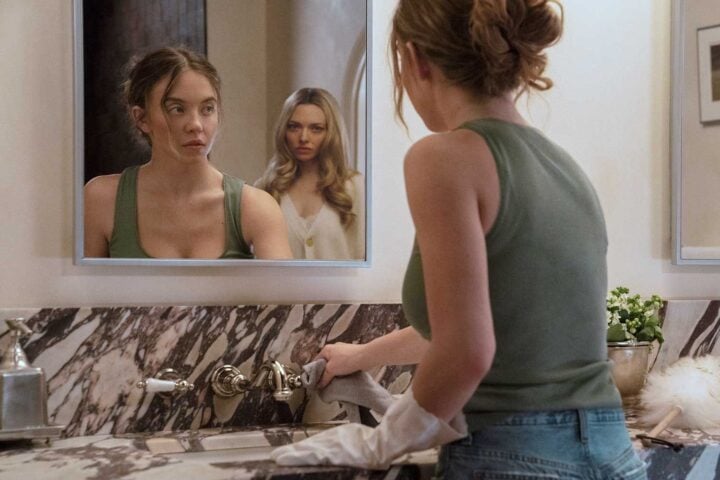
Based on Elizabeth Brundage’s 2016 novel All Things Cease to Appear, Robert Pulcini and Shari Springer Berman’s Things Heard & Seen is an atmospheric entry in the category of stories about bad things befalling urban elites who move to isolated communities. The elites in question are George (James Norton) and Catherine Claire (Amanda Seyfried), who pack up their New York City life after he’s offered a professorship at a college in a tiny burg in the Hudson Valley. Catherine, an artist struggling with anorexia, grumbles about leaving the city and her work as an art restorer behind, but since it’s 1980 and she feels obligated to be a dutiful wife and attend to George’s career, off they go.
The warning signs about what awaits the couple and their daughter, Franny (Ana Sophia Heger), abound at every turn. Even though people in the tellingly named town of Chosen are welcoming, it’s also the kind of place where you would expect to find at least a couple of cults. A certain gloom hangs over just about every exchange. For one, the curiously solicitous but closed-mouthed young brothers, Eddy (Alex Neustaedter) and Cole (Jack Gore), who show up at George and Catherine’s door offering their handymen services clearly have an agenda that one suspects isn’t to be revealed until the film’s homestretch.
The atmosphere is also charged with meaning due to Larry Smith’s gorgeously chilly and autumnal cinematography. Several of his wider compositions in which people are framed as tiny figures in a vast wooded and mountainous landscape emphasize a sense of the residents’ vulnerability to larger forces both seen and unseen. Those shots also evoke the work of landscape painter George Innes, a member of the Hudson River School who George teaches at his new place of work and who also was enamored of the writings of Emanuel Swedenborg, an 18th-century spiritualist who has a somewhat cult-like following in Chosen.
Things Heard & Seen is at its best in the early going, when tracing Catherine’s attempts to carve out some kind of life for herself while navigating an increasingly fraught marriage, not to mention a house riddled with the ghosts of the past. Her anxieties are compounded by George’s blithe inattention to her, as he’s too focused on making an impression at the college and assuaging his ego by chasing after a student, Willis (Natalia Dyer). He actively works to isolate Catherine, discouraging her from even befriending one of his co-workers, Justine (Rhea Seehorn), who he thinks might suspect him of harboring secrets. Though much of this material is fairly stock, the cast helps elevate it with some unexpectedly committed and vibrant performances. Seehorn is a particular standout, bringing a sharp-eyed and sardonic manner to Justine’s interrogations of George’s too-good-to-be-true persona.
Like the plot, the film’s haunted house elements—ranging from a piano playing itself to an eyeless specter lurking in Franny’s bedroom—are similarly generic. At one point, it does seem as though the film is taking its otherworldly aspect in a more intriguing direction. “We’re not alone, are we?” George’s Swedenborg-obsessed department chair, Floyd (F. Murray Abraham), asks Catherine after spotting a spirit flickering past while at their house for a party. His nonchalant manner about the undead, seeing them as nothing to be frightened of and potentially benevolent, is one of the film’s more resonant aspects and begins to take the story in a more interesting direction at a séance he organizes with other Swedenborg-following locals. But soon enough, all that spiritualist exploration is revealed to be a kind of ruse.
Ultimately, the film’s most impactful terrors have nothing to do with things that go bump in the night. George’s attempts to undermine Catherine’s sense of reality become truly insidious, as his veneer of humanity shows itself to be frighteningly thin. While Things Heard & Seen’s messy threading of domestic thriller and ghost-story tropes leaves a lot to be desired, its revelation that the threat to Catherine and Franny was there long before they moved into a haunted house delivers at least some element of real-world unease.
Since 2001, we've brought you uncompromising, candid takes on the world of film, music, television, video games, theater, and more. Independently owned and operated publications like Slant have been hit hard in recent years, but we’re committed to keeping our content free and accessible—meaning no paywalls or fees.
If you like what we do, please consider subscribing to our Patreon or making a donation.