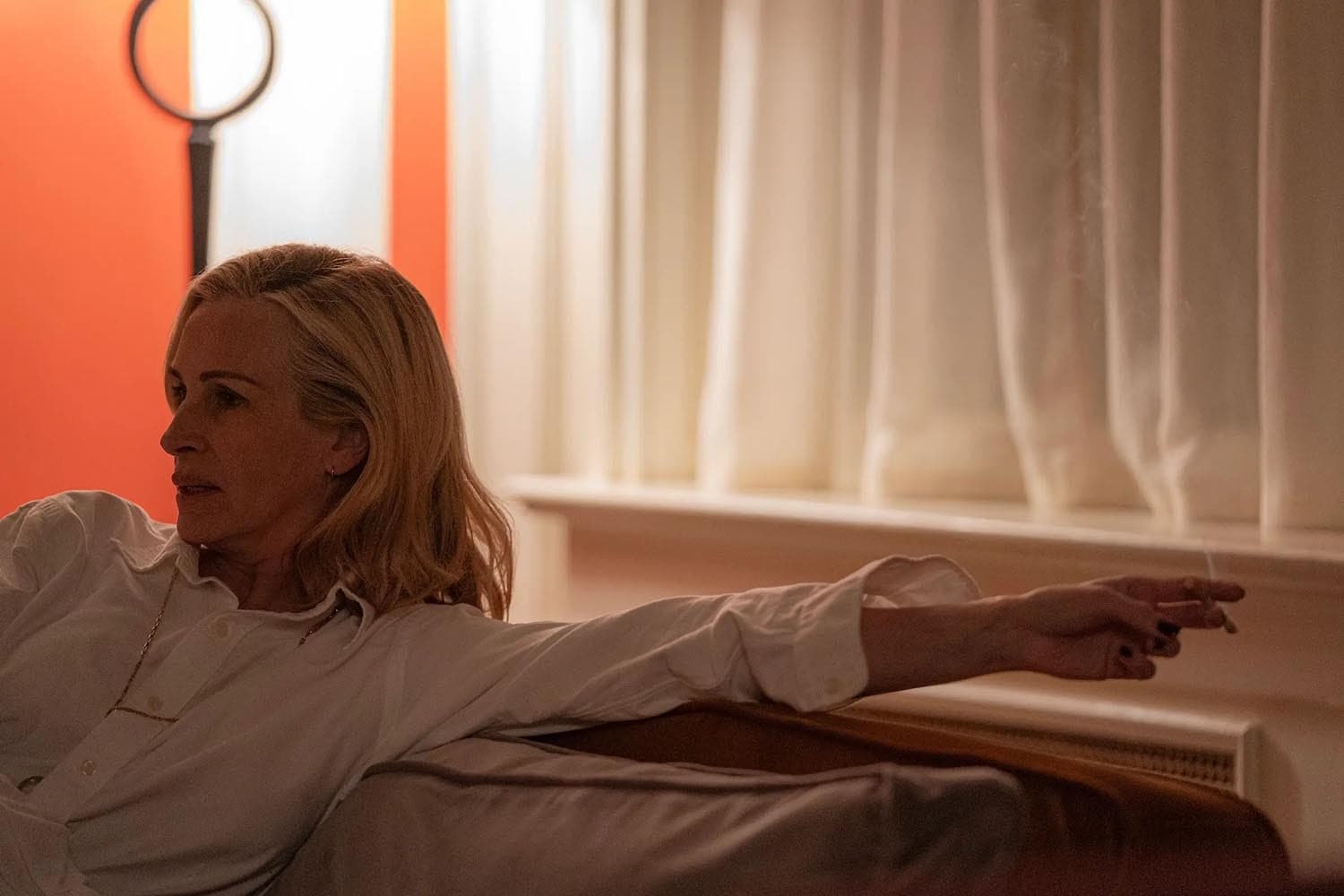
Luca Guadagnino’s After the Hunt lingers in social, political, and moral gray areas that threaten to get lost in discussions of the effects of the #MeToo movement and cancel culture. But while its desire to question absolutes is admirable, there’s a hollowness at the film’s core that prevents it from having a more pointed impact beyond surface provocation.
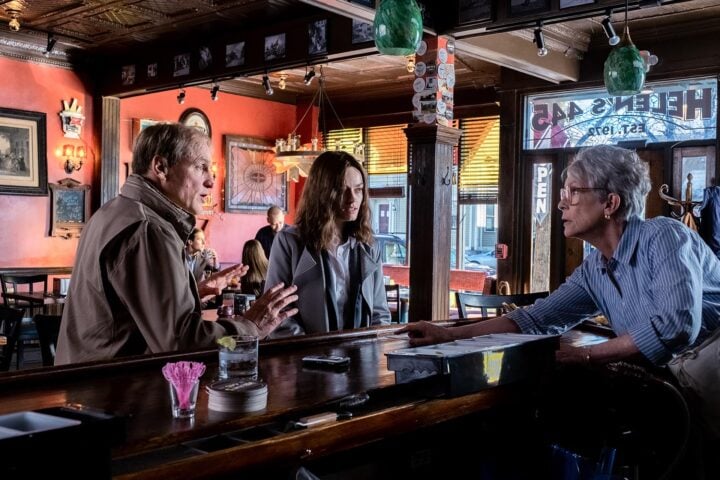
Written by first-time screenwriter Nora Garrett, After the Hunt centers on Alma (Julia Roberts), a philosophy professor at Yale who finds herself caught in the middle of a scandal when a prized student, Maggie (Ayo Edebiri), accuses Alma’s colleague Hank (Andrew Garfield) of sexual assault after a party held at Alma and her husband Frederik’s (Michael Stuhlbarg) apartment. Crucial to the film’s desire to challenge right-and-wrong binaries is its elision of both the assault and an off-the-record portion of a meeting between Alma and a dean that leads to Hank’s firing.
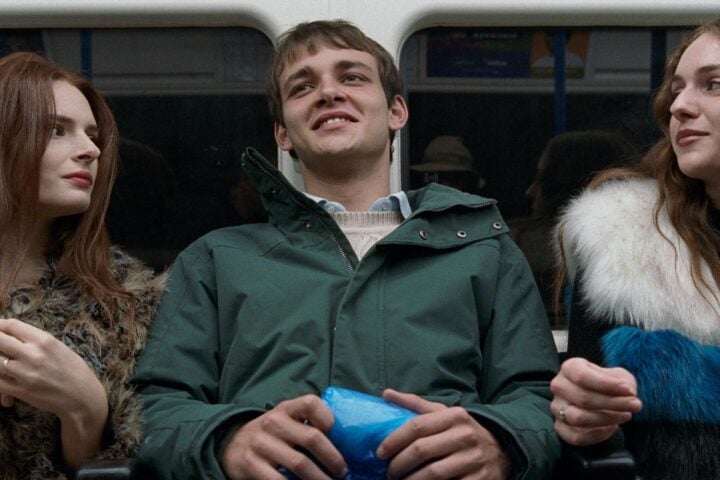
Instead, Garrett’s screenplay piles on character details to complicate our views of everyone involved in the scandal. Maggie, the adopted daughter of a generous Yale donor, is a queer woman with a nonbinary partner (Lío Mehiel), and it’s strongly hinted that she has amorous feelings for Alma. Hank is depicted as charismatic but openly flirtatious with students and colleagues and frequently willing to question societal conventions, making it understandable that people doubt his innocence. A part of Hank’s defense is that Maggie’s allegation is retaliation against him for accusing her of plagiarizing parts of her dissertation.
As for Alma, she and Hank are both up for tenure, which is why she tries to play both sides of a very sticky situation. Alma and a friend, on-campus psychiatrist Kim (Chloë Sevigny), state at various points that they’re both of an older generation that feels hesitant to question the patriarchal system within which they work, and the audience is invited to trace a rather obvious line between them navigating fraught interpersonal waters and Alma in particular building an emotional wall around herself. Of course that’s why Alma’s marriage to the long-suffering yet still-devoted Frederik is so passionless, and of course that’s why her reaction to Maggie confiding in her about her sexual assault isn’t as sympathetic as you might expect.
All of those details are enough for a thoughtful examination of the range of possible responses to sexual assault. But there comes a point where After the Hunt is defined by its convolutions. Not only does Alma harbor a secret from her past that mirrors Maggie’s predicament, but she also has a debilitating illness that she keeps secret and which has caused her to become dependent on pain medication. That addiction, in one of the film’s more heavy-handed ironies, becomes more of a threat to her potential tenure than her divided allegiances to Maggie and Hank.

Such schematic tactics point to a larger didacticism that makes these characters feel less like flesh-and-blood people than props for delivering a thesis statement. The party at Alma and Frederik’s apartment sets the film’s high-minded tone, with the academics having philosophical discussions about the effects of #MeToo and cancel culture on on-campus life. Even the most traumatizing of emotions in After the Hunt tend to be talked about rather than dramatized.
Perhaps that’s why Guadagnino, ever the aesthetic maximalist, packs the film with visual signifiers and unexpected camera angles. The most obvious of the former is the use of Woody Allen’s familiar Windsor Light typeface for the opening and closing credits. There are also many close-ups of hand gestures throughout, which task us with noting the freedom of movement of those in positions of power versus the relative constriction of those at a disadvantage. And cinematographer Malik Hassan Sayeed finds multiple ways to frame characters within doorways and staircase balusters to imply the imprisoning effects of staying true to one’s perspective.
Most noteworthy are the music cues employed outside of Trent Reznor and Atticus Ross’s dissonant score. Given the choice to score a moment in which Maggie tearfully runs out of a classroom after witnessing a tantrum thrown by a just-fired Hank to Julius Eastman’s “Evil N****r,” we’re left to ponder Maggie’s potential guilt. Another scene in which Alma is seen calming herself with a track from Miles Davis’s Sketches of Spain, a masterful exploration of cross-cultural exchange, harkens back to an earlier scene in which Fredrik cooks doro wat for Maggie while she’s in their apartment. Both moments evoke a concern for culturally inclusive optics on the white characters’ part that the film never really reckons with.
Instead of involving character drama, we’re bombarded with such over-intellectualized shorthand gestures, cloaking After the Hunt in a feeling of insularity that works against its desire to speak to the wider world in which we all live. The actors do excellent work, and Roberts is especially striking playing against type as a closed-off character with intimate moments of self-awareness and vulnerability. Pity, then, the film is all too willing to violate the emotional authenticity of their performances with an epilogue that leaves you questioning whether this moment, and maybe by extension other parts of the film, actually took place. What is clear, though, is that the moment reinforces the film’s status as a self-congratulatory think piece.
Since 2001, we've brought you uncompromising, candid takes on the world of film, music, television, video games, theater, and more. Independently owned and operated publications like Slant have been hit hard in recent years, but we’re committed to keeping our content free and accessible—meaning no paywalls or fees.
If you like what we do, please consider subscribing to our Patreon or making a donation.