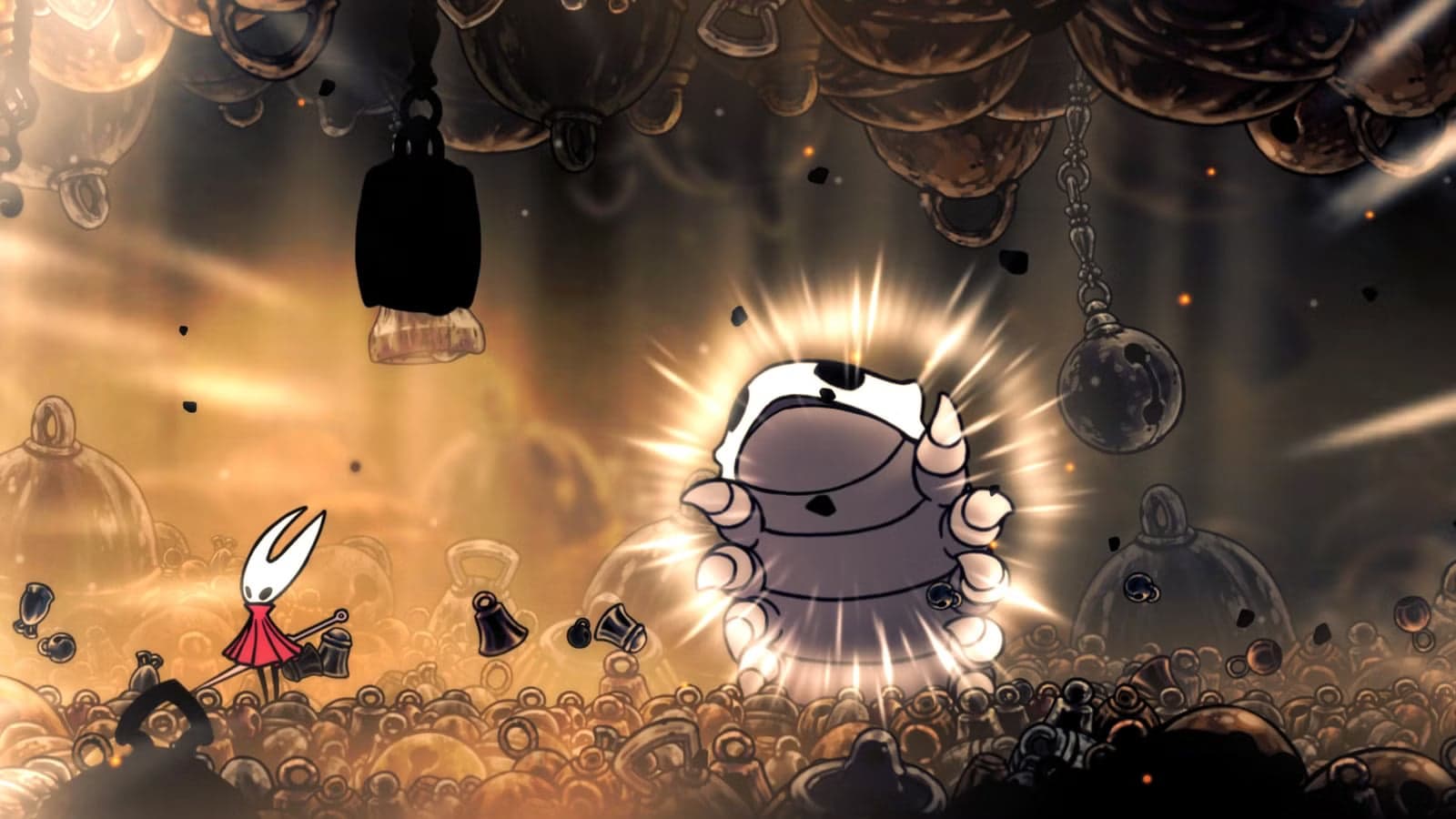
The enchantingly moody realm of Pharloom is dotted with ancient bells, baroque religious totems that lie buried in subterranean slumber. As Hornet, a stranger in these lands, you raise and ring the chimes throughout the first act of Team Cherry’s Hollow Knight: Silksong. Send not to know for whom the bells toll, they toll for the anthropomorphic bugs of Pharloom. Commanded by their creed to make pilgrimage across ruthless expanses, the lot seem doomed to perish amid wind-pummeled dunes, to fall at the claws of predators, or, perhaps most cruelly, to succumb to the curse that’s turning travelers into mindless brutes.
Over the course of Hornet’s investigation into the hex, you wield your needle against feral critters of inspired design, from beastmasters corralling cockroaches to scissor-wielding creeps that bring to mind A Bug’s Life by way of Bloodborne. But you also encounter others who cling to their sanity, who declare their enduring individuality with wonderfully expressive gestures and articulations. In a secluded cave, a weary gambler snatches his dice with blistering precision; elsewhere, a devotee sings in prayer that the gate before him be opened. If you thwack the barrier with your blade, he interrupts his warbling with a surprised, adorable “Oh!”
This seven-years-in-the-making follow-up to Hollow Knight is a work of vast, idiosyncratic personality. The outsized charm and magnetism of its miniscule creatures extends to the world they’ve carved out for themselves. Few outings from Pharloom’s beleaguered but cozy settlements, along mossy trails and into claustrophobic caverns, lack for moments of giddy discovery. Quests, treasures, and entire regions hide behind fake walls and off tucked-away paths. The landscape invites you to puzzle it out like a Rubik’s Cube, to examine it from different angles and experiment until its myriad facets click into place, revealing its secrets.
An enticing sense of acceleration suffuses Silksong. Hornet unlocks abilities that allow you to blaze across Pharloom and its snappy platforming sequences, access hitherto unreachable places, and customize your approach to the game’s acrobatic combat. The environments grow increasingly devious, and the bosses that lord over them reward close study during gripping, balletic clashes. More than once, I stumbled onto a fight that felt unreasonable—and then each attempt elucidated a new element of it, until its mechanics melted into muscle memory.
There are speed bumps, though, including a surfeit of pesky flying enemies, the weighty contact damage you take when bumping into an enemy, and the occasional excessive runback. The DIY cartography, a holdover from Hollow Knight, remains endearing, though given the addition of a quest log here, I longed for characters to be more consistently and clearly labeled on the map.
But as you meet more of Pharloom’s inhabitants, and as you endure the trials they’ve long braved, the truth of things rings clarion clear: Silksong’s speed bumps are entirely appropriate, as well as admirable. You learn that laborers are forced to work until they drop dead, that poor creatures on brutal pilgrimage must pay to rest on certain benches along the way. Anything won or eked out in Pharloom is done so by tooth and nail. Of course bosses are going to summon minions to overwhelm you. Of course territorial ants are going to booby-trap the checkpoint nestled in their home. Of course this place is going to grind you into dust.
And therein lies the scalding heart of Silksong: its humanism. Despite the relentless horrors of Pharloom, its people insist on hope. They risk their lives for each other, mourn their dead, and rebuild their communities. Even Hornet, who fashions herself a transactional cynic, gets swept up in the camaraderie and lets empathy lead her. Ushering her to and fro across the game, I found myself seeking out side quests less for their prizes than for the possibility that at least one more bug might persist, and in the process seize some happiness.
This game was reviewed with a copy purchased by the reviewer.
Since 2001, we've brought you uncompromising, candid takes on the world of film, music, television, video games, theater, and more. Independently owned and operated publications like Slant have been hit hard in recent years, but we’re committed to keeping our content free and accessible—meaning no paywalls or fees.
If you like what we do, please consider subscribing to our Patreon or making a donation.