In the summer of 2001, Ecuador is still recovering from total economic collapse. But hope is seen on television, as the country’s national soccer team is on the cusp of qualifying for the World Cup. For the people of Ecuador, the qualifying matches are as much a distraction from everyday troubles as they are a rallying cry of defiance and perseverance.
These matches have a different effect on Julián, Despelote’s eight-year-old protagonist. If he stares at a TV tuned to the qualifiers long enough, his first-person viewpoint zooms in, simulating his focus. But he spends more time running through the streets of Quito, kicking a ball around with neighborhood kids while getting into trouble with all sorts of testy adults. While the qualifying matches may be Despelote’s framing device, they’re just one of many dramas at work in the background of a game teeming with specificity and lived experience.
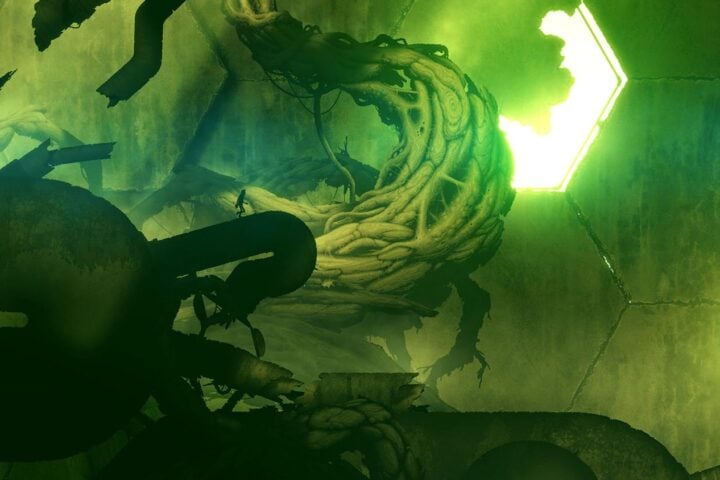
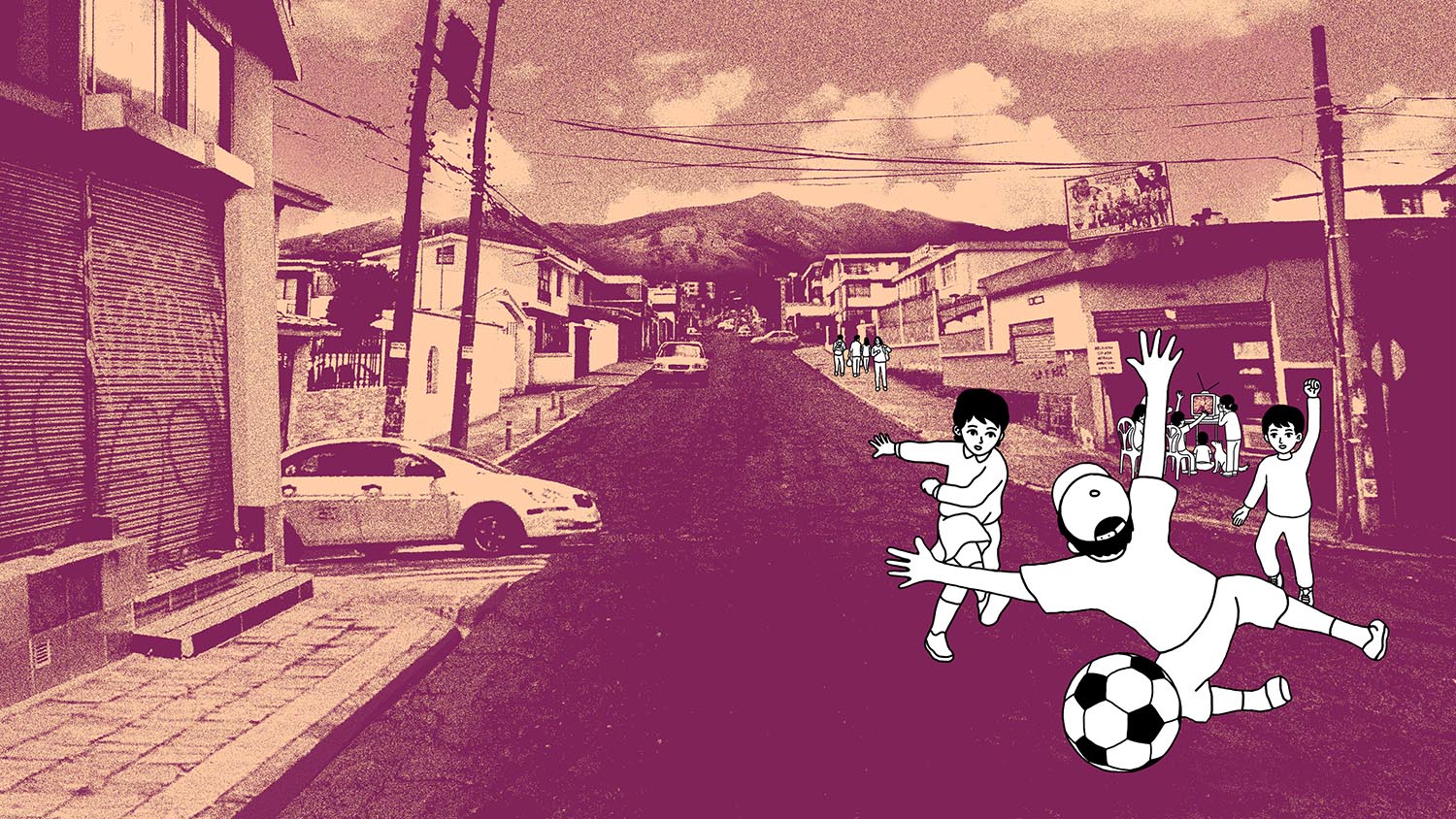
The game’s gorgeous environments straddle the line between the dreamlike and the hyper-realistic, suggesting photographs reprinted in duotone. Details are obscured at a glance, but certain people and objects are made to stand out as stark-white cartoon illustrations. Apart from cleverly highlighting all the interactive elements, this stylistic contrast simulates the way that parts of the world may capture (or fail to capture) a child’s short attention span, when youthful energy is pulling their focus every which way. For one, when you’re passing a soccer ball, your eye is drawn to an old man feeding pigeons in the distance, or to a food vendor at his cart.
It’s hard to play Julián Cordero and Sebastián Valbuena’s autobiographical game without a feeling of sensory overload, particularly if you don’t speak Spanish, as all the dialogue is spoken and translated in pop-up text boxes that progress on their own, sometimes outright obscuring the view of the TV you’re trying to focus on. In its suffusion of overlapping details and mechanics, Despelote creates a world that seems to exist independent of your input rather than, as in most games, ensuring its every bespoke crevice is vying for your attention.
Across the game, there are sights that you’ll miss, and there are conversations that you’ll only catch the end of. But that’s childhood, after all, which can make one feel left out and disenfranchised. Here, you’re never fully in control, free only to traipse around the park because an adult brought you there and told you to wait on the bench before turning her back.
A child’s time isn’t to be organized and optimized. In fact, it’s easy to lose track of time since you have to move the camera down to check your wristwatch, tearing your gaze away from the world in the process. And that underlying clumsiness is what makes Despelote so transportive in its vision of a messy childhood, which is best captured in the soccer mechanics. The ball isn’t simply glued to your foot; you might very well lose it trying to make a sharp turn or reverse direction. The first-person perspective even cuts down on your spatial awareness, in notable contrast to the top-down soccer video game that you can play throughout the story.
To play Despelote is to move like a child who’s not yet certain of himself, unable to fine-tune his aim. You’re presumably capable of kicking the ball and hitting a bottle perched on a fence post, but it feels apt that you miss time and time again, until one of the other, better kids steps in to take the shot and does what you can’t. At which point, you keep at it, because the world goes on.
This game was reviewed with a code provided by popagenda.
Since 2001, we've brought you uncompromising, candid takes on the world of film, music, television, video games, theater, and more. Independently owned and operated publications like Slant have been hit hard in recent years, but we’re committed to keeping our content free and accessible—meaning no paywalls or fees.
If you like what we do, please consider subscribing to our Patreon or making a donation.