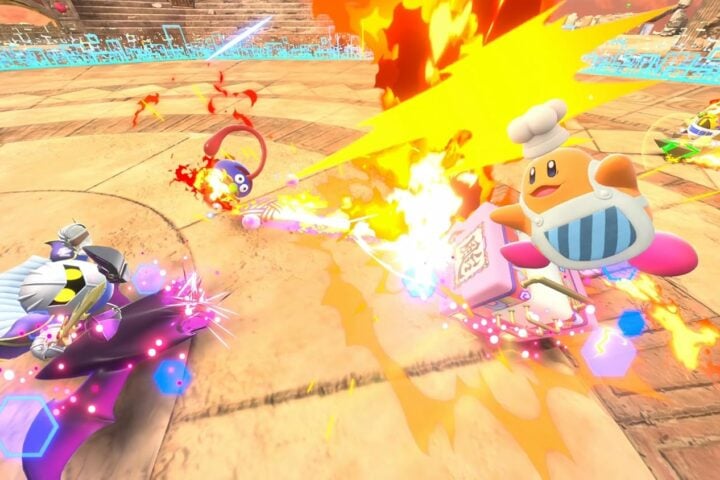
Perhaps because Kirby games revolve around our pink hero’s ability to copy his enemies, the developers at HAL Laboratory consistently go out of their way to ensure that they’re not foisting copy-and-paste jobs on players with each subsequent release in the series. Kirby has been sucked into worlds of cloth (Kirby’s Epic Yarn), traveled through paint (Kirby: Canvas Curse), and found a sci-fi adventure to call his own (Kirby: Planet Robobot). Now, in Kirby and the Forgotten Land, he’s traveled to a post-apocalyptic simulacrum of the real world that’s fully rendered, for the first time in the series, in three dimensions.
The game may not make the most of its 3D design or New World setting, but it’s a hoot anyway because of the joy packed into the new Mouthful Mode. The Forgotten Land gives Kirby the ability to absorb not just the powers of his foes but those of inanimate real-world objects (shades of latterday Paper Mario). If you thought Kirby was adorable before, just wait until you see him transform into Light-Bulb Mouth Kirby, who’s useful for illuminating hard-to-see paths; Water-Balloon Mouth Kirby, a slowly waddling sprinkler system; and Vending Mouth Kirby, a plodding rectangle who can rapid-fire soda cans at anything that crosses him.
About a dozen of Kirby’s most tried-and-true copy forms, like Bomb and Sword, also make the transition to The Forgotten Land, ensuring that there’s enough variety of action in the foreground to excuse the overall lack of anything interesting happening in the background. The abilities and costumes that he gains from these forms also get an overhaul, in that Kirby can find blueprints that unlock stronger and more cosmetically appealing versions of them, like the sharpshooting Ranger’s spacesuit and laser, or the Hammer’s especially comical upgrade, which features a massive toy hammer and puts a cute little safety helmet on Kirby.
Strengthening Kirby’s powers and visually overhauling them makes for a responsive way of showing our protagonist’s evolution over the course of the game, with the standard Tornado ability going from a mild blue swirl that’s slightly larger than Kirby to the late-game Storm Tornado’s angry black vortex of electricity, which takes up most of the screen’s length. Upgrading is also a neat way to acknowledge Kirby’s progress. There’s a feeling of triumph in switching from the ordinary hammer absorbed from the angry chimps called Mookies to the fur stole and massive stone slab wielded by the large ape mini-boss Bonkers.
If only The Forgotten Land did as much with its, well, ultimately forgettable land. Apart from big shifts in biomes—from, say, the icy buildings in the Winter Horns to the open deserts of the Originull Wasteland—there’s little that sets individual stages apart. (One exception is Wondaria, a theme park replete with a race course, fun house, parade ground, and circus.) The spare story is somewhat to blame for this, as it does nothing to establish the setting beyond saving the Waddle Dees from the Beast Pack in each area. The game’s few bits of lore, up until the exposition dump at the very end, are provided via collectible “Gotcha Balls,” but it’s a discombobulating choice to randomly provide story beats through a gacha-style mechanic.
Kirby and the various shapes that he contorts himself into are the highlights of The Forgotten Land. The focus here isn’t on that particular stretch of water or lava but the way in which Kirby exhales to make a boat sail across those surfaces. There’s no consideration given to the Alivel Mall, only to Kirby matching his Mouthful forms into holes in the wall in order to progress across the stage. And wondering why those holes are there in the first place or why the staff side of the mall is located in an entirely different region from the customer-facing one is pointless. The final boss reveals that Kirby’s dream world exists only because it split off and sucked out all the creativity from his own now barren one, so maybe the almost arbitrary nature of Forgotten Land is intentional, but it still feels like a waste of a 3D setting.
That said, we should remember that Kirby is from Dream Land on the planet Pop Star. The Forgotten Land may not nail the world-building or plotting, but it’s not snoozing when it comes to Kirby’s transformations. In fact, the new optional Treasure Road activities highlight his absorptive arsenal better than in any previous game. These short stages help players learn how to maximize the various functions of each copy ability, whether that’s for light environmental puzzles—such as the Drill ability to burrow under barriers—or to do battle armed with chakrams, axes, flames, and more. Between the Road and the relatively lengthy main quest—six zones with five stages each and a post-game area that remixes harder versions of earlier levels—The Forgotten Land really gives Kirby’s powers a workout.
This game was reviewed using a code provided by Golin.
Since 2001, we've brought you uncompromising, candid takes on the world of film, music, television, video games, theater, and more. Independently owned and operated publications like Slant have been hit hard in recent years, but we’re committed to keeping our content free and accessible—meaning no paywalls or fees.
If you like what we do, please consider subscribing to our Patreon or making a donation.