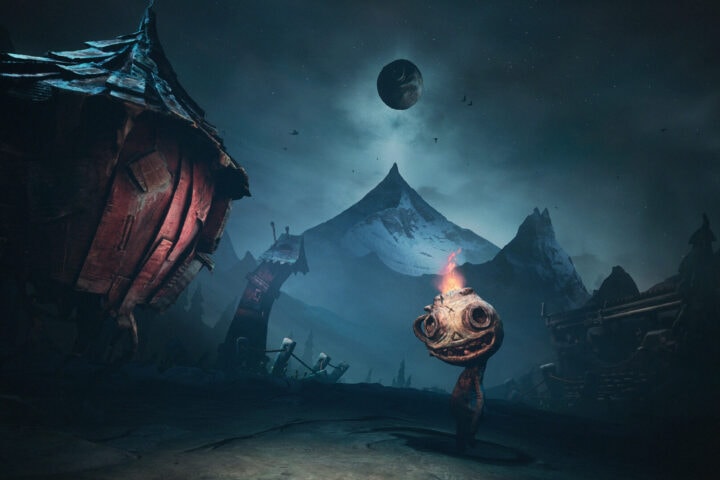
Adriaan de Jongh’s addictively strategic Rift Riff is a tower defense game whose main point of distinction is its relatively open-level layouts. Instead of traveling along clearly defined tracks, there’s usually some ambiguity to the path each group of enemies will take, and not every enemy type in a given wave is guaranteed to behave the same. Sometimes they’re lured toward towers placed on specialized nodes, occasionally they ignore everything and make a beeline for your base, and other times they just attack everything in their path. As a result, your placement of towers isn’t only a matter of dealing maximum damage in a set amount of time, but also of manipulating enemy movement to your advantage.
The game, which de Jongh made in collaboration with Sim Kaart, Matthijs Koster, Franz LaZerte, and Professional Panda, also gives you a decidedly active role during attack waves. You control a character who can build towers and collect small bits of the game’s resource, called juice (though the bulk of this is generated passively over time). This character can be customized with companions that bring a variety of effects, from different flavors of damage to improved resource collection to the ability to weaken nearby enemies.
This active playstyle is improved further by the clever addition of a mechanic charmingly named Urban Planning (de Jongh, creator of the irresistibly silly Hidden Folks, is Dutch, so he would know). This allows you to queue one structure to be built before you have the necessary juice. Utilizing it requires planning, naturally, but also some guesswork, and mastering it gives the feeling of laying down tracks one step ahead of a moving train. All these components, with the help of some minimalistic yet stylish visuals and an ace electronic score by Koster, lend Rift Riff an exceptionally groovy flow that’s not at all typical of the tower defense genre.
Though its rhythm is pleasant enough from the jump, it does take a while for Rift Riff to really bring the tactical bite. In fact, the game waits so long to remove the kid gloves that it can start to feel like they may never come off. Basically, building towers on as many nodes as possible while making sure enemies will at minimum pass through their line of fire is enough to clear about half of Rift Riff’s stages on the first try. Thankfully, this isn’t as egregious a portion of the game’s total runtime as it might sound like, since each stage comes equipped with an alternate version sporting new enemy types and generally amped up difficulty.
Once those are unlocked, the game offers plenty of chewy strategizing and ample opportunity for delightful trial-and-error experimentation. Similarly, Rift Riff’s back half displays a marked increase in variety and playfulness. (What if you could spend currency to call in massive attacks? How do you handle a map that’s just a giant open ring?) With, according to the game’s makers, the possibility of post-release content apparently on the table, it’s enough to make you wonder how much more meat is left on this conceptual bone. Probably quite a bit.
This game was reviewed with a code provided by Adriaan de Jongh.
Since 2001, we've brought you uncompromising, candid takes on the world of film, music, television, video games, theater, and more. Independently owned and operated publications like Slant have been hit hard in recent years, but we’re committed to keeping our content free and accessible—meaning no paywalls or fees.
If you like what we do, please consider subscribing to our Patreon or making a donation.