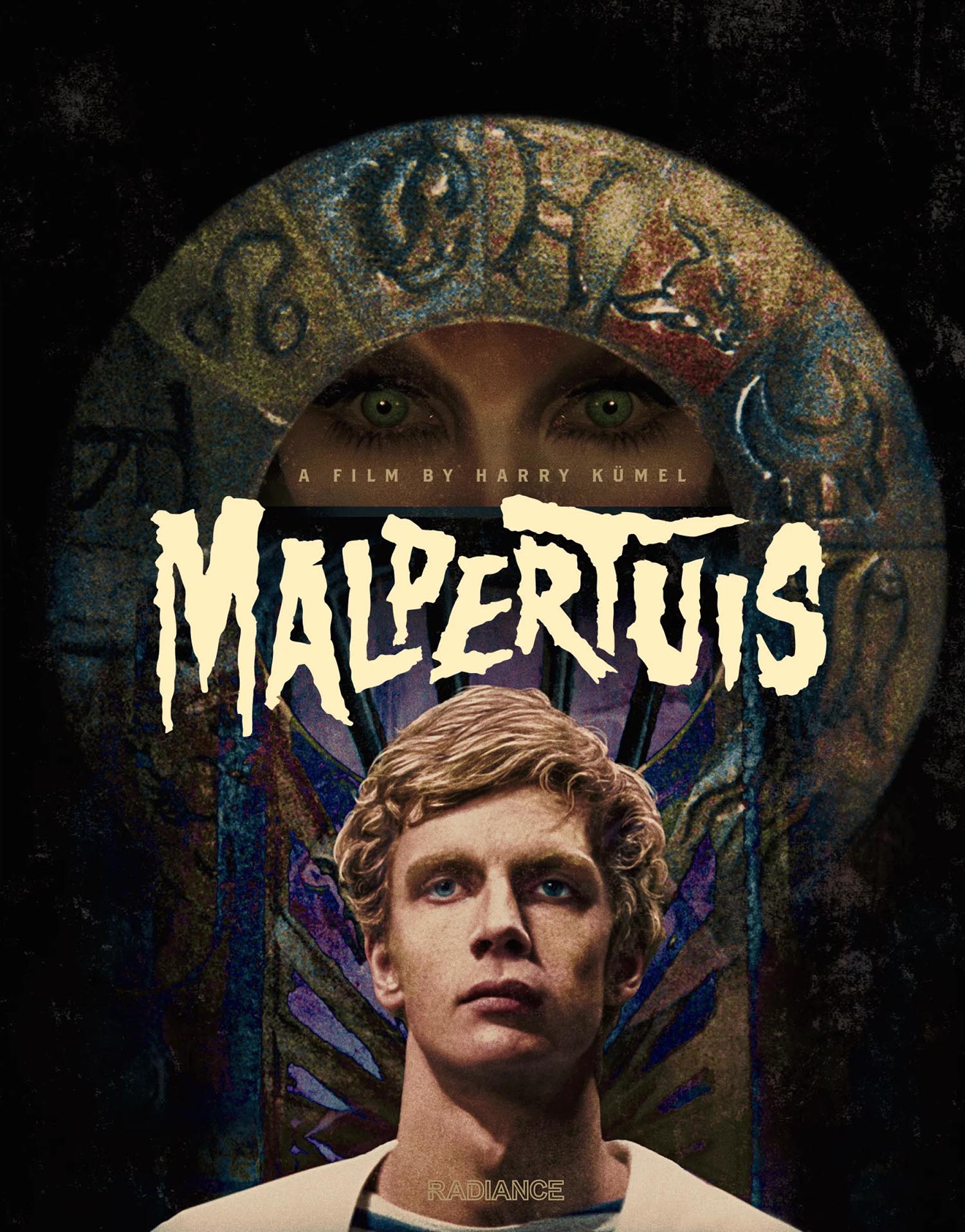
 Harry Kümel’s 1971 adaptation of Jean Ray’s labyrinthine 1943 gothic novel of the same name is a surreal, mordant, and at times erotic phantasmagoria that comes complete with a head-scratching twist ending. The book is a nesting-doll narrative where various narrators each contribute a piece of the overarching puzzle, and the film wisely zeroes in on the central section, jettisoning the other wraparound portions in order to streamline the tale.
Malpertuis unfolds like a bizarre mystery where the viewer accompanies Jan (Mathieu Carrière), a sailor home on shore leave, as he slowly uncovers the unspeakable secrets of the titular mazelike gothic mansion owned by his moribund uncle, Cassavius, who’s played by an entirely bedbound Orson Welles. Navigating the seemingly endless corridors of Malpertuis puts Jan in contact with a strange cast of characters, all of whom are biding their time at Malpertuis, waiting for Cassavius to pass away, so they can receive their fair share of his vast fortune. The dying old sorcerer has something else in mind altogether.
Malpertuis invites repeated viewings. Once you know the solution to what’s going on, many of the film’s earlier developments and dialogue take on an additional significance. In fact, getting the full gist of the material requires watching both cuts of the film: the 125-minute director’s cut (dubbed into Dutch) and the 105-minute English-language “Cannes cut.” In the latter, you can hear the actual voices of Welles and British actress Susan Hampshire, who plays no fewer than five roles in Malpertuis. There are bits of business unique to each, so that it’s a real shame that no definitive composite cut has been made from both versions.
Malpertuis has a dreamy mood all its own, with the frequent accentual splashes of green and purple recalling the work of Mario Bava. For that matter, Kümel’s film would make the perfect double feature alongside Bava’s horror fantasy Lisa and the Devil, which also takes place in a remote mansion and features lots of surreal goings-on. What’s more, both films emphasize the tension between modernity and events that take place in an earlier time.
In addition to making sly nods to Ray and some of his other work, Malpertuis is rife with references to Classical Greek mythology, culminating in the scene where Euryale (Hampshire) lets Jan in on the true state of affairs at Malpertuis. At this point, she describes her true self as the incarnation of “love and death,” the merging of Eros and Thanatos, whose borderlands have been explored by many horror films, but none quite so idiosyncratically as Malpertuis.

Over the course of the film, desire (whether erotic or otherwise) invariably leads to an unfortunate end. Witness the surprising final encounter between erotic blackmailer Dideloo (Michel Bouquet) and his victim Alice (Hampshire again). The moral, if Malpertuis can be said to possess one, resides in Euryale’s final words to Jan: “The fruit of knowledge is bitter.” Some mysteries, in other words, are better left unsolved.
Image/Sound
Radiance’s presentation of a new 4K restoration of Malpertuis, sourced from the original 35mm camera negative of the film, looks absolutely fantastic. Compared to the transfer of the long cut of the film available on the 2005 Barrel DVD release, this presentation boasts improved color brightness and more balanced white levels, and fine details, as evidenced in the costumes and set designs, see some very noticeable upticks. Black levels are deep and uncrushed, and grain is well-managed. Audio comes in a Dutch LPCM mono mix that sounds clear and strong, doing especially well by composer Georges Delerue’s delirious score.
Extras
Radiance offers a generous cornucopia of bonus materials. The most substantial extra is the commentary track by director Harry Kümel and assistant director Françoise Levie, who take a deep dive into the film’s production, its dense symbolism, and more. Also noteworthy is the lengthy interview with English Gothic author Jonathan Rigby, who discusses, among other things, the differences between the film and its source material and the place of both Malpertuis and Kümel’s earlier Daughters of Darkness in the canon of European horror cinema.
Elsewhere, a 37-minute archival documentary, “Malpertuis Archive,” offers a fascinating glimpse at Kümel’s early work, as well as some great behind-the-scenes footage of the production. A featurette on Orson Welles has Kümel and other cast and crew reminiscing about his often-cantankerous involvement and includes some priceless outtakes. Other notable odds and ends include an interview with actress Susan Hampshire, a profile of source novelist Jean Ray, and a tour of the film’s scenic locations as of 2005. “The Warden of the Tomb” is a Harry Kümel short film from 1965 that adapts a 1917 play by Franz Kafka, and tucked into the package’s slipcase is an attractively assembled 80-page book with a selection of essays by Lucas Balbo, Maria J. Pérez Cuervo, David Flint, Willow Catelyn Maclay, and Jonathan Owens.
Overall
Given a lustrous new 4K restoration and provided with copious extras, Harry Kümel’s Malpertuis is a tantalizingly surreal and at times erotic riff on gothic tropes.
Since 2001, we've brought you uncompromising, candid takes on the world of film, music, television, video games, theater, and more. Independently owned and operated publications like Slant have been hit hard in recent years, but we’re committed to keeping our content free and accessible—meaning no paywalls or fees.
If you like what we do, please consider subscribing to our Patreon or making a donation.