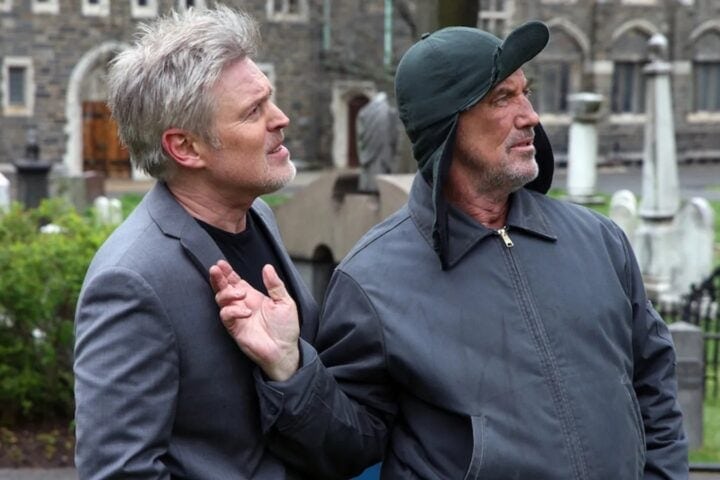
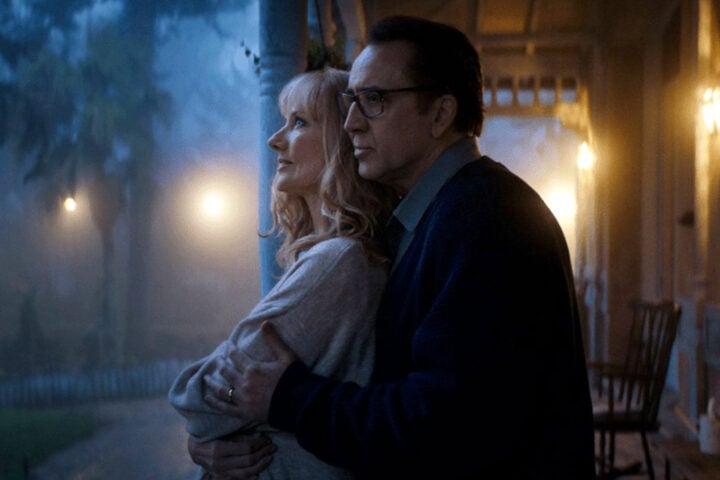
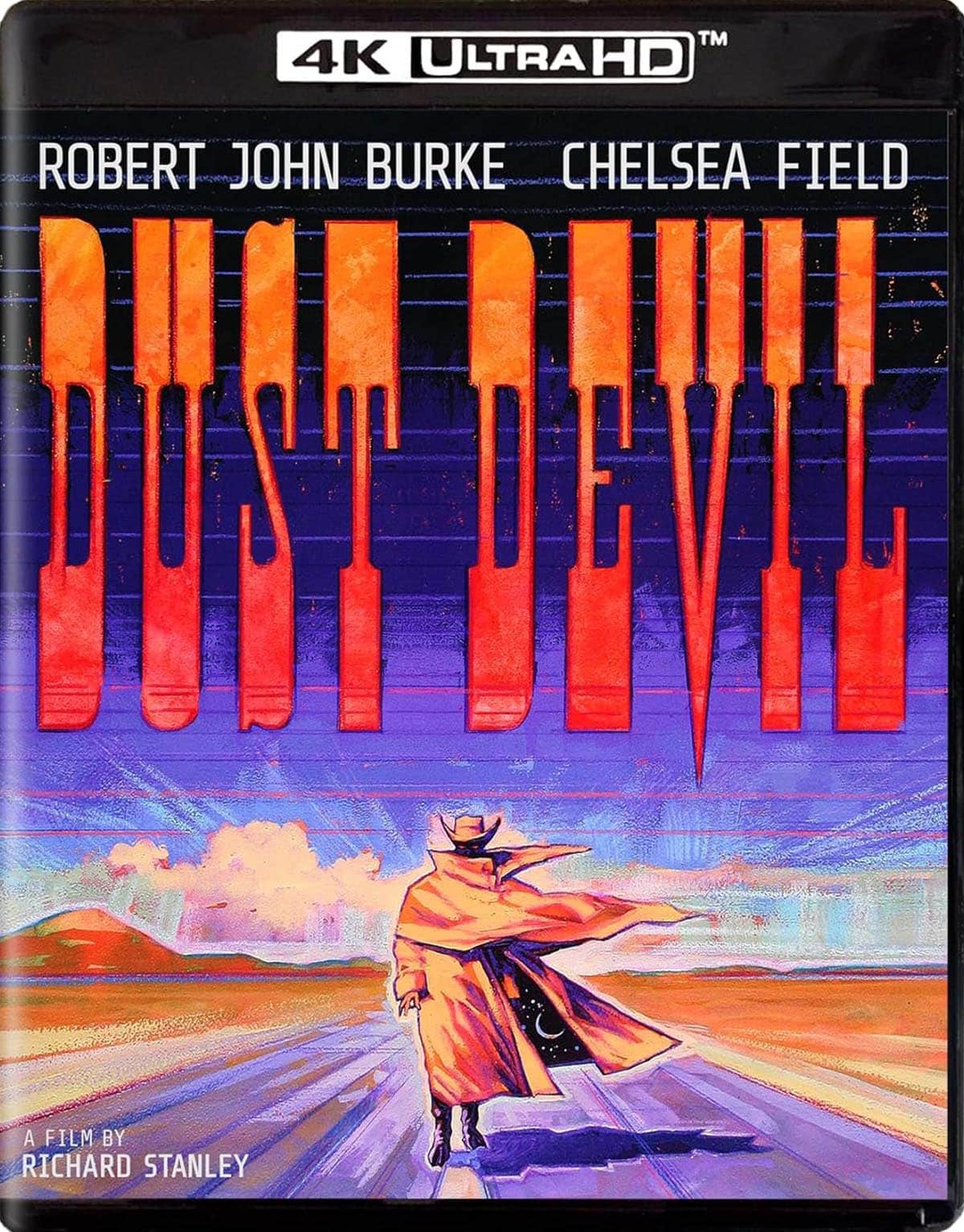
 With Dust Devil, writer-director Richard Stanley concocts a visually sumptuous and very dark fable about lost souls who hurry to meet death a little more than halfway. The film follows Wendy Robinson (Chelsea Field) as she flees her abusive husband, Mark (Rufus Swart), driving from Johannesburg into the hellscapes of the Namib desert, where she encounters the Dust Devil (Robert John Burke), a malign elemental spirit in human form. Eventually, their paths cross with police sergeant Ben Mukurob (Zakes Mokae), who’s investigating a series of gruesome ritualistic murders.
The film’s narrative isn’t a straight line like the desert highway that seems to stretch into infinity. Instead, like the spiral imagery that recurs throughout the film, it circles around and around, ever closing in on the characters. Stanley plays an intriguing game of mix and match with genre tropes. There are elements here of folk horror, serial killer films, and Italian westerns; there’s even a dash of the time-lapse nature worship, a la Godfrey Reggio’s Koyaanisqatsi.
Dust Devil’s storyline and dense symbolism are deeply informed by the myths and lore of the area’s indigenous peoples. When it comes to movies about psychopathic killers, Dust Devil seems closer to the wildly nonlinear montage of Donald Cammell’s White of the Eye than the grim naturalism of John McNaughton’s Henry: Portrait of a Serial Killer. And it’s hardly a coincidence that Burke’s eponymous figure comes wandering into the narrative like Eastwood’s Man with No Name in Sergio Leone’s Dollars trilogy.
Stanley’s unabashed cinephilia carries through to the film’s plotline in memorably unexpected ways. Narrator and local shaman Joe Niemand (John Matshikiza) works at a deserted drive-in where Ben Mukurob once attended a double feature of The Bird with Crystal Plumage and Legend of the Seven Golden Vampires. Late in the film, Mukurob crawls his way into a sand-choked movie theater where he hallucinates a film being projected that features his long-departed wife before—taking a cue from Two Lane Blacktop—the very film we’re watching abruptly unspools, leaving only the blank eye of a white screen staring back at us.
None of the characters make for easy audience surrogates. They’re all, one way or another, souls in extremis. Wendy is so wrapped up in her headlong flight from captivity that she doesn’t even stop to thank the Black man who helps dig her car out of a dune—an act of gratuitous kindness that costs him plenty at the hands of some bigoted white cops.
Even when all hope seems lost, Mark is consumed with the idea of dragging Wendy back to their bougie suburban existence. And Ben is haunted by memories of the wife who left him after the death of their son, whom Ben had encouraged to join the armed forces. These memories in turn feed into an elaborate dream sequence that utilizes the classic “double wake-up” conceit.
For all its surreal fabulosity, Dust Devil also possesses a sociopolitical edge. The film is set against the backdrop of Namibia’s war for independence from South Africa, which features in some graphic real-life footage of burning bodies shown on a TV set. Presumably, this is the conflict that claimed the life of Ben’s son. The war also features in the film’s elliptical ending, when Wendy, now perhaps possessed by the spirit of the Dust Devil, encounters a phalanx of South African troop transports emerging out of the fata morgana mirages of the desert highway.
Dust Devil is a riveting sensorial experience, immersing us in an off-kilter world that’s both rich and strange. Stanley keeps the camera moving fluidly, sometimes in spiral-like motions, never seeming to come to rest anywhere. The lighting and color schemes are delightfully expressionistic, and Simon Boswell, fresh from working with the likes of Dario Argento and Michele Soavi, provides a wonderfully evocative score that, with its soaringly resonant melodies and rumbling tribal chants, reminds you at times of Philip Glass’s music for Koyaanisqatsi. Stanley’s film offers an unforgettable glimpse into the abyss of humanity’s darkest desires.
Image/Sound
Both the director’s cut and theatrical cut of Dust Devil are available on both the UHD and standard Blu-ray discs. The 2160p UHD in Dolby Vision presentation looks phenomenal (and the 1080p HD transfer is no slouch either). Colors are incredibly rich and vivid, black levels look entirely uncrushed, and the fine details of costume and set design really stand out.
Audio comes in either Master Audio surround or stereo mixes. The former really opens up the film’s often busy soundscape, as well as composer Simon Boswell’s magisterial score, while the stereo mix hews more closely to the original theatrical experience.
Extras
Apart from Richard Stanley’s commentary track, which accompanies the director’s cut on both discs, the remainder of the bonus materials are housed on the standard Blu-ray. On the commentary, Stanley delves deep into Dust Devil’s genesis as a 16mm student film, the real-life stories that fed into the narrative, the tortured and torturous production process, and the significance of the rampant symbolism. The 2006 on-camera interview with the writer-director retreads some of the insights from the commentary, but the new information here remains fascinating. The interview also includes footage of Stanley and Simon Boswell, where the composer discusses getting his start in doing film scores by working with Dario Argento.
Overall
Receiving a sterling new 4K upgrade from Kino, Richard Stanley’s Dust Devil is a dark fable about souls in extremis who are half in love with easeful death.
Since 2001, we've brought you uncompromising, candid takes on the world of film, music, television, video games, theater, and more. Independently owned and operated publications like Slant have been hit hard in recent years, but we’re committed to keeping our content free and accessible—meaning no paywalls or fees.
If you like what we do, please consider subscribing to our Patreon or making a donation.