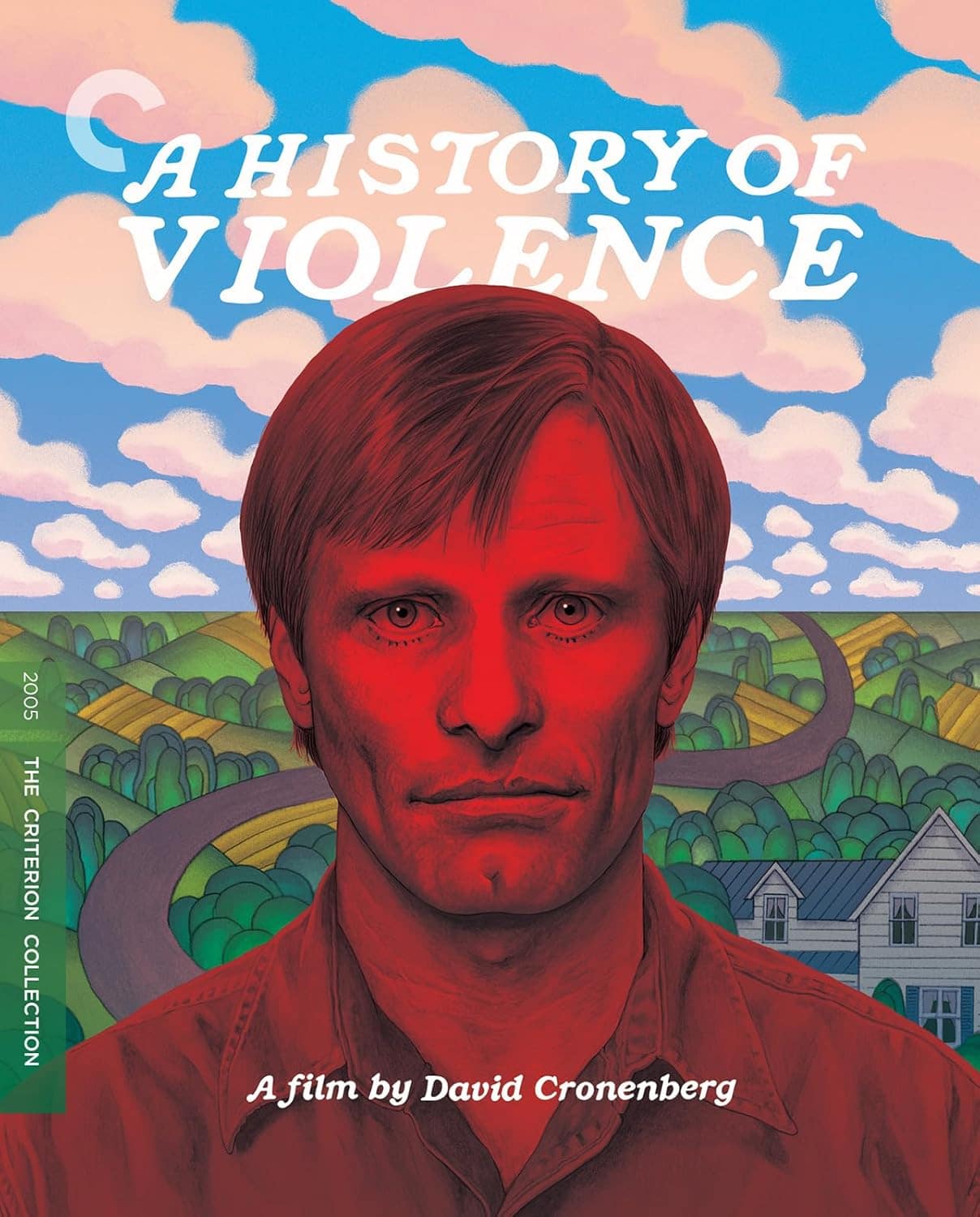
 David Cronenberg’s brutal, brooding A History of Violence, loosely adapted from John Wagner and Vince Locke’s 1997 graphic novel of the same name, examines the ways in which individual and social violence often intertwine. It also explores the effects that the disclosure of a violent personal history can have on that most American of institutions: the nuclear family. Cronenberg’s films often chronicle the metamorphoses inscribed directly upon the “new flesh” of their protagonists as a result of hideously violent actions. In A History of Violence, those changes are wrought in a more indirect, internalized fashion.
Cronenberg is fascinated by the tug of war between split or shared personalities. Think twins Beverly and Elliot Mantle in Dead Ringers, or the schizophrenic Dennis Cleg in Spider. In A History of Violence, the central battlefield is the mind and soul of Tom Stall (Viggo Mortensen), a diner owner from the rural town of Millbrook, Illinois, who had a whole other life as mob hitman Joey Cusack back in Philadelphia. The film then proceeds to interrogate the limits of Tom’s painstakingly crafted persona.
Like David Lynch’s depiction of Lumberton in Blue Velvet, Cronenberg first sets up Millbrook as an idyllic vision of picturesque Americana filled with upstanding citizens like Tom before zeroing in on the darkness at the edge of town. Cronenberg locates that darkness both externally (the killers who descend upon Tom’s diner) and internally (Tom’s past actions). It seems only appropriate that the first leads inexorably to the revelation of the latter.
Tom’s efficient yet ruthless disposal of the killers turns him into a local hero, suggesting that American society condones, if not expects, violence as a viable solution to any problem. But Cronenberg consistently undercuts this notion by depicting the violence in as unpleasant and unpalatable a manner as possible. It’s ironic, then, that his behavior rebounds on his family in some surprising ways, unleashing their own latent potential for violent action.
Tom’s son, Jack (Ashton Holmes), responds to a history of chronic bullying by putting one of his tormentors, Bobby (Kyle Schmid), in the hospital. When Tom rather hypocritically admonishes the teen that the Stall family doesn’t solve their problems by hitting people, Jack retorts: “No, we shoot them!” It’s another bit of irony that it will be Jack who disposes of fearsome mob enforcer Carl Fogarty (Ed Harris) by blasting him with a shotgun.
For her part, Tom’s wife, Edie (Maria Bello), decides to lie for him to Sheriff Sam (Peter MacNeill), though she must then confront the man she now knows him to be. A heated argument leads to some rough sex on a staircase where Edie suddenly takes the upper hand—a far cry from the vanilla kink of their early cheerleader-based roleplaying. In the moment, she seems to accept the Joey within Tom—or, at least, she’s turned on by his capacity for violence.
Our protagonist’s return to Philadelphia signals a shift in the narrative’s abiding archetype. Up until now, A History of Violence has been tinkering with the trope of the western hero: a man of violence who, having hung up his hardware in order to pursue a quiet domestic life, now finds himself forced to slap leather again. The finale then invokes the biblical story of Cain and Abel with the introduction of Joey’s brother, Richie (William Hurt), whose penchant for gallows humor underlines a vein of black comedy that runs throughout the film.
The last few minutes of A History of Violence remain its most troubling in their implications. Joey seems able to revert to Tom simply by washing away the bloody signs of his cathartic act of fratricide, as though Cain could easily wipe away the mark that brands him. Purgation through violence leads to purification by water. The contemplative moment at the river’s edge also gives viewers a minute to contemplate just how satisfied they may be with Joey’s killing spree.
The film ends on a question mark as Tom reenters the bosom of his family. Silence reigns at the dinner table before his daughter (Heidi Hayes) passes him a plate. The sequence ends with Tom and Edie staring into each other’s eyes, and it’s not immediately clear what part of him has returned to the fold, or what the consequences of his reintegration will be. At that moment, Cronenberg brilliantly brings down the curtain without suggesting any clear resolution. The most violent moment in A History of Violence very well may be that last abrupt cut to black.
Image/Sound
Criterion presents A History of Violence in both 2160p UHD and 1080p HD, sourced from a 4k scan of the 35mm camera negative of the international cut. The Dolby Vision image looks fantastic, with fine details of the costume and set design really standing out. Colors pop nicely, while black levels are suitably profound. Audio comes in a Master Audio surround track that cleanly captures the dialogue and Howard Shore’s characteristically magisterial score, while the rear speakers excellently convey the film’s periodically active soundscape.
Extras
Director David Cronenberg delivers another exemplary commentary track, full of his usual dry wit and penetrating insights into the film’s production history, including the graphic novel source material, working on the adaptation, the casting process, and the actual film shoot. Cronenberg also has a lot to say about the film’s abiding themes and character motivations. Screenwriter Josh Olson talks with writer-producer Tom Bernardo at length about his early straight-to-video days, pitching the story, and collaborating with Cronenberg.
In excerpts from a conversation at the 2014 Toronto International Film Festival, Cronenberg and actor Viggo Mortensen talk about the three films they’ve worked on together, with particular emphasis on A History of Violence. Elsewhere, we get “Acts of Violence,” a fascinating hour-long making-of documentary that combines behind-the-scenes footage and talking-head commentary on the production process, and a deleted dream sequence that features Mortensen and Harris (viewable with commentary from Cronenberg, and accompanied by its own brief making-of doc). Finally, the enclosed booklet contains an essay from critic Nathan Lee that examines how the film both executes and interrogates the conventions of the action thriller.
Overall
Brutal and brooding, David Cronenberg’s A History of Violence rigorously interrogates the personal and social consequences of its violent action.
Since 2001, we've brought you uncompromising, candid takes on the world of film, music, television, video games, theater, and more. Independently owned and operated publications like Slant have been hit hard in recent years, but we’re committed to keeping our content free and accessible—meaning no paywalls or fees.
If you like what we do, please consider subscribing to our Patreon or making a donation.