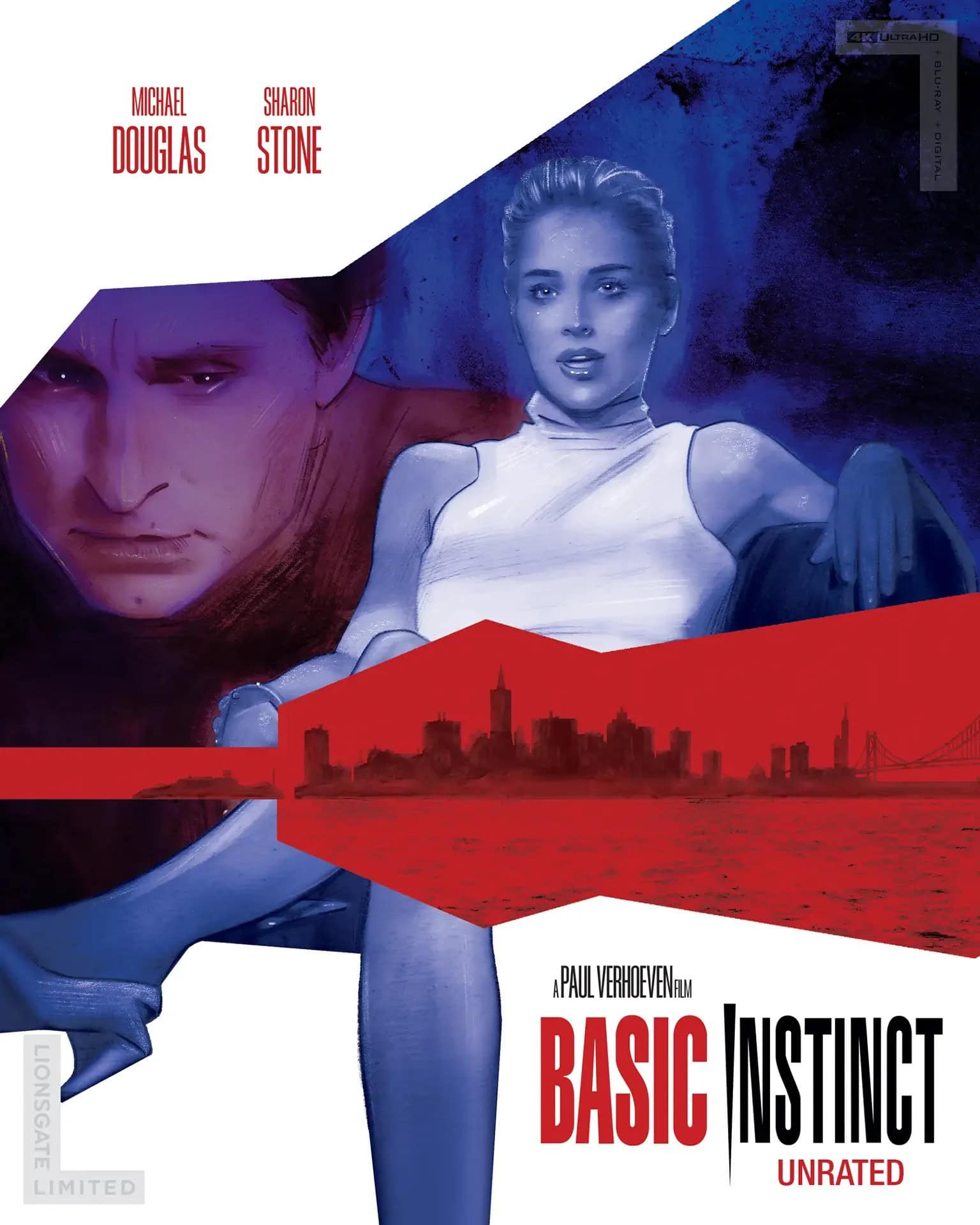
 True to its reputation, Paul Verhoeven’s Basic Instinct is graphic and crass and revels in stereotypes about women and men alike. Those qualities, though, don’t distinguish the film from other erotic thrillers. What separates Basic Instinct from the pack is its audacious shamelessness, which skims the knife’s edge of self-parody. Basic Instinct doesn’t hide behind sops to morality. It doesn’t even necessarily want to turn you on, but rather rile you up.
The film’s elevator pitch could be described as “Vertigo if we got to see what Jimmy Stewart and Kim Novak got up to behind those closed doors.” Verhoeven blows his load in the first scene, in which the camera eases into the lush and cavernous bedroom lair of a middle-aged rock star and a gorgeous woman, whose face is obscured by her blond hair. An ornate mirror in the ceiling illuminates them having frenzied sex. The blonde mounts the man, tying his hands to the elaborate cage that serves as the bed’s frame. From somewhere below she produces an icepick as she rides him, stabbing him many times, with blood gurgling from the man’s neck as he’s about to climax. As a detective later says, with practiced callousness, “He got off before he got off.”
This boffo opening is Verhoeven’s way of letting the audience know that traditional rules of innuendo are being discarded. Written by Joe Eszterhas, Basic Instinct isn’t an erotic thriller that asks us to wade patiently through an act’s worth of clichés in order to catch a poignantly paltry glimpse of an attractive woman undressing, say, in front of a window—a chestnut that’s also eventually reprised here and rendered unusually explicit. The blonde’s flesh and curves are lingered on, and the murder, as overseen by FX guru Rob Bottin, is extravagantly gory. Not even Brian De Palma has ever gone this far in mingling sex and carnage.
And yet, a pervading irony of Basic Instinct first arises in this scene. Something about the nudity in this sequence doesn’t exactly feel fetishistic, at least not erotically so, and the violence is startling but not scary. Though scintillating and grotesque, this opening salvo doesn’t have the neurotic pull of, say, the elevator slashing in De Palma’s Dressed to Kill that, incidentally, is later reprised in Basic Instinct. Verhoeven’s touch isn’t exactly personal—or, if it is, it’s that he’s turned on by impersonality. He shares the self-regard of Basic Instinct’s black widow: As he stages all this sex and violence, he seems guided above all else by his swagger and brio. With one exception, Verhoeven doesn’t even feign sympathy for the characters that are killed here.
Verhoeven appears to see this film’s iconic femme fatale, Catherine Tramell (Sharon Stone), as something of a co-conspirator then. It’s her authority that turns him on, and maybe scares him, and it’s these emotions that inform the mixture of arousal and death that bleeds into every one of the film’s subsequent and quite aggressive sex scenes. Rarely has a filmmaker felt such kinship with a femme fatale, and rarely has one been so unguardedly admired on screen.
Even Basic Instinct’s most infamous scene, in which Catherine flashes her crotch while crossing her legs in an interrogation room full of men, turning them into jelly, revels in her power. Yes, that scene was a gift to hornballs in the audience, but the joke in Verhoeven’s film is on the male characters. There’s no self-consciousness attached to Catherine’s power, and while her ludicrous super-human abilities are established with tongue firmly planted in cheek, her authority is taken seriously. Verhoeven and Eszterhas don’t want a citizenship badge for granting her “agency”; they’re enthralled with her confidence and charisma, her extravagant evil, and Stone matches them step for step in boldness, never flinching and softening Catherine.
If a sly progressivism manages to sneak into the film, it’s because the filmmakers have no patience for the macho self-pity that drives most erotic thrillers. We’re allowed to discern that Detective Nick Curran (Michael Douglas) has no power, and his illusions of being able to do anything that Catherine doesn’t want done are often parodied. Again, these textures are taken as a given without sociopolitical speechifying. Catherine’s usurpation of Nick, and Stone’s usurpation of Douglas, underscores the film’s central fantasy. It’s a fantasy that runs through most noirs but has rarely been so starkly underlined: that of the man for the woman to take over his life, to run things even though he can’t admit it, per the dictates of traditional masculinity.

As overripe and ridiculous as the copulation here can be, it has something that sex in most movies doesn’t: a point beyond the obvious. The sex between Nick and Catherine is a series of cage matches in which she conditions him to bend to her will, while Nick’s disturbing encounter with his psychiatrist, Beth Garner (Jeanne Tripplehorn), is his attempt to reclaim himself as an alpha. He bends Beth over a couch and takes her from behind in a sex act that begins consensually but quickly suggests rape. All of the sex in Basic Instinct is a show of violence.
As crass as this film can be, Verhoeven takes Beth’s violation seriously without digesting its implications for us. It hangs in the air. Beth and Nick’s sexual relationship is more authentic and neurotic and unresolved than Nick’s situation with Catherine. To pull Vertigo back into the fold, Beth is Midge to Catherine’s Madeleine, a friend taken for granted by the male lead in favor of a sex fantasy so powerful and disruptive that it borders on the supernatural, or cinematic. Given that Basic Instinct operates as a super-sized version of Vertigo in terms of cruelty and explicitness, Beth pays a much steeper price than Midge for her loyalty.
Such currents run through Basic Instinct, not even really as subtext, and yet they still feel somewhat superfluous to the heart of the matter. Similar claims can be made of the subtexts driving RoboCop, which is typically celebrated as a Reagan-era satire, or Showgirls, which has been dissected as a parable of the entertainment industry’s commodification and violation of female flesh, or Starship Troopers when it’s bandied about as a parody of America’s colonialist legacy. Those reverberations are all undeniably there, but the tension and ambiguity of Verhoeven’s work springs from a question of whether or not he “means” these humanist implications. His films, especially the American ones, are above all about the sheer pleasures of exerting force—of a gifted stylist revitalizing genre tropes through talent and will. Ruthless and sensational craftsmanship is Verhoeven’s highest form of politics.
What Basic Instinct says about “men and women” may matter less than Jerry Goldsmith’s silky and menacing score, a character in its own right, and the stunning figure that Stone cuts in that white dress, as well as the fabulous designer coldness that cinematographer Jan de Bont manages in his merging of the chic and trashy. This sophistication taken in tandem with Eszterhas’s pulpy plotting and lewd one-liners is difficult to resist, especially for cinephiles looking for a walk in the gutter. This movie doesn’t seem to give a fuck whether you like it or not.
Image/Sound
This 4K UHD presentation of the director’s cut of Basic Instinct, courtesy of Lionsgate, offers spectacular clarity and depth, which is certainly new to this viewer who was too young to see the film in the theater. The attention paid to San Francisco, home of many erotic thrillers, including Alfred Hitchcock’s Vertigo, especially stands out here, from the crispness of the cityscapes to the earthy materiality of the cliffs and beaches. Interior settings have gotten a major bump here as well, emphasizing the warm womb-like hues in which many of the bedrooms and office spaces are bathed. Skin and clothing textures are stunning, intensifying the intimacy of the many interludes of sex and murder, and the range of color and shadows is quite immersive.
Two sound mixes are included: a DTS-HD Master Audio 5.1 track and a LPCM stereo option that better reflects the theatrical presentation. Both tracks vividly balance Jerry Goldsmith’s incredible score with the dialogue and other sound effects, though the 5.1 mix offers more aural oomph for your buck. A Blu-ray is also included in this set, and its specs are likewise top-notch.
Extras
This set is loaded with goodies that all more or less communicate the same information about Basic Instinct’s genesis and reception. Audiences interested in the nuts and bolts of filmmaking should listen to the audio commentary with Paul Verhoeven and Jan de Bont, which goes deep on bringing off the film’s style. For a more critical bent, the commentary with academic and feminist Camille Paglia persuasively defends the film against its various detractors, elucidating its sense of a sexual energy that threatens to upturn a male-driven status quo. For a one-stop shop, the new featurette “Basic Instinct: Sex, Death and Stone” offers a frank and detailed discussion of the film’s making and legacy, with Sharon Stone stealing the show. The release is rounded out by a series of odds and ends, including storyboard comparisons, screen tests, trailers, TV spots, introductions, and an archive audio commentary with Verhoeven.
Overall
Basic Instinct is about sex as a power struggle, as well as the filmmakers’ willingness to do whatever they hell they want in order to bowl you over.
Since 2001, we've brought you uncompromising, candid takes on the world of film, music, television, video games, theater, and more. Independently owned and operated publications like Slant have been hit hard in recent years, but we’re committed to keeping our content free and accessible—meaning no paywalls or fees.
If you like what we do, please consider subscribing to our Patreon or making a donation.