Mizoguchi Kenji’s staggering Ugetsu is a film of many riddles and paradoxes that unfolds with the illusory simplicity of a fable. Its initial straightforwardness, as a parable against the pitfalls of human greed, is a misdirection that leads us into a void in which objectivity and subjectivity intermingle, hopelessly and invigoratingly clouding rationality.
The narrative begins on the shore of Japan’s Lake Biwa in the 16th century, when the country was engulfed in civil war. Mizoguchi spotlights two neighboring families: Genjurô (Mori Masayuki), his wife Miyagi (Tanaka Kinuyo), and their child (Sawamura Ichisaburo); and Tôbei (Ozawa Eitarô) and his wife Ohama (Mito Mitsuko). The heads of these families are broadly contrasted, as Genjurô is a serious potter while Tôbei is a stumbling ne’er-do-well whose dreams of becoming a samurai are ridiculous in lieu of his humble origins. (The film is alert to the classism of the samurai code.) War is coming, and like many people unaccustomed to its savagery, Genjurô and Tôbei see only glory and self-actualization. The men wish to profit from the war so as to bolster their statuses in their wives’ eyes, while the women insist that the men are already enough for them.
It’s in this awareness of miscommunication that Ugetsu, written by Kawaguchi Matsutarô and Yoda Yoshikata, should especially resonate with contemporary Western audiences, as the film’s understanding of the tension between the sexes hasn’t aged an iota. The men launder their ambition through their women in a process of self-justification that reveals their feelings of inferiority. Patriarchy also entraps men, most clearly those of lower classes, nurturing a perpetual fear of impotency that’s ironically realized through the efforts to assuage said fear.
Ugetsu’s early passages unfold with a hushed sense of inevitability. A town elder warns the families to prepare for an incoming invasion, but Genjurô and Tôbei are eaten up with dollar signs. Both men forge their wares and make a small killing at a village that’s experiencing an economic boom from the war, and they return home with silver in their pockets. Genjurô buys Miyagi an expensive kimono, saying that he’s always wanted to shower her with such luxury. Whether or not Miyagi actually wants the kimono is immaterial.
Ugetsu is based on two ghost stories from Akinari Ueda’s collection Ugetsu Monogatari, which translates to Tales of Moonlight and Rain, and pivots on morals handed down from Japanese and Chinese cultures. Another significant influence on the film is the writing of Guy de Maupassant, which is evident in Tôbei’s narrative. These sources share with Mizoguchi’s work a heightened awareness of how we devise our own tragedies with our hypocrisies, and of how cruelty begets cruelty in an endless and self-perpetuating cycle.
In Ugetsu, war is brilliantly evoked as an extension of the male ego: The Japanese civil war exists on the macro stage of society while the domestic tragedies of Genjurô and Tôbei occupy the micro. The civil war dramatically reconstitutes Genjurô and Tôbei’s families, scarring them in a fashion that parallels the destruction of the house of Lady Wasaka (Kyô Machiko), a spirit who enchants Genjurô while his own home turns to war-torn rubble.

The ironies here are elusively exponential, as a simulacrum of Genjurô’s dream—as the head of a house occupied by a beautiful, glamorous, and subservient woman—paves the way for his nightmare of rootlessness, which resonates with a postwar Japan that was occupied by the United States after losing its own quest for dominion. The film’s obsession with the splintering of families and the decisive castration and evolution of the modern male clearly parallels Japan’s crisis of identity following WWII, which Mizoguchi would explore again in Sansho the Bailiff.
On the film’s surface is the assertion that man shouldn’t be greedy, but Mizoguchi resists such pat categorization—and it’s this simultaneous explicitness and ambiguity that inform Ugetsu with its roiling power. Mizoguchi’s formalism brings to life the irresolvable thorniness of lust, longing, love, and self-hatred. The scenes between Genjurô and Lady Waska, set among a dream of what her palace once was and clearly modeled on the traditions of Noh Theater, are among the most erotic ever committed to film, expressing sex through heightened classical roleplay.
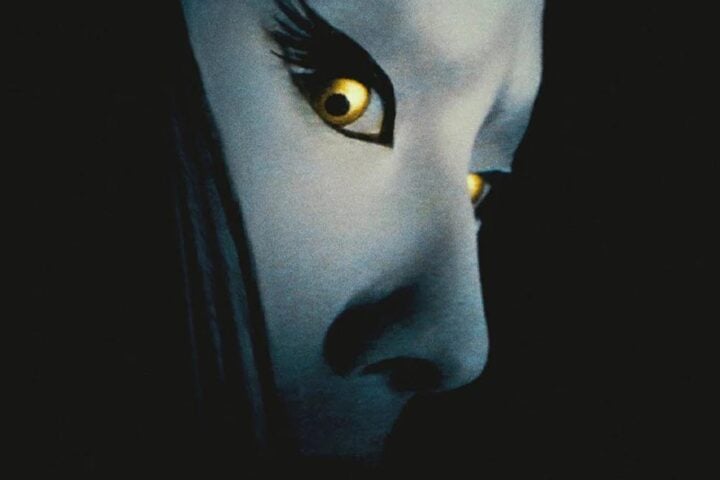
Lady Waska moves through the frame with a languorousness that’s true to our perception of her supernatural otherness, or as a masturbatory illusion of Genjurô’s. They have tea together and Lady Wasaka complements Genjurô’s pottery, understanding that men secretly treasure flattery as much, if not more so, than women. Then, a long shot follows Lady Wasaka as she crosses a room, her hair down to the back of her knees, suggesting a serpent in a flourish that’s sexy as well as threatening. We believe Genjurô when he says that he’s never known such pleasure, as Lady Wasaka convincingly suggests capital-S sex as pure flesh incarnate, complemented by the sensuality of Mizoguchi’s legendary long takes and in-camera editing.
Mizoguchi’s masterful staging conjoins the war narrative and the supernatural symbolism with frightening finesse, sometimes in a single shot, such as when Genjurô returns to his destroyed home searching for Miyagi, strolling out back only to re-enter the front of the residence to see her impossibly manifested, cooking by a fire. Embracing the flow of Japanese scrolls, Mizoguchi perfected an art of fluidity, blending expressionism and heightened neorealism in a manner that heightens each aesthetic via unlikely juxtaposition. When Genjurô and Tôbei’s families flee their invaded village, they sail into a lake of mist that suggests the River Styx, matter-of-factly guiding the audience out of a war film into a horror film and back into a war film yet again.
Later, as Miyagi collapses from a stab wound, we see her die as her killers enjoy their spoils in an elegant and devastating contrast of what war means to men and women, and to multiple variations of the empowered and the powerless. While Miyagi dies, Genjurô has the privilege of retreatment into an ecstasy that is, itself, enabled by male carnage. Ugetsu is a tragic, poetic, and irreconcilably rapturous vision of violation. In the tradition of many male directors preoccupied with the atrocities suffered by women, Mizoguchi expresses his compassion through a pronounced and cleansing pitilessness.
Image/Sound
The 4K restoration here debuted on the Criterion Collection’s Blu-ray release in 2017. Aside from the ocassional instability, the presentation is flawless. The image boasts an immaculate sense of richness and clarity, and compared to the image on Criterion’s 2005 DVD edition, the blacks are much deeper and more stable, while the whites are softer and more varied. There’s also a greater tactility to this image, which is evident in the textures of the landscapes, the water, and the often pained and impassioned faces of the characters.
The soundtrack is also the same as the one on the 2017 Blu-ray, and it boasts fewer hisses and a more vibrant and delicate palette of diegetic and non-diegetic effects than the track on the 2005 DVD. The score, a classic in its own right, resounds with an especially diaphanous subtlety.
Extras
Yes, this is the same package that accompanied Criterion’s prior two editions of Ugetsu, but these supplements would be difficult to improve upon, as they offer an invigoratingly deep dive into Mizoguchi Kenji’s career while shedding light for Western audiences on the Japanese postwar culture that informed the film. The audio commentary by critic, filmmaker, and festival programmer Tony Rayns begins on a playful note, with Rayns conceding that many of his observations stem from a Mizoguchi book that he never finished. This drollness permeates a commentary that invaluably elaborates on the evolution of the filmmaker’s aesthetic over the decades, while riffing on the sorts of politics and personal relationships that inform art.
Rayns also discusses at length Ugetsu Monogatari, the story collection that partially inspired Ugetsu. This discussion is complemented by the interview with the film’s first assistant director, Tanaka Tokuzo, who shows us Mizoguchi’s oft-revised working draft of the film’s script. Meanwhile, “Two Worlds Intertwined,” a 2005 appreciation of Ugetsu by Shinoda Masahiro, abounds in beautiful and incisive observations, including the memorable assertion that the film includes “so many realities that they turn into a kind of fantasy.” (Shinoda also elaborates on the intricate, multi-cultured layering of the film’s score.) The 1992 interview with cinematographer Miyagawa Kazuo is the shortest on the disc, but still affords the legend the opportunity to compare vintage and contemporary methods of visual storytelling.
Tying the room together, so to speak, is a 150-minute documentary, Kenji Mizoguchi: The Life of a Film Director, which ingeniously weaves its own making into its narrative. The filmmakers retrace Japanese landmarks that are significant to Mizoguchi’s life, in the process providing Western audiences with a revelatory spatial sense of locations that were instrumental in the Japanese pre- and postwar film movements. Rounding out this package are trailers, a characteristically superb essay by Phillip Lopate that juggles Western and Eastern philosophies with surgical finesse, as well as the Ugetsu Monogatari stories that informed the script.
Overall
This masterpiece of world cinema has never looked or sounded better, with a vintage supplements package that provides invaluable analysis of Japanese film culture.
Since 2001, we've brought you uncompromising, candid takes on the world of film, music, television, video games, theater, and more. Independently owned and operated publications like Slant have been hit hard in recent years, but we’re committed to keeping our content free and accessible—meaning no paywalls or fees.
If you like what we do, please consider subscribing to our Patreon or making a donation.