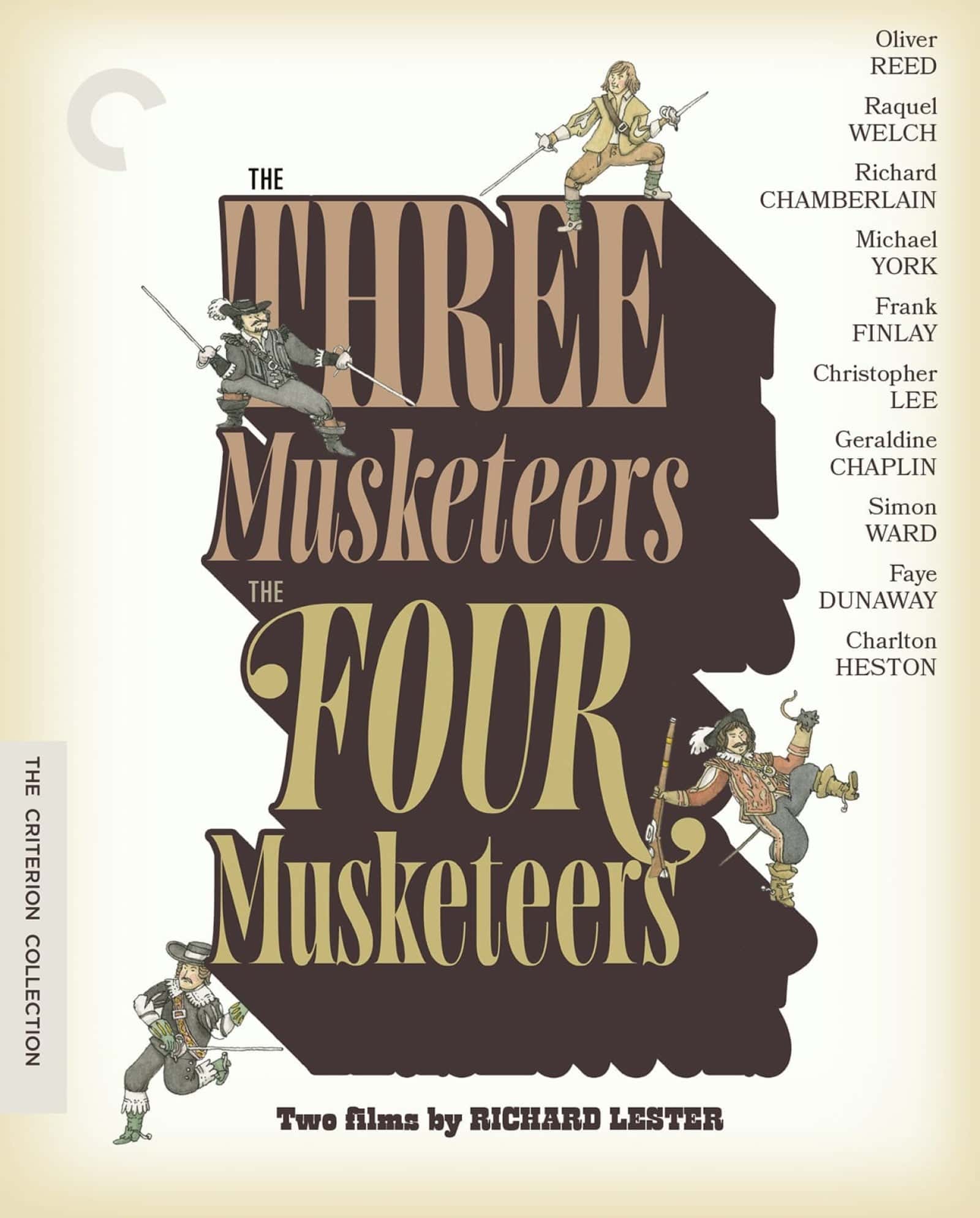
 By 1973, Richard Lester, Philadelphia-born but as vital a figure in the cutting edge of ’60s British cinema as Tony Richardson and Lindsay Anderson, had run his film career aground with a string of flops. But he never fully gave up on his plans to adapt The Three Musketeers, a project originally intended as a vehicle for the Beatles.
A few years after the Fab Four went their separate ways, Lester finally got the production off the ground, and he approached his adaptation of Alexandre Dumas’s classic 1844 novel with the same comic lens that informed his earlier work. Initially planned as a single epic complete with intermission, the final movie would be split in two for greater ease of distribution and profit potential.
The films follow the plot of the novel faithfully: Lowborn but skilled swordsman d’Artagnan (Michael York) travels from the country to the capital to join the elite Musketeers, where he eventually charms the trio of Athos (Oliver Reed), Porthos (Frank Finlay), and Aramis (Richard Chamberlain), elite fighters whose high-minded dedication to their duty and noble pride cannot fully mask their vices for women, wine, and gambling. The musketeers and their new companion find themselves in the midst of political intrigue in the time of Louis XIII (Jean-Pierre Cassel).
The novel remains a high-point of swashbuckling adventure, and the films boast plenty of swordplay, while also adding a revisionist streak of satirical humor. But Lester and screenwriter George MacDonald Fraser also generally elevate the social commentary that was already threaded into Dumas’s text. The work of a man living in the tumult between republican and royalist governments of 1800s France, The Three Musketeers already expressed clear skepticism toward the ancien régime—specifically the characters’ notions of chivalry and noblesse oblige.
Lester and Fraser never lose sight of the fact that the novel’s driving conflict isn’t the hostility between Louis XIII and France’s foreign enemies but the web of court intrigue spun by the conniving Cardinal Richelieu (Charlton Heston) to exert even more influence over government matters. The first film pointedly ends with d’Artagnan saving the day not with a swashbuckling duel or a great display of patriotism but with a herculean effort to conceal the queen’s (Geraldine Chaplin) affair with the English Duke of Buckingham (Simon Ward).
The Four Musketeers takes place against the backdrop of the siege of La Rochelle, the apex of Louis XIII’s brutal repression of the French Protestant Huguenots. Even as the Musketeers continue to work against Richelieu’s machinations, they also largely support his greater mission of restoring Catholic supremacy within the kingdom, and Porthos’s opening narration haughtily affirms the justice of putting the Protestants down for “their working-class ideas about religion.”
Not all of the comedy across the films is satirical in nature. In a standout gag in The Three Musketeers, the Comte de Rochefort (Christopher Lee), Richelieu’s chief henchman, breaks into a home one night to abduct Constance (Raquel Welch), one of the queen’s attendants. Outraged, her husband (Spike Milligan) swears to defend her, only to begin the arduous process of loading a flintlock pistol, laboriously pouring powder, wadding, and shot into the gun as Rochefort stands by, musing about how long to let this sad farce play out before stopping the man.
The films also abound in outstanding swashbuckling scenes, choreographed by William Hobbs and imaginatively staged by Lester. One fight between the musketeers and Richelieu’s forces in The Three Musketeers not only balances complex interactions between individual pairs of duelists and their occasional intersections with others but also makes use of vertical space in how swordsmen end up on platforms being winched up and down on pulleys. The climax of The Four Musketeers begins with a skirmish between the heroes and a squad of Richlieu’s enforcers that takes place in a barn that catches fire around the duelists, forcing them to contend not only with opponents but the rapidly disintegrating ground on which they stand.
Lester’s tendency to look for the comedy in any project could occasionally do the material a disservice—most notoriously in the debacle that is Superman III—but here he strikes the perfect balance between heightening the material’s marginal humor and respecting its picaresque plot. The result was the most influential works in the swashbuckler genre since Michael Curtiz’s The Adventures of Robin Hood and an obvious touchstone for nearly every subsequent entry in the genre, from future Zorro and Musketeers adaptations to the Pirates of the Caribbean series.
Image/Sound
Criterion’s release captures the strengths and inevitable weaknesses of the location-shot movies. Some of the exteriors are a bit washed out by sunlight, though such moments are endemic to the original photography. Otherwise, the transfers are impressive. Colors are especially vibrant, most notably in the red and purple costumes of Richelieu and his personal soldiers. Fine detail is also strong, as evidenced by the textures of stone walls and the hand stitching of clothing, and black levels look consistently sturdy. The soundtracks keep dialogue clear despite the constant presence of battle and Michel Legrand’s epic score, and the balance is so strong that it’s easy to mistake these mono mixes for stereo or even surround sound.
Extras
A 1973 making-of documentary contains production footage that attests to the impressively large scale of the shoot and the need to corral substantial numbers of extras amid the complex ensemble action. Elsewhere, a 2002 retrospective documentary includes interviews with cast and crew looking back on the films’ long gestation, their inadvertent impact on talent contracts for multi-film projects, and their legacy as pinnacles of swashbuckling cinema.
Criterion also includes a new documentary by film scholar David Cairns that extensively delves into the films’ long gestation and their meticulous assembly, calling particular attention to how well the movies link disparate scenes through such measures as match dissolves and similar blocking and character movement between two shots. Cairns draws from a range of cast and crew diaries and memoirs along with clips of audio interviews collected over decades. It’s one of the most in-depth retrospective documentaries in some time, recalling the no-stone-left-unturned productions Charles de Lauzirika frequently made in the 2000s.
Finally, this release comes with a booklet essay by critic Stephanie Zacharek that affirms how the films’ humor honors the source material instead of parodying it. Zacharek also places the films in the context of Lester and the cast’s respective careers.
Overall
Richard Lester’s phenomenal action comedies look radiant on Criterion’s 4K UHD release.
Since 2001, we've brought you uncompromising, candid takes on the world of film, music, television, video games, theater, and more. Independently owned and operated publications like Slant have been hit hard in recent years, but we’re committed to keeping our content free and accessible—meaning no paywalls or fees.
If you like what we do, please consider subscribing to our Patreon or making a donation.