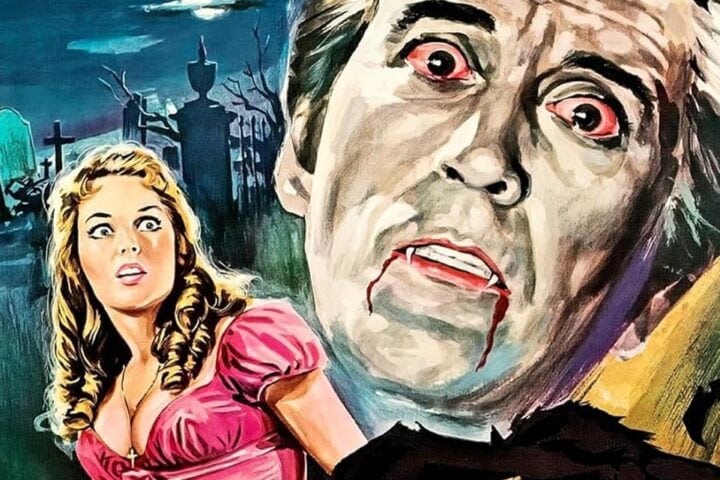
Mario Bava’s The Whip and the Body is a Technicolor fever dream of violent, unquenchable desire that extends beyond the grave. It’s also a gothic tale steeped in murder and revenge, with added elements of sadomasochistic eroticism and just a whiff of necrophilia. Wedged between Black Sabbath and Blood and Black Lace in Bava’s canon, The Whip and the Body shares those films’ consummate use of color cinematography to refine mood and convey disturbing shades of atmosphere. Acting as his own cinematographer, with credited DP Ubaldo Terzano working as de facto camera operator, Bava revels in a riotous palette of sickly greens, otherworldly purples, and sanguine reds.
The opening of The Whip and the Body brings to mind Emily Brontë’s Wuthering Heights, an equally disturbing tale of mad love that was celebrated by the surrealists. Heathcliffe stand-in Kurt Menliff (Christopher Lee) returns to his seaside castle home soon after the marriage of his brother, Christian (Tony Kendall), to the woman, Nevenka (Dahlia Lavi), who was once intended for him. Kurt had been banished by his father, Count Vladimir (Gustavo De Nardo), when he seduced and abandoned the daughter of housekeeper Giorgia (Harriet Medin), resulting in a bloody suicide that Giorgia hopes one day to avenge.
Kurt’s Sadean philosophy is tidily summed up when he opines, “It’s wonderful to see things born, to see them born, and watch them die.” His perverse inclinations are further revealed when he encounters Nevenka woolgathering on the beach. He quickly turns her own riding whip against her, the repeated lashings not calling forth a response of pain or fear, but rather a look of ravished ecstasy. It’s clear that Nevenka still carries a scorching hot torch for the brutish Kurt, who haughtily informs her: “You haven’t changed, I see. You always loved violence.”
Interestingly, the riding whip also features as an item in the Menliff’s domestic décor, serving as rather bizarre door handles, signifying their dominant role in the ongoing master-slave dialectic playing out on several levels in the household. For one thing, Giorgia’s desire for revenge is satisfied when Kurt dies by the very dagger her daughter used on herself, and soon after the Count is found murdered in his bed. The masters are dropping like flies.
The second half of The Whip and the Body hinges on a twofold mystery: Is Kurt really dead, and, if so, who killed him and the count? Before it delivers a not entirely surprising answer to those questions, the film teeters for quite a while on the fulcrum point of what literary critic Tsvetan Todorov called “the fantastic,” that moment of narrative indecision before seemingly inexplicable events either are attributed legitimately to the supernatural (the marvelous), or are dispelled by some rational explanation (the uncanny). The Whip and the Body ultimately emerges as a fascinating character study that delves deeply into an emotional maelstrom of radically unchecked desire at war with the more conservative forces of fear and repression.
The result of this unresolvable contest is a frenzied descent into madness. According to Jung’s idea of the house as psychic symbol, the cluttered, cobwebby crypt where the film concludes represents the inchoate forces at work in Nevenka’s unconscious. Only here can she be reunited with Kurt in what just might pass for an infernally happy ending of sorts. The film’s fiery finale image can be read as damnation for transgressive behavior or celebration of a ceaselessly blazing passion. Either way, Nevenka got to taste the whip in love not given lightly, as the song always says, and she obviously sees her fate as a consummation devoutly to be wished.
Image/Sound
Kino offers The Whip and the Body in “a 2023 4K scan and 2K restoration from archival print materials by 88 Films.” This new transfer is strikingly different, and a vast improvement, over the one found on Kino’s 2013 Blu-ray release. Gone is the often oppressive blue haze, revealing more natural and brighter colors as well as more easily discernible fine details. Audio comes in either English or Italian DTS-HD Master Audio mono. There’s one noticeable instance where the Italian track lacks a distractingly unnecessary sound effect found on the English, but otherwise they’re about on par in terms of depth and richness. On the other hand, it’s clear that most of the actors were delivering their lines in English, so that the English track syncs up better in that regard. Both options stirringly convey composer Carlo Rustichelli’s lush and lovely score, dominated by the haunting “Windsor Concerto” theme for piano.
Extras
Aside from a slate of trailers for other Mario Bava titles, the sole supplement here is a commentary track from film historian and critic Tim Lucas (author of the definitive Mario Bava: All the Colors of the Dark) that dates back to the 2000 DVD release from VCI. This is another impeccably detailed and researched listen. Lucas covers nearly every aspect of the film’s production history, delves into the careers of the main cast and crew members (including the need for using Anglo-friendly pseudonyms), explores the film’s dominant themes and visual motifs, and expertly situates the film within Bava’s larger body of work.
Overall
Mario Bava’s The Whip and the Body is a gorgeously stylized gothic ghost story, replete with kinky sex, fiery passions, and coldblooded murder.
Since 2001, we've brought you uncompromising, candid takes on the world of film, music, television, video games, theater, and more. Independently owned and operated publications like Slant have been hit hard in recent years, but we’re committed to keeping our content free and accessible—meaning no paywalls or fees.
If you like what we do, please consider subscribing to our Patreon or making a donation.