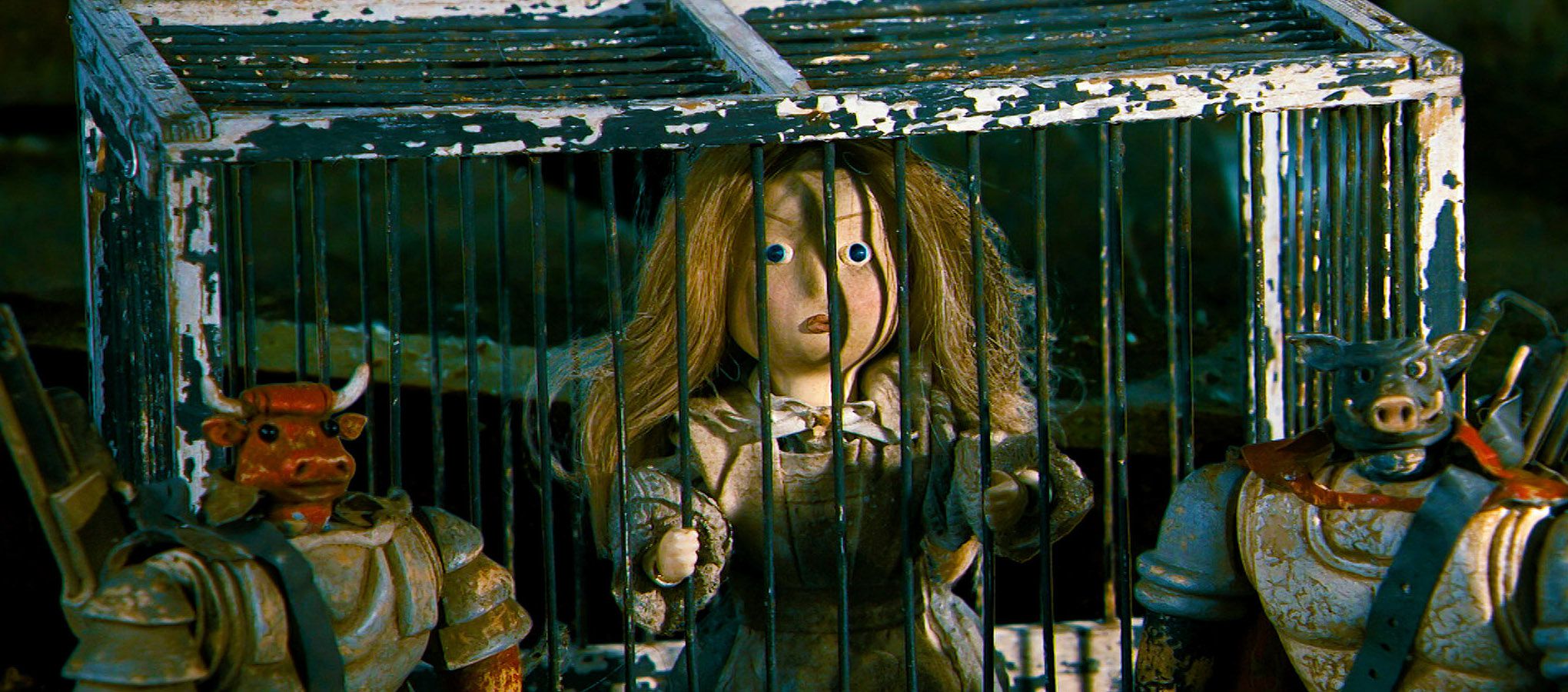
 Jiří Barta is one of the pioneers of stop-motion Czech animation, though he got his start a good bit later than Jiří Trnka and Jan Švankmajer. Across the feature film and seven shorts collected on this Blu-ray release by Deaf Crocodile, it’s obvious that Barta’s work is characterized by the radically different animation styles employed in each work. The choice of style is made with the intention to draw out the dominant underlying themes of the storyline.
The Pied Piper, from 1986, is a pitch-black fairy tale of greed, corruption, duplicity, and betrayal that’s relieved only by the faintest flicker of hope at the end. Based on a 1915 novella by Viktor Dyk, Barta’s film veers away from the better-known version of the tale (perhaps best exemplified by Robert Browning’s verse rendition), eschewing the involvement of children altogether, instead having the grotesque townsfolk turned into rats and led to a watery demise by the Piper. His motivation also differs: In this telling, in addition to failing to honor their end of their agreement, some of the citizenry stoop to acts of rape and murder. Quite obviously, this is no cartoon for the kiddies.
Just as remarkable as the variations that Barta plays on the classic narrative are the film’s striking imagery and almost convulsive soundtrack. The wildly Expressionist set designs for the town of Hamelin recall the jagged angles, foreshortened perspectives, and spatial disorientation that characterize Paul Wegener and Carl Boese’s 1920 adaptation of The Golem. Michael Kocáb’s score modulates from a stirring atavism that evokes Igor Stravinsky’s Rites of Spring to an ominous fuzz-guitar dirge that signals the doom of the townsfolk.
“Riddles for a Candy,” from 1978, is a formalist bit of fluff for children, involving a gluttonous anteater solving picture puzzles for a candy reward, with Barta effectively juxtaposing the bas-relief animal and the two-dimensional rebuses. “The Design,” from 1980, satirizes Soviet-era rigidity and conformity, with the disembodied hand of an architect scrupulously sketching out the blueprint for a housing project. The unruly design elements of prospective residents, represented by colored decals, get ruthlessly snipped away and the denizens ironed out until they’re indistinguishable from the rectilinear severity of their domiciles.
“Disc Jockey,” from 1981, follows a day in the life of the titular record-spinner. The film’s imagery is dominated by circular objects: clock faces, pills, cups, LPs, spiral staircases, road signs, and more. The way Barta sees it, human time rolls on without relief, for he sees even the disc jockey’s day as a circle, a routinized grind from morning till night and all over again.
“The Vanished World of Gloves,” from 1982, seems to have lifted its premise from Jean-Luc Godard’s description of Weekend as “a film found in a dump,” only here that film chronicles the history of film through a series of exquisitely rendered vignettes featuring a dazzling array of gloves. Each segment meticulously captures the period aesthetic of the films being parodied, which range from Buster Keaton’s Cops to Steven Spielberg’s Close Encounters of the Third Kind. Along the way, there are also hilarious riffs on Luis Buñuel’s Un Chien Andalou and Federico Fellini’s La Dolce Vita, even if the latter is rendered in overripe color cinematography. The short ends with the film reel and gloves being buried under concrete. This is Barta’s sly take on the value of such decadent Western art under the Communist regime.
From 1983, “A Ballad about Green Wood” plays like a stop-motion animated kissing cousin to Jiří Weiss’s The Golden Fern with its emphasis on the mythic and elemental powers of nature. These forces are embodied in Barta’s film by a piece of firewood that undergoes an almost ritualistic cycle of death and rebirth as the seasons change from winter to spring and back again. That cycle is nowhere more beautifully represented than by a funeral pyre that’s lit and burnt by leaves and grass standing in for the flames, a truly stunning sequence.

“The Last Theft,” from 1987, is something of an anomaly in Barta’s filmography since it’s a live-action, albeit highly stylized, short film. Throughout, Barta cleverly tinkers with speeding up and slowing down the film, lending the actors’ movements a jerky, puppet-like quality. The filmmaker also painstakingly hand tints various parts of the frame to call attention to certain visual elements. The story is dark fairy tale material: A thief (Ivan Vojtek) breaks into a cobwebby gothic mansion looking for some easy plunder but gets more than he bargained for when the place turns out to still be inhabited by a “family” of unconventional bloodsuckers. The ultimate reveal of precisely where the thief has ended up is truly haunting.
From 1989, “The Club of the Laid Off” uses life-sized wooden mannequins to act out its dark tale of life under communism with and without the trappings of Westernized “decadence.” The first half of the short follows a group of discarded mannequins as they routinely perform the same acts: One office worker continually leaves for his desolate office space, only to tumble down the stairs owing to his ungainly gait. Another mannequin regularly spies on a female mannequin through a peephole. At the halfway point, a couple of foul-mouthed laborers arrive to deliver another bunch of castaways, only this lot are all gussied up with colored Mohawks and stylish apparel. The resultant culture clash decidedly has something to say about Czech culture on the eve of the Velvet Revolution, even if it’s a little opaque as to just what that is, a sort of ironic ambiguity that leaves it open to viewer interpretation.
Image/Sound
The films collected here have been newly restored by Deaf Crocodile and look uniformly excellent. Colors are vivid, black levels appear deep, and there’s little in the way of damage on display. Since these films are mostly dialogue-free, the Czech Master Audio two-channel mono mixes are mostly vehicles for the wonderfully eclectic film scores.
Extras
The extras for this set are spread across two Blu-ray discs. On the first disc, there’s a commentary track for the feature film that teams Czech film expert Irena Kovarova and film historian Peter Hames, who discuss the history of Czech animation, Jiří Barta’s career, the film’s aesthetic features, and the different versions of the source material. The making-of doc “Chronicle of The Pied Piper” provides a fascinating behind-the-scenes look at the film. A video interview with Barta moderated by Deaf Crocodile’s Dennis Bartok first lays out the filmmaker’s upbringing and film school days before diving deep into the production history and techniques of both The Pied Piper and “The Vanished World of Gloves.”
The second disc includes another video interview with Barta about his short films, moderated by Bartok, that covers the inspiration and choice of animation technique behind each of the short films included in this set. “Pushed to the Margins” is a visual essay from Irena Kovarova and Peter Hames that explores the themes and visual motifs of the short films. Finally, the deluxe slipcase also includes a 60-page book with essays from film historian Jonathan Owen, film critic and author Walter Chaw, and Czech film expert Irena Kovarova.
Overall
Deaf Crocodile’s collection The Pied Piper + Jiří Barta Shorts presents an incredible panoply of Barta’s diverse animation styles and thematic preoccupations.
Since 2001, we've brought you uncompromising, candid takes on the world of film, music, television, video games, theater, and more. Independently owned and operated publications like Slant have been hit hard in recent years, but we’re committed to keeping our content free and accessible—meaning no paywalls or fees.
If you like what we do, please consider subscribing to our Patreon or making a donation.