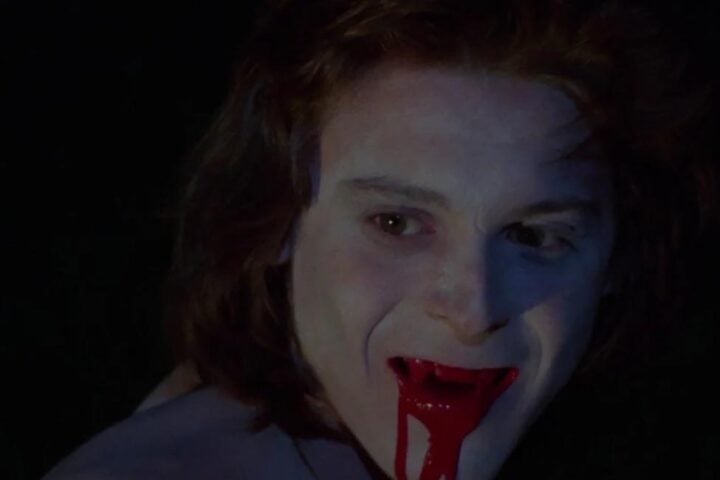
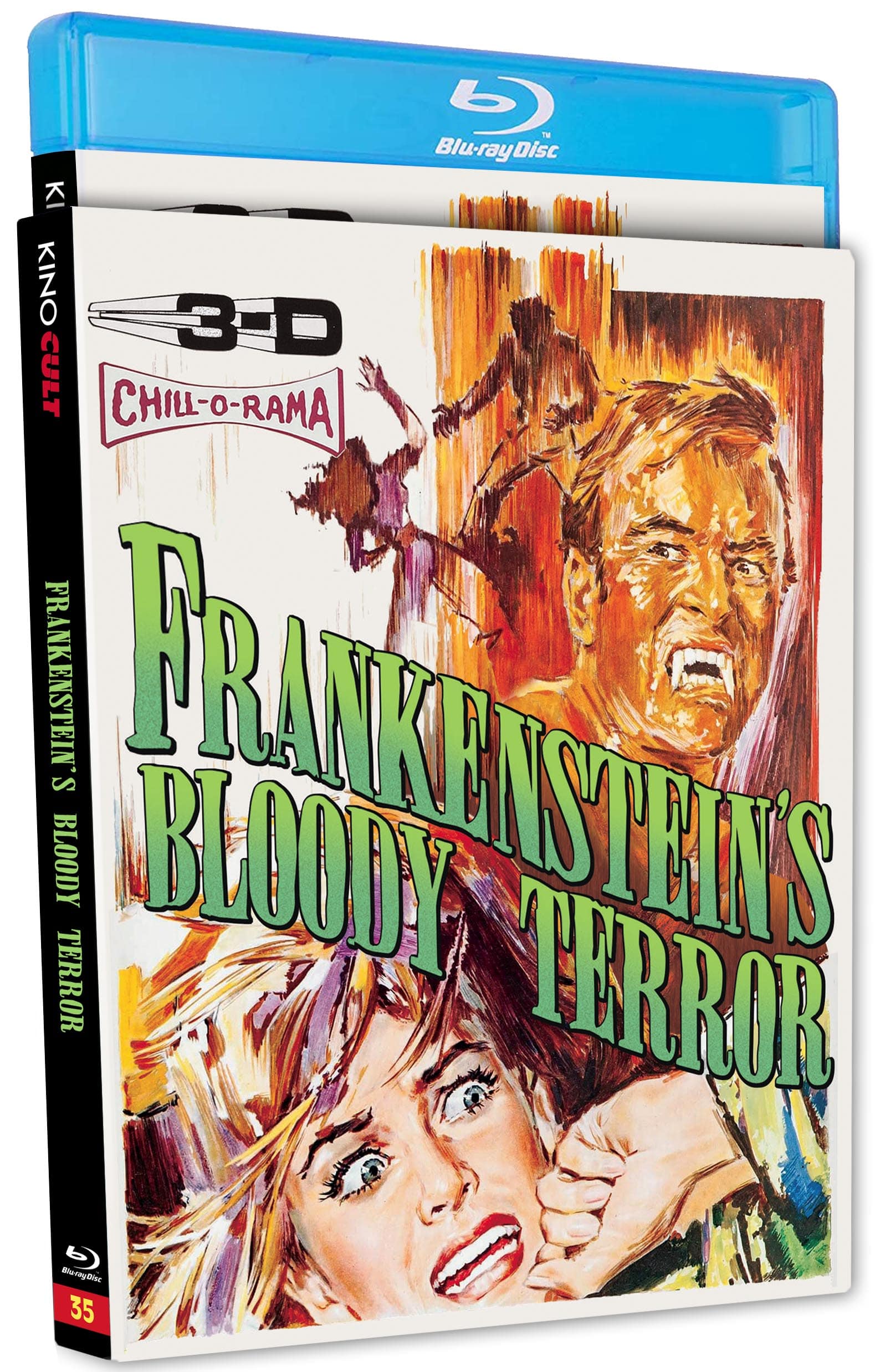
 As Spain’s reigning horror movie star, Paul Naschy, né Jacinto Molina Álvarez, played Dracula, Frankenstein’s creature, the Mummy, Mr. Hyde, and other iconic monsters throughout his career. With Frankenstein’s Bloody Terror, which he wrote as well as starred in, Naschy initiated a long-running series of films that featured the character of reluctant werewolf Waldemar Daninsky.
This film sets the template for the rest—including a bit of lore claiming that a werewolf can only be killed by someone who loves them, thus imbuing the Daninsky films with an aura of doomed romanticism—and, like most of them, eventually morphs into something of a monster rally. Not only is there a brawling werewolf duel, but there’s also a husband-and-wife team of satanically inclined vampires to double your fun.
What Frankenstein’s Bloody Terror lacks is any actual Frankenstein. When he acquired the film in the early 1970s, distributor Sam Sherman of Independent-International hacked off the first reel, inserting instead a montage of the film’s highlights and a bizarre animated sequence that purports to explain how the renowned Frankenstein name was corrupted into Wolfstein, the name of the cursed family as it actually appears in the Enrique López Eguiluz-directed film.
The titular mad doctor may be nowhere to be seen, but this film is as patched together as Frankenstein’s monster. Naschy cobbles together narrative and thematic bits of business from earlier werewolf films extending from Universal’s Werewolf of London to Hammer’s Curse of the Werewolf, turning the film into a fun game of “spot the reference” for genre fans.
Visually speaking, Frankenstein’s Bloody Terror is a ravishing banquet for the eyes. Shot originally on 70mm and in 3D, the film is awash in gothic atmospherics: ruined castles, cobweb-strewn crypts, and a tenebrous nocturnal forest that eerily presages Dario Argento’s Suspiria. DP Emilio Foriscot also makes liberal use of gel lighting—vibrant greens, and purples—that seems clearly inspired by the films of Italian maestro Mario Bava.
Frankenstein’s Bloody Terror exists in a disorienting middle ground between present and past. The opening scenes make extensive use of modern automobiles, but the rest of the film is submerged in gothic gloom, and you wouldn’t be at all surprised if a horse-drawn carriage came rattling by at some point. The film is likewise coy about where it’s set. The names are vaguely Germanic, and all the signage is risibly rendered in an unreadable Fraktur script. This is very much in keeping with Hammer’s equally unlocatable Mitteleuropa settings for their films.
Despite this presumably intentional sense of timelessness, Naschy’s screenplay incorporates elements that were quite timely in the late 1960s, which Spain was still in Franco’s vice grip. This is especially true when it comes to the acute sense of an unbridgeable generation gap between the film’s authority figures, aristo Count von Aarenberg (Jose Nieto) and Judge Weissmann (Carlos Casaravilla), and their wayward children, Countess Janice (Dyanik Zurakowska) and law student Rudolph (Manuel Manzaneque), respectively.
For most of the film, these pontificating paterfamiliases stand around sipping sherry or playing billiards. Only the extremely convenient discovery of a letter from Rudolph begging for help sends them off for the melee at film’s end. Their depiction toes a tricky line: They’re aware and effective enough for grownups to take them seriously but starchy and bullying enough to be seen as somewhat caricaturized by the film’s younger viewers.
Equally timely, not to mention trendsetting for Spanish cinema, is the at times sadomasochistic eroticism. The vampire couple, Dr. Janos Mikhelov (Julian Ugarte) and his wife Vanessa (Aurora de Alba), quickly place Janice and Rudolph under their sexualized spell. Though fully clothed, Vanessa’s languorous seduction of the young man is made even more palpably sensual by the use of composer Bruno Nicolai’s woozy “Drug Party” from Jess Franco’s Eugenie on the soundtrack. And it seems like the bad doctor and his missus derive distinct voyeuristic pleasure from the sight of bare-chested Waldemar heaving and panting his way through being manacled to the wall with a burning brazier set perilously close to his torso.
Notwithstanding some narrative shortcomings and heavy-handed editing, Frankenstein’s Bloody Terror remains visually sumptuous and unabashedly entertaining. It’s a distinctly Janus-headed film. On the one hand, it casts a nostalgic eye back to the heyday of Universal Horror movies. On the other, it clearly anticipates the deluge of increasingly explicit lashings of sex and violence that would become the staples of Continental horror cinema in the 1970s. Whichever direction you’re facing, it’s a truly enjoyable and memorable viewing experience.
Image/Sound
Kino presents the film in a new 4K transfer sourced from archival 35mm elements that were restored by the 3D Film Archive. There are three viewing options included on one disc: stereoscopic 3D requiring the right monitor and player, anaglyphic 3D using the included blue-green glasses, and a flat 2D version. Given the condition of the elements, which had been prey to extensive emulsion rot, the image looks impressive overall, especially in the fine details of the sets. Colors register boldly, and black levels are mostly deep and dark, though there are a few instances of unsightly crushing. Audio comes in an English Master Audio two-channel mono mix that’s a bit thin when it comes to the film’s dialogue. Still, it solidly conveys a soundtrack that’s comprised of various library tracks that fluctuate in terms of effectiveness.
Extras
Kino offers a solid roster of bonus materials, starting with a complementary pair of commentary tracks. Novelist and film critic Tim Lucas delves into the film’s tangled production and release, the history of the werewolf on celluloid, the career arcs of key cast and crew members, and more. It’s a deeply researched and meticulously presented track. The other commentary with film writer Troy Howarth and podcasters Rodney Barrett and Troy Guinn offers a more informal, conversational, and often humorous account of Naschy’s early years, how this film inaugurated both his career as a horror star and the genre of “fantaterror” in Spanish cinema, and where the film sits among the dozen or so other Waldemar Daninsky werewolf films.
Lucas returns for an exhaustive and rewarding account of both the Hi-Fi Stereo 70 3D process (and other competing technologies of the era) and the meticulous restoration process performed by the 3D Film Archive. There’s also an alternate opening sequence under the Hell’s Creatures U.K. title, and, more importantly, a selection of deleted scenes that include the entire 10-minute first reel of Frankenstein’s Bloody Terror that distributor Sam Sherman hacked off, which more effectively sets up the characters and their interrelations.
Overall
Frankenstein’s Bloody Terror has been given a fabulous new 4K restoration, viewable in both 2D and 3D, as well as some fine supplements.
Since 2001, we've brought you uncompromising, candid takes on the world of film, music, television, video games, theater, and more. Independently owned and operated publications like Slant have been hit hard in recent years, but we’re committed to keeping our content free and accessible—meaning no paywalls or fees.
If you like what we do, please consider subscribing to our Patreon or making a donation.