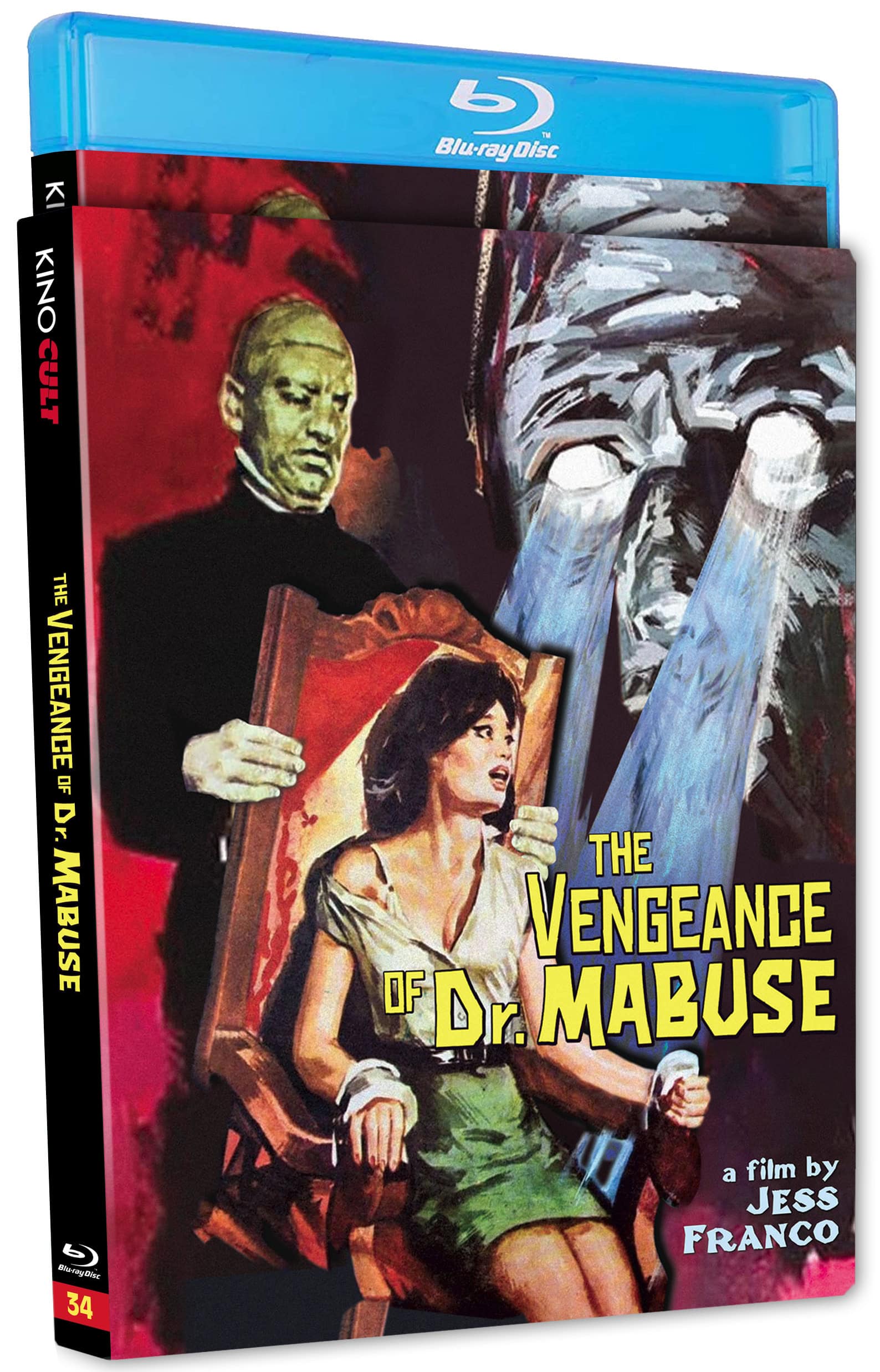
 Jess Franco knew how to bring a franchise to its logical conclusion: by submitting its abiding visual and thematic tropes to a playful combination of parody and self-referential deconstruction. He did it first with his pair of Fu Manchu movies for producer Harry Alan Towers in the late 1960s. He did it again with The Vengeance of Dr. Mabuse, which ended a run of films focused on the titular master criminal and arch hypnotist that began with a decades-spanning trilogy from Fritz Lang before becoming a five-film franchise in the ’60s produced by Artur Brauner, who was also the financial force behind Franco’s film.
From the start of The Vengeance of Dr. Mabuse, Franco tweaks the longstanding series by never even mentioning the M word. In the German-language cut available here, the title card coyly reads Dr. M. Strikes and the resident mad medico goes by Dr. Cranko (Jack Taylor), which gives you a fair idea of the level of parody at work (Krank in German means sick, so that his name translates as Dr. Sicko).
The name game continues throughout. The first of several lengthy and gratuitous conversations about why certain characters go by various names concerns a stripper, Jenny (Ewa Strömberg), who’s adopted the surname of her layabout boyfriend, Paganini (Andrea Montchal), because of her admiration for “that great pianist.” Later, we learn that a drunken angler (Roberto Camardiel) switched names with his dog Sultan because he got bored being called Carlos. Such buffoonery could be construed as a jab at how characters in these crime films usually come complete with shady aliases, or it could be a more meta jape at how characters in different edits of a “Euro-pudding” co-production often end up having completely different names.
Another method Franco uses to tweak the tropes of the Mabuse crime film is by routinely sidelining the nominal hero, Sheriff Bromer (Fred Williams)—who’s more often seen feeding his face than tracking down leads—in favor of sending in the aforementioned tippler to save the day in the film’s rather anticlimactic climax. And any semblance of a straightforward storyline is thwarted by Franco’s tendency to continually introduce new characters at regular intervals, and whose overall impact on the narrative is usually quite negligible.
In fact, it could be said that the film’s boilerplate plot—Mabuse and his gang commit a series of kidnappings and killings in order to obtain some sort fancy space laser—is an excuse for Franco to indulge his stylistic predilections. In addition to some delightfully lurid lighting, there’s an abundance of fisheye-lens shots that render strange and surreal the often-striking locations and set designs. When used in close-ups, they render a similar service to the human physiognomy, especially in the case of Andros (Moisés Augusto Rocha) and his surgical scar-lined face. Sonically speaking, there’s an endlessly bouncy bebop soundtrack interlarded with dissonant cues that evoke the mildly sci-fi provenance of Cranko’s sparsely outfitted laboratory.
All this isn’t to say that The Vengeance of Dr. Mabuse is entirely successful. As with some of the more cheaply budgeted Franco features of this era, the viewer has to actively engage with the material in order to make sense of its inordinately messy storyline. Otherwise, you can just let the oddball sights and sounds of Franco’s spirited pastiche roll over you like the endless surf that sounds and resounds under the end title card.
Image/Sound
The Vengeance of Dr. Mabuse makes its domestic home video debut with a 1080p HD transfer that looks decent overall, albeit exhibiting plenty of artefacts and a tendency for the colors to turn pink in quite a few scenes. Colors are reasonably bold, and the clarity of fine details registers decently well. Any sense of depth is mostly compromised by the use of extreme fisheye lenses and the resultant flatness of the depth of field. Audio comes in a German Master Audio two-channel mono mix that works admirably, given the film’s dubbed-in-post nature, nicely conveying the upbeat jazzy score and its occasional discordant flourishes.
Extras
The sole supplement available is an excellent audio commentary from critics Troy Howarth and Nathaniel Thompson that delves into the two very different cuts of the film (only the German cut is available here), the history of the Mabuse films, the career of producer Artur Brauner, links to other Jess Franco films, and how most of this film’s cast worked on other Franco projects. It’s an engaging listen with some agreeably humorous touches.
Overall
Jess Franco’s The Vengeance of Dr. Mabuse is part parody, part self-aware deconstruction of a longstanding film franchise.
Since 2001, we've brought you uncompromising, candid takes on the world of film, music, television, video games, theater, and more. Independently owned and operated publications like Slant have been hit hard in recent years, but we’re committed to keeping our content free and accessible—meaning no paywalls or fees.
If you like what we do, please consider subscribing to our Patreon or making a donation.