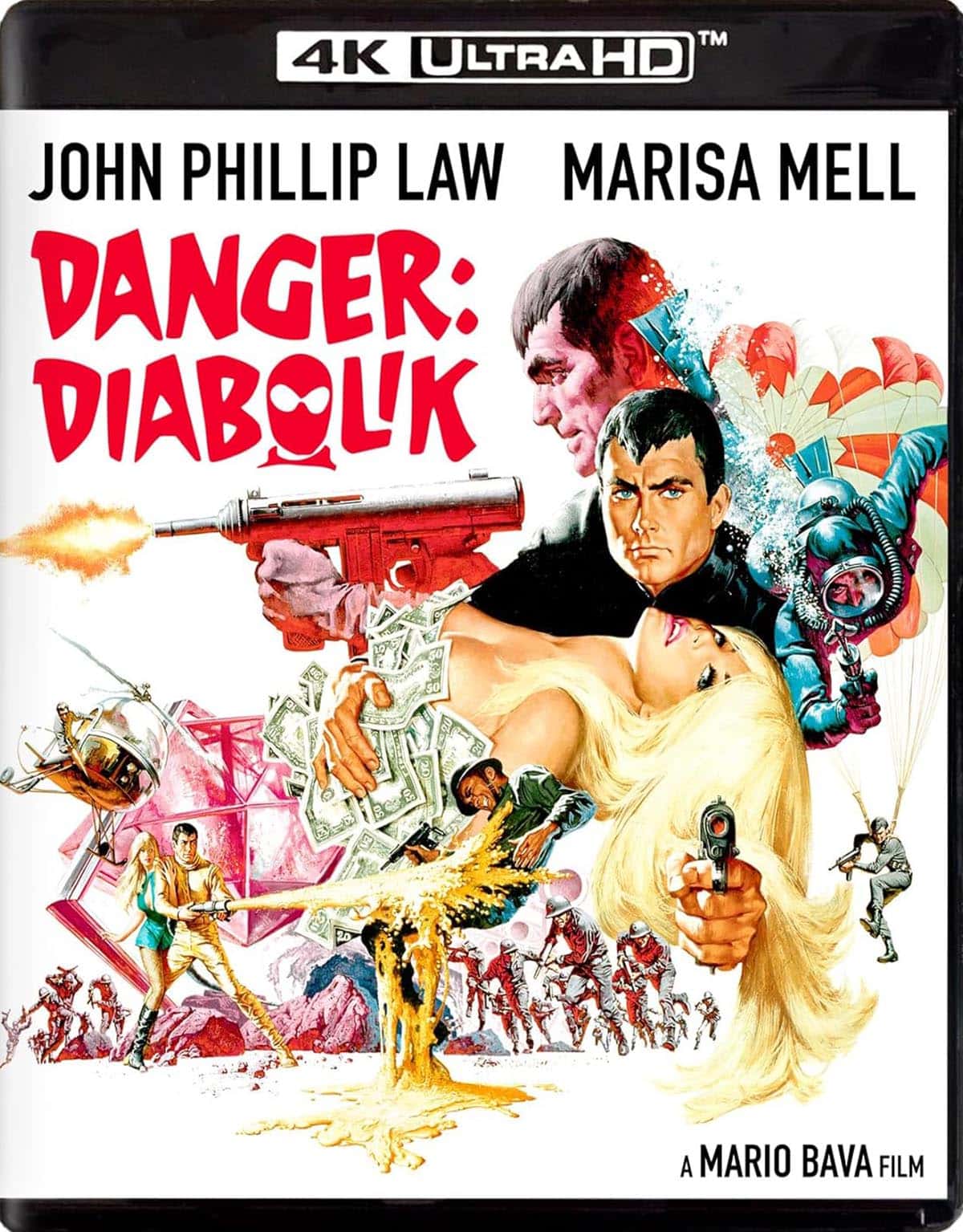
 Aesthetically speaking, Mario Bava’s Danger: Diabolik may be the greatest film to spawn from comic book source material. Given the Italian filmmaker’s work as cinematographer, this is hardly surprising. Bava’s choice of lenses (lots of fisheye), sense of composition, and eye for color are unrivaled. With Danger: Diabolik, Bava adapts his technique at times to approximate the arrangement of panels within a comic book page, breaking up the frame into compartmentalized units by situating objects like rearview mirrors, wrought bedframes, and elaborate shelving in the foreground of the shot.
The plot here is almost secondary to its set pieces. Diabolik (John Phillip Law) and his partner, Eva Kant (Marisa Mell), steal from the rich to give to themselves. Not exactly adverse to violence, it’s no big deal for Diabolik to dispatch his foes, when necessary, usually with an unerringly lobbed dagger. Given some of his actions, Diabolik could even be branded a terrorist. Then again, such intimations of anarchy were certainly part and parcel of the late-1960s counterculture.
Diabolik’s foremost act of terrorism consists of blowing up the buildings that house the major financial institutions of the nameless country where the film is set. This orgy of destruction decidedly anticipates the similarly motivated terroristic act that concludes David Fincher’s Fight Club, so much so that you wonder if Fincher was inspired by Bava’s movie. In Fight Club, the mayhem serves as backdrop to the film’s ironic final (punch) line, and Danger: Diabolik also sees the humorous potential of such a cataclysmic situation.
The newly minted minister of finance (Terry Thomas, almost stealing the show) goes on television to beg the citizenry—in the name of law and order—to pay the taxes they believe they should. Not only is the suggestion ridiculous, but it’s made even more so by Terry Thomas’s outsized delivery, making it clear that the minister is (badly) reading his plea off cue cards. The clearly intentional humor and its overall playful manner ought to leave viewers laughing with it, not at it, as its appearance on the finale of Mystery Science Theater 3000 would indicate.
The film is also quite clever in the way that it parallels many of Diabolik’s diversionary tactics with Bava’s own visual trickery. At one point, Diabolik uses a photograph to convince a surveillance camera that nothing is going on in the room he’s about to burgle. This is a direct reference to Bava’s frequent use of photo mattes, which entails holding a photo of, say, a chateau pasted to a plate of glass in front of the camera to present the illusion that it’s in the shot. Later in the film, Diabolik stretches a reflective material across a roadway to confuse a pursuing vehicle into thinking there’s another car headed right for it, which can be read as an in-joke about Bava’s mastery of (particolored) smoke and mirrors.
Danger: Diabolik was made back-to-back with producer Dino De Laurentiis’s other comic book adaptation from 1968: the Jane Fonda vehicle Barbarella, which also stars John Phillip Law. Unlike Bava’s wildly kinetic approach to the material, Barbarella often uses static compositions to approximate a single comic book frame, giving the film a far more ponderous pace.
Interestingly, some of the same props and set dressings carry over from one film to the other, especially in the lysergic go-go discotheque owned by Danger: Diabolik’s real villain, Ralph Valmont (Adolfo Celi). Another flourish bound to attract the approval of the counterculture has to do with the film’s vision of the older generation corrupting and controlling the youth by feeding them hard drugs, counteracting the “flower power” sentiments signaled not by the set design, but by the massive spliff one of the patrons gets handed during the scene.
Image/Sound
Kino presents Danger: Diabolik in both 2160p and 1080p transfers, each housed on its own disc. The 4K restoration looks spectacular, making significant improvements (especially in terms of depth and clarity) over the 2020 Shout Factory Blu-ray, which had been sourced from an older HD master. Colors almost leap off the screen, especially those omnipresent reds and greens. Fine details of décor and costume really stand out, and black levels are deep and inky, especially in several key “day for night” sequences, which are far darker than in earlier releases. Some of the blemishes, especially in some of the optical effects (like the particolored smoke released in the opening car hijacking), have been meticulously cleaned up.
Audio comes in both Master Audio 2.0 and 5.1. The surround mix opens up the soundscape a bit, but the mono track sounds fuller and bolder. Both do fine by Ennio Morricone’s absolutely knockout score, which many consider the composer’s finest.
Extras
Kino carries over the bundle of extras that go all the way back to the 2005 Paramount DVD, except for the second commentary that was created for the 2020 Shout Factory Blu-ray. The archival track features Mario Bava biographer Tim Lucas and star John Phillip Law dispensing many fascinating details about the film’s production history, including Bava’s special effects techniques, the locations, and the various cues from Morricone’s terrific soundtrack. The newer commentary with authors Troy Howarth and Nathaniel Thompson covers some of the same ground, but with different emphases, and contains a lot of intriguing comparisons between Danger: Diabolik and other genre titles, in particular the Bond franchise.
The other extras are found on the second Blu-ray disc. The featurette “From Fumetti to Film” has comics artist and historian Stephen Bissette—intercut with bits from John Phillip Law, producer Dino De Laurentiis, and composer Ennio Morricone—discussing the history of the Italian comics (or fumetti), the origins of the Diabolik character, how the film references specific images from the comics, and its legacy. To illustrate the last part, the video for the Beastie Boys’s “Body Movin’,” which incorporates and parodies scenes from the film, is also included, and it’s accompanied by an optional commentary from bandmember and director Adam Yauch.
Overall
Mario Bava’s ravishing and ridiculously entertaining Danger: Diabolik gets a stunning 4K upgrade from Kino Lorber.
Since 2001, we've brought you uncompromising, candid takes on the world of film, music, television, video games, theater, and more. Independently owned and operated publications like Slant have been hit hard in recent years, but we’re committed to keeping our content free and accessible—meaning no paywalls or fees.
If you like what we do, please consider subscribing to our Patreon or making a donation.