
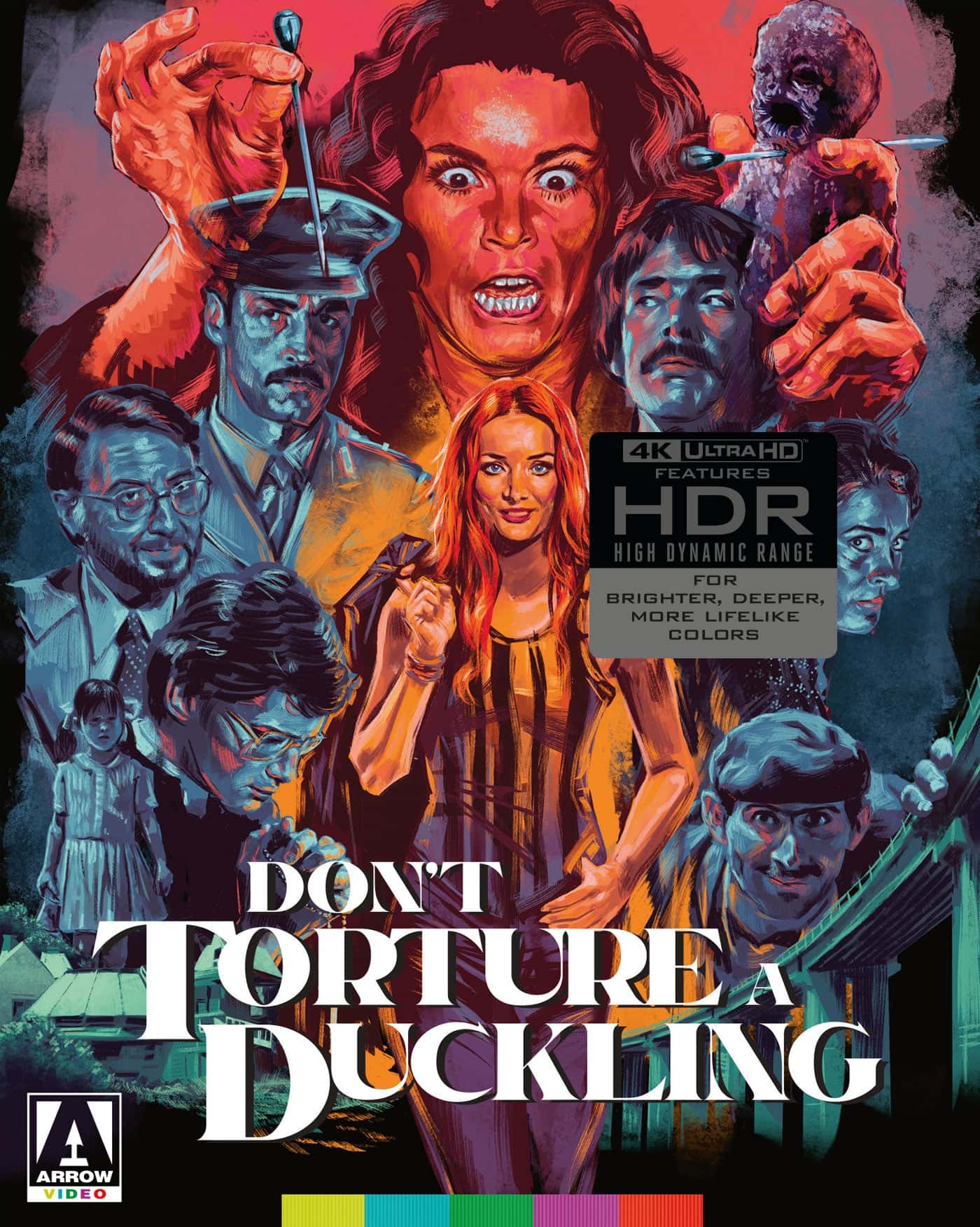
 Lucio Fulci’s Don’t Torture a Duckling is a haunting depiction of a series of child murders. It’s also something of a rare bird within the giallo genre, as it doesn’t take place in an urban setting (think the second half of Sergio Martino’s Torso), and the shocking subject matter could be considered fairly radical for early-’70s Italy, given the repressive climate of the era fostered by religious institutions and political regimes. It also displays a thematically resonant twist when it finally reveals the identity of the murderer.
The main characters in Don’t Torture a Duckling are all outsiders in one way or another. The requisite amateur detective is Andrea Martelli (Tomas Milian), a bit-city reporter who swoops down on rural Accendura looking for his next big break, sort of like Kirk Douglas in Billy Wilder’s Ace in the Hole. Nudist and resident temptress Patrizia (Barbara Boucher) is killing time at her wealthy father’s trippy modernist digs until a drug scandal blows over, while local “witch” Maciara (Florinda Bolkan) lives in the hills outside town, practicing her black magic in order to protect the bones of her long-dead child.
Much of Fulci and co-screenwriters Robert Gianviti and Gianfranco Clerici’s social commentary comes at the expense of the villagers, exposing their paranoid suspicion of outsiders and unwavering grasp of “the old ways,” superstitions and prejudices that have been handed down from time immemorial. Maciara, for instance, has been cast out of their society not because she’s an unrepentant devil-worshipper, but because she happens to suffer from epilepsy, an affliction that the community of Accendura refuses to see as anything but a curse from God.
The film’s centerpiece is the heartbreaking demise of Maciara. Released from jail after a false confession, Maciara is tracked down and beaten to death by the angry fathers of the dead boys. The violence, as Maciara’s body is smashed by clubs and ripped apart by chains, is almost as graphic as anything in Fulci’s Zombie or House by the Cemetery. But this brutality carries a weight of misdirected hatred and mistaken retribution that far surpasses any emotive gestures those films might make. In lieu of Fabio Frizzi’s suitably gothic basso profundo synths for those films, this scene uses a canzone warbled by Ornella Vanoni as ironic counterpoint.
By far the most striking aspect of Don’t Torture a Duckling resides in the identity of its serial child murderer, who turns out to be the local priest, Don Alberto (Marc Porel). The priest espouses a gospel of salvation from ineluctable sin via an early exit from this vale of tears. This perverse theology could be dismissed as a singular aberration attributable to Don Alberto’s upbringing by a mother (Irene Papas) who the town considers to be a termagant who drove her husband to suicide, thus rendering her another outcast and outsider.
But Fulci gives us several visual signs that this aberration just might be institutional and not strictly individual, none more explicit than one image of the boys in church awaiting confession. It’s shot on a disorientating canted angle, with a skeletal figure of Death looming over the young men in the background, an orthodox memento mori about the wages of sin. Church-sanctioned repression, an indignant Fulci seems to suggest, is payment enough, let alone the forfeiture of one’s very existence. By explicitly engaging with such thorny issues and potentially off-putting themes, Fulci made one of his finest, if, in many ways, most uncharacteristic, films.
Image/Sound
The new 2160p UHD transfer of Don’t Torture a Duckling, sourced by Arrow from an original two-perf Techniscope camera negative, looks incredible compared to the distributor’s already impressive Blu-ray presentation from 2017. Given the HDR, colors appear deeper and denser. Fine details of costume and décor stand out even more evidently. Black levels are solid and uncrushed. Audio comes in either English or Italian LPCM mono mixes, both of which sound quite solid, deftly bringing forward the film’s aggressive sound effects, as well as the memorably atonal score from composer Riz Ortolani featuring the ethereal vocals of Ornella Vanoni.
Extras
Troy Howarth, author of Splintered Visions: Lucio Fulci and His Films, delivers a characteristically engaging commentary track for this release. The track is packed with information about the film’s rural Italian shooting locations, its links to both other giallo films and other Lucio Fulci films, and the contributions of key cast and crew members, right down to the voice artists of the English dub, who often don’t get the attention they deserve.
In a video discussion, Mikel J. Koven, author of La Dolce Morte: Vernacular Cinema and the Italian Giallo Film, talks about the way the film somewhat ironically reflects its intended audience, the visual and thematic tropes inherent in the giallo, and the relative infrequency of non-urban giallo films. And in a video essay, film historian and critic Kat Ellinger delves into Fulci’s vision of this world as a living hell, how that influences his attitude toward religion in this film, the roles embodied by the three female leads, and the script’s complex view of children.
The extras are rounded out by a series of interviews. In a rare 1988 audio-only interview with Fulci, the filmmaker discusses, among other things, his take on Dario Argento and admiration for David Cronenberg’s version of The Fly (while throwing some shade on Stanley Kubrick’s adaptation of The Shining). Elsewhere, actress Barbara Bouchet outlines her acting career and later entrepreneurial outings; actress Florinda Bolkan talks about working with Fulci on this film and Lizard in a Woman’s Skin; cinematographer Sergio D’Offizi discusses the Italian film industry at the time and his satisfaction with the film’s overall look; editor Bruno Micheli gets into the nuts and bolts of the film’s music and sound design; and makeup artist Maurizio Trani divulges an amusing anecdote about fishing wigs out of the water for an acrobatic troupe.
Overall
Lucio Fulci’s Don’t Torture a Duckling, a haunting examination of guilt, innocence, and repression, gets an impressive UHD upgrade from Arrow Video.
Since 2001, we've brought you uncompromising, candid takes on the world of film, music, television, video games, theater, and more. Independently owned and operated publications like Slant have been hit hard in recent years, but we’re committed to keeping our content free and accessible—meaning no paywalls or fees.
If you like what we do, please consider subscribing to our Patreon or making a donation.



As someone who has previously watched and appreciated the genius of this Fulci outing; I found myself on a recent revisit unable to get past that extreme woman-beating scene, which has also been the case with one or two polizziatecchis I’ve watched or rewatched of late … My own view, even vis-a-vis American films such as the disturbing remake of The Killer Inside Me & etc.; is that we have to make a distinction between avoiding prudishness or excessive sensitivities (whilst fully acknowledging any given cinephile’s perfect individual right to steer clear of such films entirely of course) — and a sort-of ludicrous excessive libertinism which one finds in some genre audiences and critics, of behaving as if it’s OK to watch these kinds of materials — no different essentially in their lurid appeal to prurience than extreme maledom and torture porn materials … And to just blithely give them a pass without commenting on these kinds of scenes as representing a negativity in that culture in that moment in time … In a situation in which Italy is even currently a hotbed of extreme domestic abuse at a level which has been recently commented on by Amnesty Intl. & other watchdogs; I do feel it’s important — just as we acknowledge our mixed feelings about a film like The Birth of A Nation glorifying the KKK — to acknowledge that these kinds of lurid depictions are not anything which need be viewed as a sort of rite of passage for libertine cinephiles — as some seem to want to give a pass to elements which do represent pathology and ought not to be viewed as a twisted manner of art