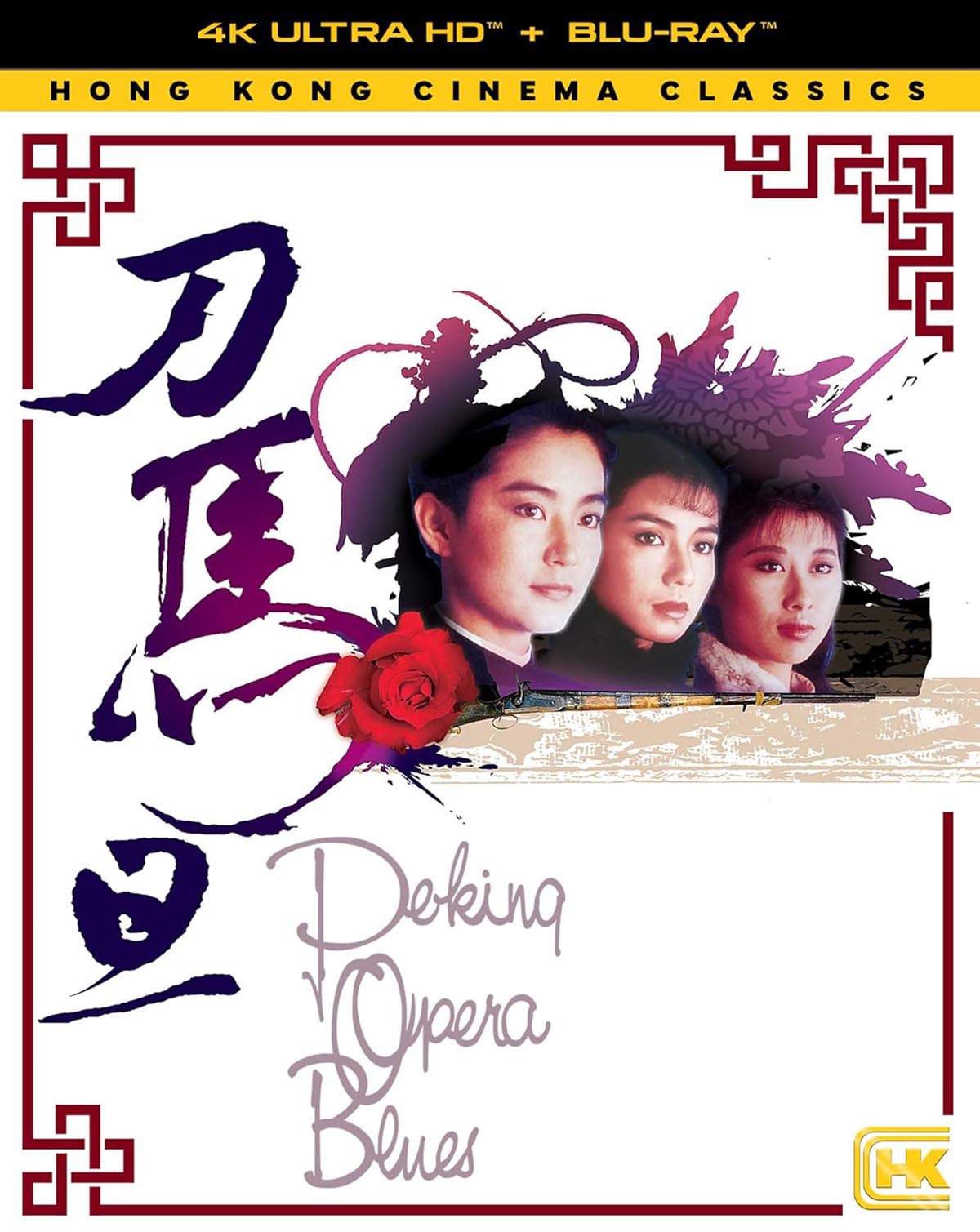
 Rarely has the ability of Hong Kong genre cinema to juggle wildly conflicting moods been more evident than in Tsui Hark’s Peking Opera Blues. The film doesn’t so much alternate between as simultaneously embody a screwball comedy, political thriller, buddy action flick, and a melodramatic tribute to rapidly forged yet unbreakable emotional bonds. That it not only hangs together but flows cogently and provides a stellar showcase for each of its lead actresses marks the film as one of Tsui’s finest achievements.
Set shortly after the fall of the Qing Dynasty, Peking Opera Blues depicts a transitional society at risk of destabilization. Successful revolutionaries have begun to descend into factionalism as generals vie for power and lowly soldiers largely content themselves with looting. During one such ransacking, singer Sheung Hung (Cherie Chung) makes off with a case of jewels, only to lose them in a cart bound for an all-male opera run by Mr. Wong (Wu Ma), whose daughter, Bak Nau (Sally Yeh), wishes to be an actor. Among the opera’s patrons are General Cho (Kenneth Tsang) and his daughter, Wan (Brigitte Lin), who acts as a spy for a rival group of republican fighters opposed to wannabe warlords like Cho.
As these characters become embroiled in a violent struggle between political rivals, Peking Opera Blues never loses sight of their individual ambitions. Cho imperiously jockeys for power, and so does an underling, Captain Lui (Ku Feng), the men’s endless scheming distracting them from stomping out the spy network under their noses. Cho and especially Lui also make rapacious passes at the women, who rally to aid Wan in her clandestine activities.
Tsui’s swooning camera movements are equally suited to scenes of opera dance and abrupt explosions of brawls and gunfights. When one shootout between revolutionary squads erupts in Wong’s theater, the camera constantly cuts above and below rows of seating as the civilians of the crowd leap up and down depending on how a given line of soldiers crouches or stands to fire. Later, the climax sees the heroes dressed as actors making an escape to hurl themselves up to the rafters and out onto the roof as soldiers pour gunfire into the ceiling.
In many respects, though, the film’s standout moments are less its intricately choreographed, escalating action sequences than the small moments where Tsui plays up the intimate and larger social ills that weigh on the characters. When Lui makes lecherous demands in Wong’s theater, first for the troupe’s lead actor and then for Bak, Wong’s encouragement to both to submit to the soldier for the sake of the company isn’t mercenary but nervous and resigned, aware that resistance will result in the same outcome but greater destruction.

Tsui often juxtaposes broad comedy on a subject with a more somber reflection on the same topic. For one, the film’s depiction of Wong’s troupe of cross-dressing male opera actors unfortunately reinforces wince-inducing stereotypes of effeminacy. On the other hand, in a scene where Bak and Sheung ask Wan why she dressed in a man’s military uniform and conducts herself with a masculine attitude, the revolutionary cannot help but smile to herself as she speaks vulnerably about the confidence and comfort it gives her.
For all its genre pleasures, Peking Opera Blues seriously reflects on the political upheavals of 20th-century China. Nestled within that look backward is an anxious glance forward to the 1997 handover of Hong Kong from the United Kingdom back to the Mainland and the political changes it might bring to the province. In many respects, the film is an effective rehearsal for Tsui’s later wuxia epic Once Upon a Time in China and its statelier reckoning with history.
Image/Sound
Shout! Factory’s 4K transfer perfectly captures the florid colors of the cinematography, with the pinks and rouges of the opera makeup and the costuming practically popping off the screen, and the cooler tones of blue and green captured in a gamut of gradations. Detail is consistently sharp and contrast is stable, with no crushing artifacts or softness on display.
The lossless audio track is a boisterous mix of city noise, gunfire, and the brassy percussion blasts of Chinese opera orchestration that keeps each element well separated from the others. Dialogue is placed at the front of the mix in even the most overwhelming scenes, keeping every line clearly audible no matter the chaos that surrounds the characters.
Extras
Shout! Factory commissioned a host of new extras to mark the film’s long-belated release on Region 1 video. In a new commentary track, critic James Mudge offers a mix of biographical information on the cast and crew along with analyses of Tsui Hark’s plethora of aesthetic feats of wonder. The disc also includes interviews with actor Mark Chen discussing his career and cinematographer Ray Wong sharing his memories of the project as one of his earliest gigs (he was only the focus puller here). Wong gives numerous insights into Tsui’s working methods and also recounts anecdotes about the lead actresses’ dedication on set.
We also get a handful of new interviews about the film with various critics and authors. Grady Hendrix offers an accessible overview of the film, Tsui’s career, the relevant Chinese history of the story’s setting, and the film’s hostile reception by domestic critics who failed to see its subtler social critiques beneath a crowd-pleasing surface. David West delves deeper into the director’s career, while Professor Lars Laamann gives a thorough account of both the revolutionary events in 1910s China and the changing landscape of national opera.
Overall
Tsui Hark’s masterpiece receives a gorgeous A/V transfer worthy of its freewheeling, genre-blending beauty from Shout! Factory, along with a bevy of outstanding extras.
Since 2001, we've brought you uncompromising, candid takes on the world of film, music, television, video games, theater, and more. Independently owned and operated publications like Slant have been hit hard in recent years, but we’re committed to keeping our content free and accessible—meaning no paywalls or fees.
If you like what we do, please consider subscribing to our Patreon or making a donation.