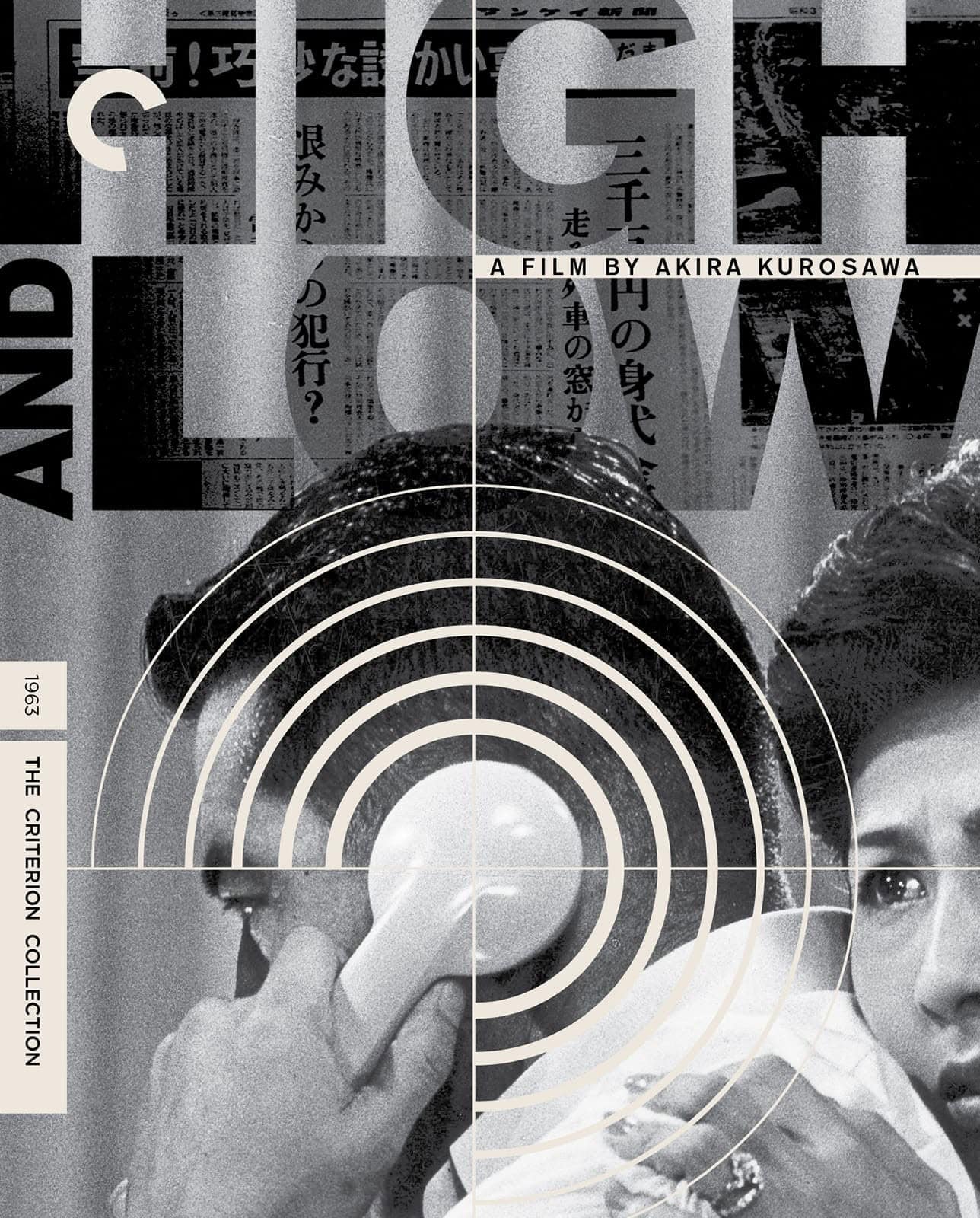
 Rarely has widescreen been employed more perversely than in Kurosawa Akira’s 1963 thriller High and Low, with the excess space at the sides of the frame used to emphasize how lavishly business magnate Gondo Kingo (Mifune Toshirô) lives and how his home nonetheless comes to feel like a prison when his son is kidnapped and held for ransom.
Or, at least, that’s what he thinks when a mysterious criminal calls him with the news. In short order, though, Gondo learns that the kidnapper actually abducted the child of his chauffeur, which complicates ransom negotiations. Drawn into a moral quandary as the criminal demands payment anyway, Gondo weighs possibly bankrupting himself against letting a child come to harm. Swiftly, all that vast empty space in Gondo’s house is filled with police setting up tracing and tapping equipment to track down the kidnapper while guiding the executive through calls with the man.
Kurosawa often used long camera lenses that captured the smallest details in deep focus while also compressing the visual depth of field, with objects in the foreground and background often looking like they occupy the same plane. It’s a dissonant effect that exacerbates the tension of the proceedings in High and Low, and when the film does move beyond the environs of Gondo’s home, it only becomes more oppressively hellish as the action descends from the “high” of the wealthy man’s hilltop abode to the “low” of the impoverished streets it overlooks.
The film’s power is also traceable to Mifune’s performance. Gondo initially radiates a quiet confidence befitting a successful tycoon, but gradually we see how his sense of executive power extends to his home life, and his stentorian calm starts to look like patriarchal megalomania. Mifune compartmentalizes his gift for explosive emotion, instead deliberately modulating the increasing panic and shame that crack Gondo’s facade of self-assurance.
Mifune’s restraint also sets up an eventual contrast with the later on-screen appearance of kidnapper Takeuchi (Yamazaki Tsutomu), a man so wracked by poverty and resentment that his limbs jut angularly from his torso from the effort of containing his rage. Without justifying Takeuchi’s crimes, the film calls attention to trickle-down psychological and physical damage wrought on those who live beneath the indifferent heel of their social betters.
Image/Sound
The Criterion Collection’s transfer comes from a recent 4K restoration. The textures of curtain fabric, furniture upholstery, and various decorations in the Gondo house are tactile in their sharpness, and there are no crushing or other artifacts to the shadowy, richly inky images of the street-level scenes. Elsewhere, the moments in Gondo’s house when the camera gazes out his giant windows to a cityscape obscured by blinding sunlight are never washed out. Ported over from Criterion’s 2011 Blu-ray release of the film is the 4.0 surround DTS-HD Master Audio soundtrack, which perfectly distributes off-screen noises around the crystal-clear dialogue.
Extras
All the extras here originated on Criterion’s 2008 DVD release of High and Low. Still noteworthy is the commentary track from film historian Stephen Prince, who balances analysis of the film with behind-the-scenes stories and context around life in Japan in the 1960s. The disc also includes a rather hagiographic 37-minute documentary on Kurosawa Akira produced by Toho, as well as archival interviews with Mifune Toshirô and Yamazaki Tsutomu about their careers and memories of working with the director. A booklet contains a report from the set of the film by film scholar Donald Richie and an essay by critic Geoffrey O’Brien that unpacks Kurosawa’s subtle means of constantly ratcheting up the tension throughout the film.
Overall
Kurosawa Akira’s masterful 1963 thriller comes to native 4K with a transfer that captures the film’s formal mastery in sparkling detail.
Since 2001, we've brought you uncompromising, candid takes on the world of film, music, television, video games, theater, and more. Independently owned and operated publications like Slant have been hit hard in recent years, but we’re committed to keeping our content free and accessible—meaning no paywalls or fees.
If you like what we do, please consider subscribing to our Patreon or making a donation.