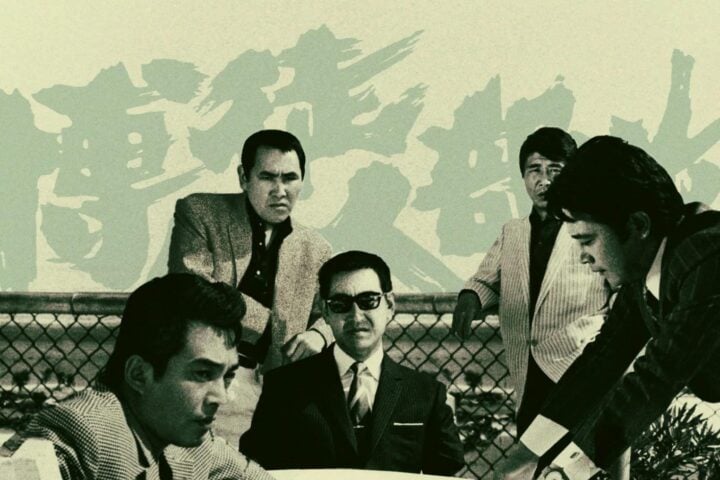
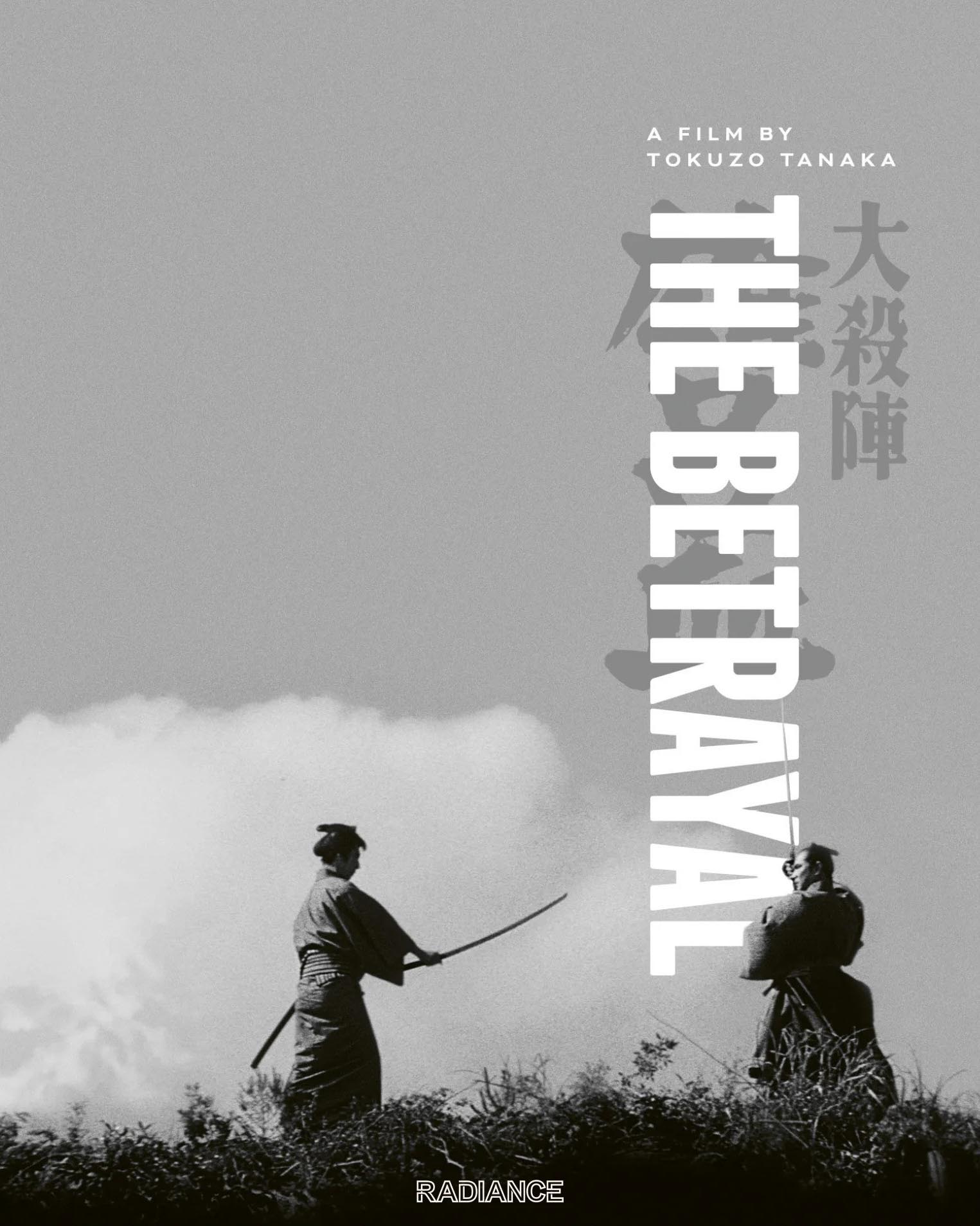
 Released amid a wave of bleakly revisionist jidaigeki samurai films like Harakiri and The Sword of Doom, Tanaka Tokuzô’s The Betrayal takes a similarly cynical view of the supposedly chivalric codes of conduct of Japan’s feudal warriors.
The film, written by Nakamura Tsutomu and Hoshikawa Seiji, begins with two samurai stabbing a member of a rival clan in the back over a petty insult, setting up a war of reprisal. To make matters worse, one of the killers (Nakatani Ichirô) is the son of a feudal lord, Makabe (Uchida Asao).
Seeking to protect his son and head off a larger feud, the lord turns to Takuma (Ichikawa Raizô), a loyal soldier and fiancé to his daughter, Namie (Yachigusa Kaoru), with a proposition to take the blame for the murder, hide out for a year to let the heat die down, then return and be readmitted to the clan with a belated admission of his innocence. Despite the circumstances of this request, Takuma so fervently believes in the nobility of samurai loyalty that he agrees, only for Makabe to die shortly before his time in exile ends and strand the young swordsman in a lie that leaves him a target of both the rival clan and his own, as well as the local constabulary.
Compared to some of the more elaborate stylizations that filmmakers such as Kobayashi Masaki or Okamoto Kihachi brought to their own samurai pictures, Tanaka keeps the visual language of The Betrayal relatively simple. His frames stress the negative space of castle rooms, using their emptiness to comment on the hollow, for-display-only grandeur of the noble class.
Tanaka also subtly calls attention to the flat geometry of shoji-screen interiors, which are constantly opening up to reveal eavesdroppers or waves of swordsmen primed to attack Takuma. The film makes no illusions that the samurai clans of old were anything other than the forerunners of modern-day yakuza—nothing but ladder-climbing gangsters for whom the tradition of bushido is merely propaganda to prettify their criminal behavior.
And where even the most caustic samurai movies tend to remain within these high-born realms, The Betrayal follows Takuma into the lower strata of Japanese society as he flees from his assailants. In hovels and streets, the young warrior finds that the rot at the top of the system has trickled downhill and reduced peasants to the playthings of nobles who torment them for their own amusement. Tanaka employs more close-ups in this setting, isolating individuals to stress their lack of structural power. In the film’s bleakest moment, a woman (Fujimura Shiho) nurses Takuma back to health after an attack and even exhorts the now-disillusioned man to remain a samurai, only for her to be raped and killed by some of his pursuers.
Everything comes to a head in an extended climax, in which Takuma stares down a horde of clan members and constables. Despite the repetitive nature of the protagonist largely being set upon by one man after another, the climax continuously complicates the characters’ movements. Buildings, objects, and even the mounting pile of dead bodies start to crowd the frame, necessitating change-ups in how Takuma is arrayed against his attackers. Beneath the catharsis of Takuma’s rampage, Tanaka makes clear the irony that this once-idealistic warrior finally does bring honor to his profession only in killing as many of his peers as possible.
Image/Sound
Radiance’s transfer lacks any noticeable flaws attributable to either the encode or the source print. There are no glaring instances of damage or debris, and the grays and blacks of the cinematography remain stable and rich in both high- and low-light conditions. The film’s many deep-focus shots retain detail well into the background, and close-ups reveal minute textures on actors’ faces. The mono soundtrack lacks any tinny quality and keeps dialogue clear amid the increasing chaos of boisterous music cues and the sound of mass carnage as the action escalates.
Extras
This disc comes with two contributions from critic Tom Mes: scene-specific commentary for some of the film’s standout moments, and a video essay on some of the aesthetic and thematic traits of Tanaka Tokuzô’s work. Additionally, critic Philip Kemp supplies a brief visual essay that compares The Betrayal to Futagawa Buntarô’s 1925 silent Orochi and reminds us that cinema was interrogating samurai iconography well before the revisionist works of the ’60s. A booklet essay by film historian Alain Silver expounds on the film’s relationship to other jidaigeki of the time and delves into the wider careers of both Tanaka and lead actor Ichikawa Raizô.
Overall
Tanaka Tokuzô’s brutally antiromantic samurai film has long lived in the shadows of more famous contemporaneous works, and Radiance’s Blu-ray offers it the spotlight it deserves.
Since 2001, we've brought you uncompromising, candid takes on the world of film, music, television, video games, theater, and more. Independently owned and operated publications like Slant have been hit hard in recent years, but we’re committed to keeping our content free and accessible—meaning no paywalls or fees.
If you like what we do, please consider subscribing to our Patreon or making a donation.