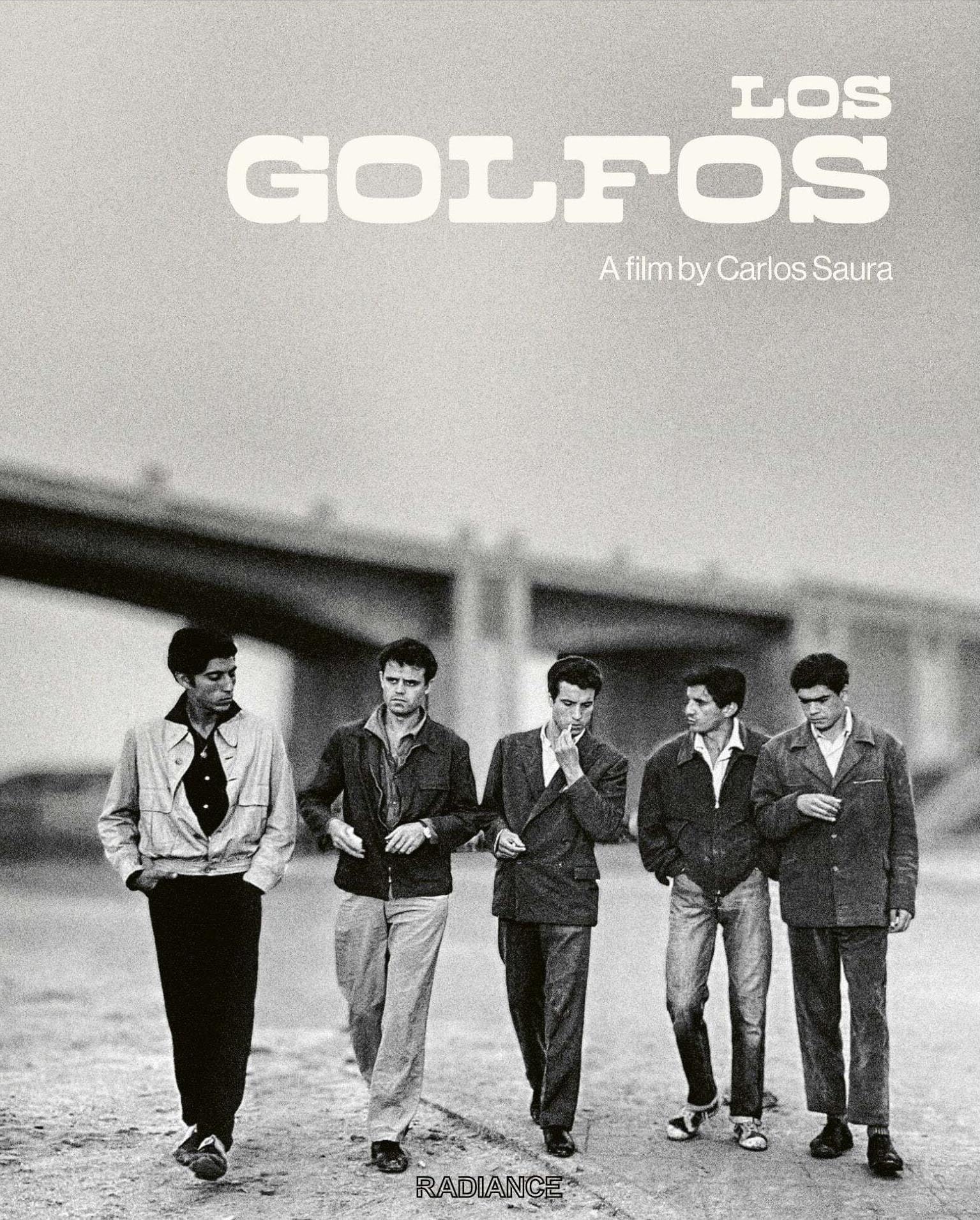
 Not unlike Luis Buñuel’s Los Olvidados, Carlos Saura’s debut feature, Los Golfos, is neorealism at its most confrontational and unsentimental, capturing the decline of a society not through the crushing of an innocent naif but through a generation forged by the very rot that continues to eat it. Shot around Madrid, Los Golfos ran afoul of Franco’s censors for its unvarnished look at the seediest corners of Spain’s capital, and not even mandated edits could diminish the potency of Saura’s vision.
The film follows a gang of young misfits who rob and cheat to get by, their petty crimes barely keeping them fed but instilling in them a false bravado, as evidenced by the way they hit on women. Of the group, only the charismatic Juan (Óscar Cruz), who dreams of becoming a matador, has any ambitions higher than giving free reign to his libido, though the film subtly emphasizes the parallels between fascism’s glorification of brutality and the tradition of bullfighting that’s steeped in violence and machismo.
The filmmakers lead the young men’s idle barbarism and anomie to grotesque, if logical, conclusions: One of them ends up face down in a literal pile of shit, and even Juan comes to see the harsh limits of trying to reach stardom through bloodsport in a nation desensitized to violence and more eager to see someone fail than triumph. And yet, for all the abject misery of the film’s conclusion, Los Golfos eschews the satiric bleakness of Los Olvidados in favor of an empathetic assessment of how few options its characters have.
At every turn, the film calls attention to the way that fascist acts undercut the conservative values that the ideology ostensibly champions. The Spain of Los Golfos is a land of widows and orphans, with a conspicuous shortage of middle-aged men thanks to the Civil War and subsequent purges. Fascism regularly promotes conservative family values, but the film underlines the irony of this in a system that has left so many families broken by violent oppression. Ultimately, the film adopts a melancholic tone toward the many failures that produced the narrow-minded young men at its center, seeing their personal flaws as the inevitable result of the twisted values imparted upon them.
Image/Sound
Sourced from Filmoteca Española’s 4K restoration of Los Golfos, Radiance’s transfer is a nearly spotless presentation of Carlos Saura’s film outside of the occasional, faint sign of print damage and washout-out exterior shot. The variations of gray are well-delineated, and detail in close-ups is consistently fine. The soundtrack neatly balances dialogue with the ambient sounds of Madrid’s bustling skid row, while scenes set in a local nightclub and the bullfighting arena capture the overwhelming din of the crows without devolving into muddiness.
Extras
The disc comes with two early short films by Saura. “La Llamada,” a one-reel silent from 1955, is a dreamlike vision of a soldier heading to war, with the quotidian reality of a young couple’s parting complicated by the wife’s Cassandra-like visions of doom. But it’s Saura’s 1957 student thesis, “La Tarde del Domingo,” about a maid who endures the constant nagging and condescension of her employers, that more clearly hints at the filmmaker he would become, namely in its patient observation and deep empathy for the harried young woman at its center. Saura is attuned not only to the class divisions that disempower the maid but also the predations of men who harass her during her all-too-brief moments of personal time.
Elsewhere, author and film curator Esteve Riambau provides a new introduction to Los Golfos, and filmmaker Ehsan Khoshbakht discusses Saura’s influences and the career paths of the film’s mostly nonprofessional actors. The Spanish government heavily censored the film ahead of its initial release, and the disc comes with a reel of cut footage with notes from both Saura and the censor board indicating what was eliminated. A booklet essay by critic Mar Diestro-Dópido discusses the film in relation to the growing boldness of young Spanish filmmakers of the 1950s and ’60s pushing against the strict cultural and representational limits of the nation’s regime.
Overall
Carlos Saura’s grim but humanist portrait of poverty and crime in Francoist Spain receives a sturdy A/V transfer from Radiance Films.
Since 2001, we've brought you uncompromising, candid takes on the world of film, music, television, video games, theater, and more. Independently owned and operated publications like Slant have been hit hard in recent years, but we’re committed to keeping our content free and accessible—meaning no paywalls or fees.
If you like what we do, please consider subscribing to our Patreon or making a donation.