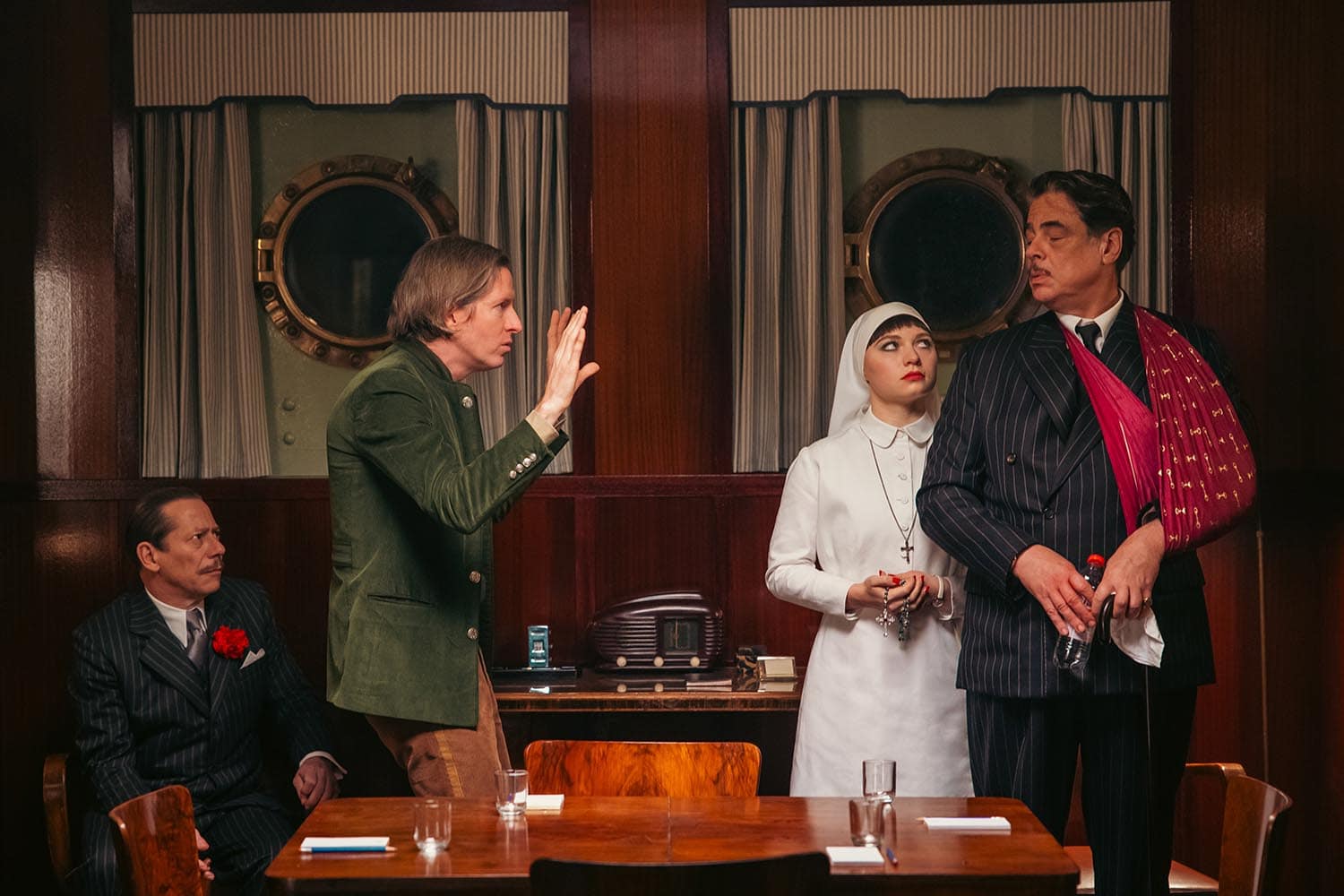
“Watching [Wes Anderson] discover and use Michael [Cera] was like watching God discovering water,” quipped Benedict Cumberbatch at the Cannes Film Festival press conference for The Phoenician Scheme last week. “It seems like a pretty obvious, natural element to have in his arsenal as a filmmaker.” And Cumberbatch is right, as it does feel long overdue for Cera to join one of Anderson’s ensembles.
The duo makes up for lost time in The Phoenician Scheme, Anderson’s 12th feature, by building the indelible character of Bjorn Lund together. This Norwegian tutor obsessed with bugs makes for a delightful third wheel to Benicio del Toro and Mia Threapleton’s characters in the film. Bjorn is there every step of the way with European business tycoon Zsa-za Korda (del Toro) and his novitiate nun daughter, Liesl (Threapleton), as they traverse the continent locking down more favorable rates on an infrastructure project that will define Korda’s legacy.
Like the most memorable figures in Anderson’s work, the meticulously manicured Bjorn is more than initially meets the eye. Cera deftly navigates the reveals of his character’s true nature across the journey to meet with Korda’s partners in commerce. No matter what persona he assumes, the actor always maintains a blend of wry wit and warmth that defines the filmmaker’s style.
I spoke with Anderson and Cera jointly prior to the New York premiere of The Phoenician Scheme. Our conversation covered how they created the character of Bjorn, why they reject the classification of the film’s sensibility as “deadpan,” and what preparation is necessary to make a story come to life on screen. While our time ended with a celebration of another legendary comic pairing in Nichols and May, our chat had to begin with a subject a little closer to home given that Anderson’s legacy was in my Houstonian bloodstream from a very early age.
Wes, I’m a fellow Houstonian and remember when Rushmore was shooting near where I grew up. Although I went to your rival high school, Kinkaid…
Wes Anderson: Marshall, you know we actually shot Rushmore at Kinkaid!
Yes! It’s Rosemary’s classroom, right?
WA: That’s it, you’re right.
Something I haven’t seen a ton of discussion about is the “Biblical Troupe.” Is that pulling from any of our shared Texan background in addition to some of the Buñuelian Catholic surrealism elements?
WA: I like that: Buñuelian Catholic surrealism and our Texas background. You’ve probably just captured the entire thing. The Texan background would be that it’s a religious state, right?
To some extent! And I know your alma mater, St. John’s, had some religious connections when you were there.
WA: I went to a school called St. Francis, and then I went to a school called St. John’s. There was definitely an Episcopalian thread. In the case of this story, we have this character who keeps dying. It’s become a habit for him at a certain point, so it just came out of that reality for this character. We did genuinely have Buñuel at the front of our minds as something we wanted to be inspired by. But I think if you grow up being given this religion, it’s sort of always there.
Was there any thought to what a heavenly hallucination might look like for Bjorn?
Michael Cera: [laughs] It would be in color! And bugs, a lot of bugs.
WA: I wonder if it would be Bjorn. I think if he went to heaven, he would be Agent Carlson. Since he has two [personas]. Yeah, maybe the other characters would say, “Who is this?”
MC: Bjorn would be at the table with him. He would serve Bjorn.
WA: That’s good. We’d use our visual effects.
Given some of what we later learn about Bjorn in The Phoenician Scheme, how did you go about building a cohesive character in everything from the outward details of his accent to the inner workings of his psychology?
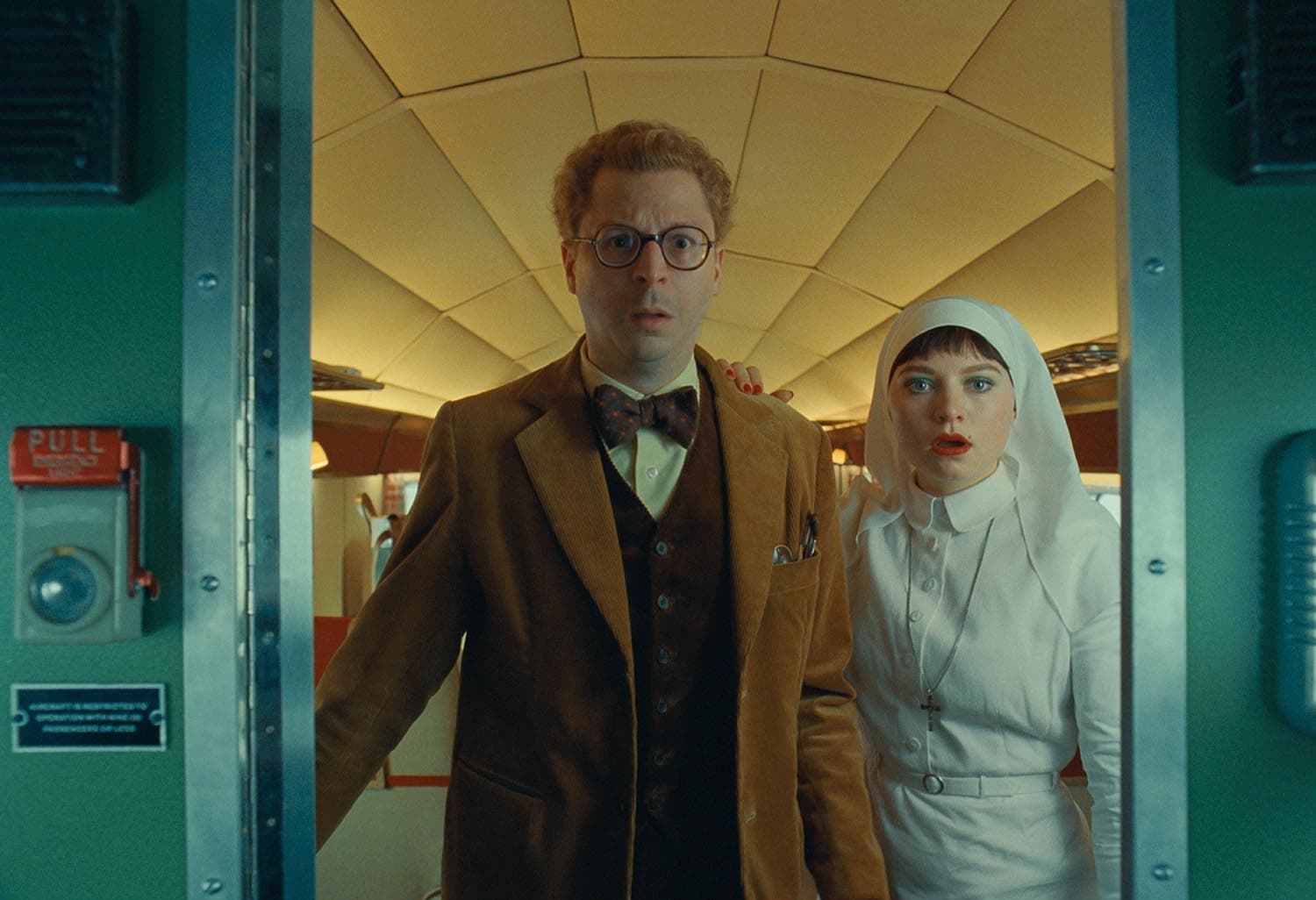
MC: We had a rehearsal period, and it was really invaluable. When I showed up, Wes and Milena Canonero had a good idea of the look of the character already, at least from the costumes. You and I started talking about the hair and the glasses. The glasses were a big part, and they came together slowly. We even shot a few scenes where the lenses weren’t in them yet.
WA: Because he has lenses that you can’t even see [through]. He had to wear contact lenses underneath the glasses in order to be able to see with these distorting [lenses].
MC: Yeah, it was negative 12 prescription. We shot a few scenes before I had the contacts, too, so I think I was blind.
WA: You say we had these things in place. But in fact, my experience was we had some raw materials, and then you took the wardrobe—I would say, more than anybody else in the movie—and shaped how these costumes were worn and how they were combined. That’s my perception.
MC: Really? I guess when you want to change over to Carlson, but you’re in the same clothes…
WA: Because he has changes during the movie before he has his transformation, even.
MC: That’s true. And looks, but the same elements. The same elements with this tri-color suit. It’s like three different suit colors that he combines with the vest, jacket, and pants. They’re different combinations.
WA: Different rusts and beiges.
One thing I’ve noticed in the lead-up to the film’s release is that many of the actors are emphasizing how your direction, Wes, emphasizes and encourages naturalism. What does that process look like for Bjorn given that there’s almost like a performance within his performance?
WA: I do think there’s a thing where, somehow, I feel like somebody watches a movie and they see a different movie from the one I feel I’m showing them. Somebody feels like I’ve done something where I’ve told everybody where to look or when their eyeballs are meant to move, and that’s not my approach in any way. People say my deadpan “blah, blah, blah,” and I don’t ever remember wanting deadpan. I understand why people say it…
MC: I take umbrage with that too. That’s not deadpan, I don’t think.
WA: It’s not what I look for. I think partly it’s in the writing, maybe. There’s a certain thing about the writing. Essentially, what I hope is the actors take this thing and bring it to life. But I guess it’s within the limits of the script of and what the dialogue is like.
MC: Just to expand on that from my perspective working with Wes, there are parameters in place, which there are on everything. On every job as an actor, you learn what the parameters are. [Sometimes] they’re physical from a blocking standpoint. If you do a play, you do a lighting rehearsal, then you’re locked in blocking because there are lighting cues connected with your staging. So those are your parameters, but within that as an actor, you have to bring it to life.
When you work on Wes’s movies, there’s an animatic created by Wes which predetermines the blocking, for instance. Wes isn’t limited by it, but it’s a time-saving tool, I would presume. You know where your blocking is as an actor. You don’t have to get there and fumble through that. You know where you belong in the frame, and there’s sort of a delicacy to what we’re doing, where there’s a spell being cast that could easily burst if I’m doing this [leans hard to his right]. It’s really gonna kill the effect. So there are things like that that are particular to you, but within that as an actor, it’s your job to be somewhat atonal within that and bring a music to it. That’s kind of what’s going to bring everything to life: the characters and their dynamics.
WA: When we talk about the animatic, it’s a sort of storyboard cartoon version of the movie. I make this thing for Adam Stockhausen, our production designer. I make the thing so we can know what to build. Essentially, we’re always making a movie that’s twice as big as the budget, so we try to figure a way that we can work between a frame and a set to get the biggest ideas we can across in the most efficient way. That’s what this thing is for, but it does sometimes say here’s the blocking within that. I try to come up with some blocking ideas that could be fun for the actors to say, “This would be challenging, but let’s use this.”
MC: I do think we also found things that were surprising in the rehearsals.
WA: Always. Yes, yes, yes.
MC: There’s always something that you could never have anticipated.
WA: And somebody like Michael, who’s doing this since he was young. I mean, he’s young now; he was very young then.
MC: Younger then.
WA: When you’ve done it before and made this your life, then when you come into a thing, you say, “Okay, there’s a bunch of things here I think need working out.” You know you arrived with, “I have these things that we need to make specific.” Well, when you’re inexperienced making a movie, you get on the set and you realize what you haven’t figured out. When you’re experienced, you’re sooner to recognize, “Here’s some stuff that needs some attention, right?” And you say, “I’ve been on one where we completely didn’t have anything ready for this. That was a mess. That didn’t work! We couldn’t use that.” That’s just a bit of process for you!
MC: And you just get one shot, so do want to be ready. All these scenes are really important. You read the script and you go, “Oh my god, that’s gonna be great, but only if we get it right on our one day we get to shoot it.”
WA: The one time in our lives where we’re gonna get to do this scene.
MC: So it really matters!
Michael, were there any experiences that stand out as preparing you more to step into Wes’s world so seemingly effortlessly?
MC: When you step into a movie with Wes, you know as an actor that you’re working with a director who really cares about every inch of the movie and isn’t missing anything. It just relaxes you. You feel like, “Okay, I’m in good hands, I’m working with someone who’s obsessive,” which is really what you want as an actor. You need less preparation, actually! You just show up and make yourself prepared to be available to the process and go with it.
Wes, when you’re building these ensembles of actors who have different artistic backgrounds and experiences, how do you get them to harmonize? Is it something you achieve through the script or from just getting people onto set together?
WA: We have a story, we have characters, [and] we have a group. I’ve spent a lot of time figuring out who the group is or trying to lure everybody in here. Getting everybody together, that’s the big task. Back when Mike Nichols was alive, I asked him, “I’ve never done a play. What’s it like? What do you do?” He told me, “Well, the first thing you do is you get everybody together, and you start talking. Then, you order some coffee, and then you talk a bit more about the script a bit, or maybe you just talk about something that happened when you met before. Then, maybe you order some sandwiches. And then, eventually you say, ‘Should we read it?’ And then you read it, and then you talk some more. And then you order some more sandwiches, and then you get some more coffee and talk some more. And then you say, ‘Should we read it again?’”
I was surprised, but that’s sort of what it is! You just start doing it and doing it, and ultimately, the thing you want to happen is the thing that does happen. They take it, and you watch. The other thing, though, that you do have to do in my job is pay attention. You’re the audience, and you’ve got to be there. In a minute, somebody’s going to come to you and say, “What do you think of that thing?” You need to be tuned in and joining them with it. Really, what you need to be is an audience member who’s part of the cast.
Since you brought up Mike Nichols, I just finished reading a biography of Elaine May where Michael is quoted as saying he would have taken out the garbage on the production of The Waverly Gallery to spend time with her. What do you still retain from that experience and being in her presence?
MC: She’s just an amazing person to be around and spend time with. I love Elaine. I’m just happy to have her in my life, and that’s kind of all that I wanted. [to Wes Anderson] Have you spent time with Elaine? She’s just up the street!
WA: I went to a set of short plays that Matthew Broderick was in, and I met her backstage for 30 seconds 20 years ago. I don’t know her.
MC: Elaine is such a silly person. That’s what I love the most about her. When we did that play together, Elaine was 86 and that’s already seven years ago. [deadpans] So she’s that much older, you would presume. She’s doing so good, though, and all Elaine wants to do is goof around.
WA: Can we have dinner with Elaine May? I did have dinner with Stanley Donen once, and he spoke with her on the phone while we were at dinner. That was as close as I got.
MC: Of course! I just saw her in the fall. We went and saw Oh, Mary! together. We should see her. Any opportunity to see her is a gift.
Since 2001, we've brought you uncompromising, candid takes on the world of film, music, television, video games, theater, and more. Independently owned and operated publications like Slant have been hit hard in recent years, but we’re committed to keeping our content free and accessible—meaning no paywalls or fees.
If you like what we do, please consider subscribing to our Patreon or making a donation.