
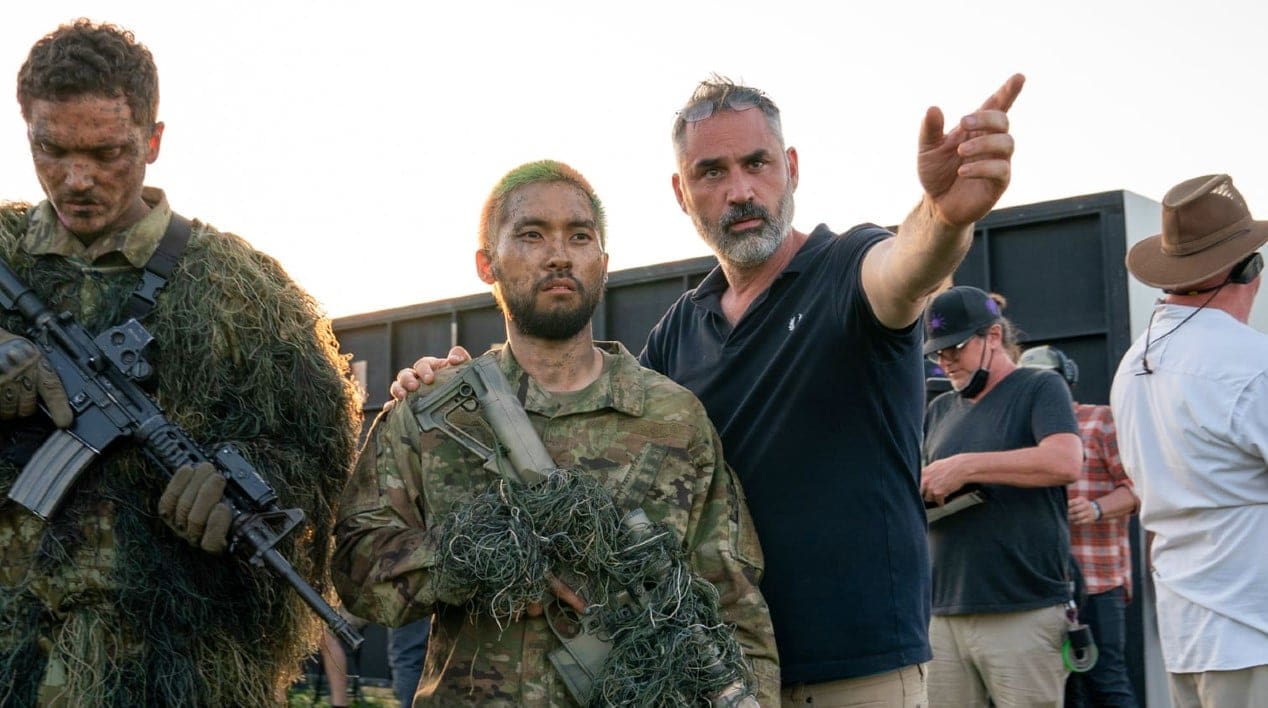
Few things make us question the grammar of cinema and the limits of its capacity to emulate real horrors like the topic of war, a fact that Alex Garland is keenly aware of and tackles head on in his new film Warfare. Co-directed by Iraq War veteran Ray Mendoza, the film is based on the memories of the SEAL team members who lived through a mission that went wrong in November of 2006 in Ramadi, the most populous city in western Iraq.
Garland collaborated with Mendoza on staging the climactic White House assault that concludes Civil War and saw an opportunity to refine and expand upon the techniques utilized for that film to create an honest and immediate war movie that adheres to a Dogme 95-esque code of purity and unfolds in real time. The result is a stunningly immersive technical showcase that also finds meaning within its limitations, raising profound questions on the nature of cinematic truth, the ethics of telling a story drawn from life, and the mechanics of war itself.
I sat down with Garland and Mendoza ahead of Warfare’s release to discuss their collaboration and the importance of trusting the intellect of their audiences.
Warfare starts unexpectedly with the soldiers watching the music video for 2004’s “Call on Me” by Swedish DJ and producer Eric Prydz. Can you speak about how that was the right choice to open such an intense movie?
Ray Mendoza: I think maybe about halfway through principle photography, I showed it to Alex. There’s not a lot of dialogue or narrative between the actors, so we were always [thinking], “How are people going to connect with them?” We knew that may potentially be an issue. I’ve always wanted to put this song into a movie. There’s a lot of other vets that work in film, [and] we’ve all wanted to use the song. It’s almost been like a race. I have some other buddies that work in the industry who are just like, “You beat us to the punch!”
It was kind of a ritual that we would watch [the music video]. You know, back in 2006, there wasn’t streaming, so you’d just find a way to entertain yourself, and we were just young kids, and there were videos that would get passed around and this one came around. And for some of us, it was like, “Yeah. Man, I wish I was that dude [in the video],” and we’d make jokes, and you’re seeing beautiful women in there…we would just have fun with it. It was just [time] to be kids [but] it became a ritual. It was like, “All right. It’s time. Everyone get their gear on. It’s video time. Everyone get around. Let’s watch the video.”
Alex Garland: There was a rule in the film, a kind of Dogme-like rule, that nothing could be invented—nothing could go into the film that wasn’t sourced from someone that was there. Ray would give me extraordinary details and information about some of the guys or the things that happened on other operations, character details, but because they sat outside the time frame [of the film], it’s like it would be gold dust normally in a film but we just couldn’t include it because it was outside of our window. There’s a few [details] in particular that are almost painful in terms of how helpful it would have been to [help audiences] understand some of the [characters], but the rules were the rules, and we got something else by sticking to the rules.
What would you say the intro does for the film specifically?
AG: It’s crucial to understand these young guys watched that video as a semi-superstitious ritual before going out on operations. [But] it does have this very useful function of introducing you to a group of faces and even some coded bits of information, not just to do with their youth, but the different ways some of them respond to that video and respond to each other. So, there’s a lot of movie-like information. The crucial thing was it happened, so it’s not a conceit on the part of the filmmakers—it’s absolutely within the kind of Dogme rules that we set ourselves.
Speaking about the obvious memory aspect of this, once the soldiers have left, you choose to end the film on the Iraqi combatants and the family whose home the Americans commandeered. Were these invented details?
AG: Not invented whatsoever. We weren’t allowed to invent, [but] let me caveat that slightly. You will see things in the film like a soldier scratching the back of their head or pushing dust off an upturned bed frame with their finger. Those aren’t sourced from a real thing. Those are actors inhabiting the moment. And also, in some of the dialogue, someone will say, “I checked this in with Cowboy,” or something like that, but it’s not exactly what was said, [or] the precise words that were used. But, we know the conversation happened.
So, there’s an area of license, I’d say, which is to do with that. But what we could not do, as either me as Ray’s co-writer and co-director or the studio or the production designer or the DOP or whoever, we could not just invent stuff. We could not change sequences of events. We could not do what film often does which is compress time, remove characters that are perceived as not being sufficiently dramatic, or crunch three people into one person. That’s what we couldn’t do. So, we had a super-simple goal: How do we make this as accurate as we can? And we had memory to work off. But the short answer to your question is yes, we had an account of what happened on the street directly afterwards.

This is a story of Ray’s unit, but you choose to conclude with the people of Ramadi who are left behind. What was your intention in leaving the audience there as opposed to following the soldiers themselves?
RM: [Because] that’s what happens. It’s a way to say it [all] didn’t mean anything. It didn’t mean anything as in it’s not this huge, significant event. [It’s not] “Oh, we just changed the outcome of the war.” It’s one of many, many, many days in conflict, and the next day we did it again.
AG: I’d say that one of the pluses you get in trying to be honest and presenting things as much as possible as they were, doing everything you can to be neutral and offer that up, is that audiences get to be treated as adults and not be told what to think. But there are any number of inferences you could make from that [ending]. That would be up to you and your lived experience and your outlook on the world and conversations you might have with friends or family or people who have their own take on this sequence of events or any other sequence of events. That would be the upside of it. It is not Ray and I trying to force our opinions on people. It’s us trying to be honest while being neutral, and there being a value in that.
Let’s dig into that just a little bit, because Civil War sparked some controversy from viewers who felt that you didn’t come down definitely enough on either side…
AG: I get it. I understand the controversy. I think what it’s about is the desire of some people to infantilize audiences. There’s plenty of information in Civil War provided you step up as an audience member or a journalist or whatever the fuck you are—I’m not talking about you directly—and engage your own mind and your own thoughts and your own lived experience. There’s plenty to go off. I don’t like infantilizing audiences.
I’ve worked in film about 25 years. It used to be the studios that infantilized audiences. You used to have to smuggle ideas through studios in order to get it to audiences. And knowing the audiences were adults, knowing they were nuanced, knowing they were sophisticated, you had to get it past the moronic sort of groupthink that had been created about what people would or wouldn’t accept. And now the moronic groupthink seems to have moved from the studios into other spaces. I don’t really care. As long as I’m allowed to do my job, I’ll continue to do my job, and part of that job has always been to treat audiences like they’re grown-ups, not children.
Warfare goes even further in stripping away any sort of moral messaging…
AG: Look, reality is full of messages. What the fuck does anyone want? That’s how things work.
But was this an intentional sort of doubling down on not infantilizing audiences?
AG: No, because I’m not motivated [by a need to respond to criticism] in that way. As a matter of fact, Ray and I started work on this film way before Civil War had been released. The first serious conversation we had about this was during post-production on Civil War while I was cutting together a sequence that Ray had constructed in terms of the details of it where some people are fighting their way down the corridor toward the Oval Office, and I was seeing some things about Ray’s work and wondering if that could be extrapolated to an hour and a half, and not applied to fiction, but to something that had actually happened. Warfare is absolutely not a reaction to those sorts of criticism. I came off [Civil War’s premiere at] South by Southwest and went straight into rehearsals for this film. There wasn’t even a 24-hour gap. It was literally straight out of one thing into another.
You’ve been on the fence about continuing on as a director for a while, but this is your first film with a co-director. Did that make this a better experience for you?
AG: It worked super easily. I’d worked with Ray before. I love working with Ray. It took a lot of stuff off my plate and put it on his and I was grateful for that.
Would you say you challenged each other creatively or what each other’s pre-conceived notions on what the military or war look like?
RM: He knew the story I wanted to tell. He just wanted to help me. He’s good at what he does, right? I learned so much from him in regards to the craft and the filmmaking, so it’s him helping me tell my story. We had no clashing whatsoever. I’ve been on a lot of films, a lot of TV shows. It was actually effortless. Besides the content and it being emotional for me, it was probably the smoothest, most efficient project I’ve ever been in.
AG: Yeah, I’d echo that.
I’m interested in the coda with the photos of the actors and their real-life counterparts and the behind-the-scenes footage, because you work so hard to create this illusion and it feels like its punctured. Can you speak on that a bit?
AG: These aren’t the real young men at the real moment. It’s something that’s being constructed as truthfully as possible. I know lots of films end with a set of photographs and a few lines that are saying, “This person is now working at a gas station in Minnesota,” or whatever it is, but it felt important to be clear that this actor was playing this real person, to be really explicit about that. But also, within that, there were some very interesting things, and it’s to do with, in a way, with how the film was made and seeing some very complex interactions.
For example, [in the behind-the-scenes footage] you see Charles Melton following someone whose face is blurred out because it has to be for various reasons, [and Melton is] watching very closely as [the man] shows how he exited this space, shot down the street, moved into the middle of the street, picked something up and returned. And then, you may remember you have seen Charles exercise that action. How did Charles know how to exercise that action? Because this guy showed him how to exercise that action. And so, it’s a strange conflation of the various states that the movie exists in, which is a real event that happened, a complete reconstruction of that event with some people who had nothing to do with it, and the fact that people who were in the real event were present.
It’s asking people to, as you said, step up as an audience member and actively consider what they’re seeing.
I mean, it’s inviting people to consider that while Cosmo Jarvis is lying on the ground, or while Joe Quinn is lying on the ground acting their injury, and the horrors attached to that injury, the real person who suffered that injury is 10 feet away from them, observing, and to think about what that means. I don’t think there was anything cynical in your question or anything, and sort of trying to wrong foot or anything like that, but I can see because I know how the world works, how quick people are to attribute cynical motivations. It’s a completely uncynical motivation. At the core of this movie, the cast and the crew had a responsibility to real people, one of whom was leading this enterprise, and [the coda’s purpose] is to be clear about that. In the same way [that] we don’t at the beginning of the film say, “This is a true story,” we say “This film is based on memories,” because that is the most honest statement we can make at that moment, and I feel like those photos are the most honest statement we can make at that moment.
Since 2001, we've brought you uncompromising, candid takes on the world of film, music, television, video games, theater, and more. Independently owned and operated publications like Slant have been hit hard in recent years, but we’re committed to keeping our content free and accessible—meaning no paywalls or fees.
If you like what we do, please consider subscribing to our Patreon or making a donation.



A film with a rigidly conservative, right wing message blaring loud and clear: war is hell but it just happens; it has no cause outside itself; Western soldiers are morally unimpeachable and the victims – who barely exist – have no human feelings or rights. A shamelessly pro-war film that denies the humanity of Iraqi people and proclaims military aggression by the West to be morally worthy.