
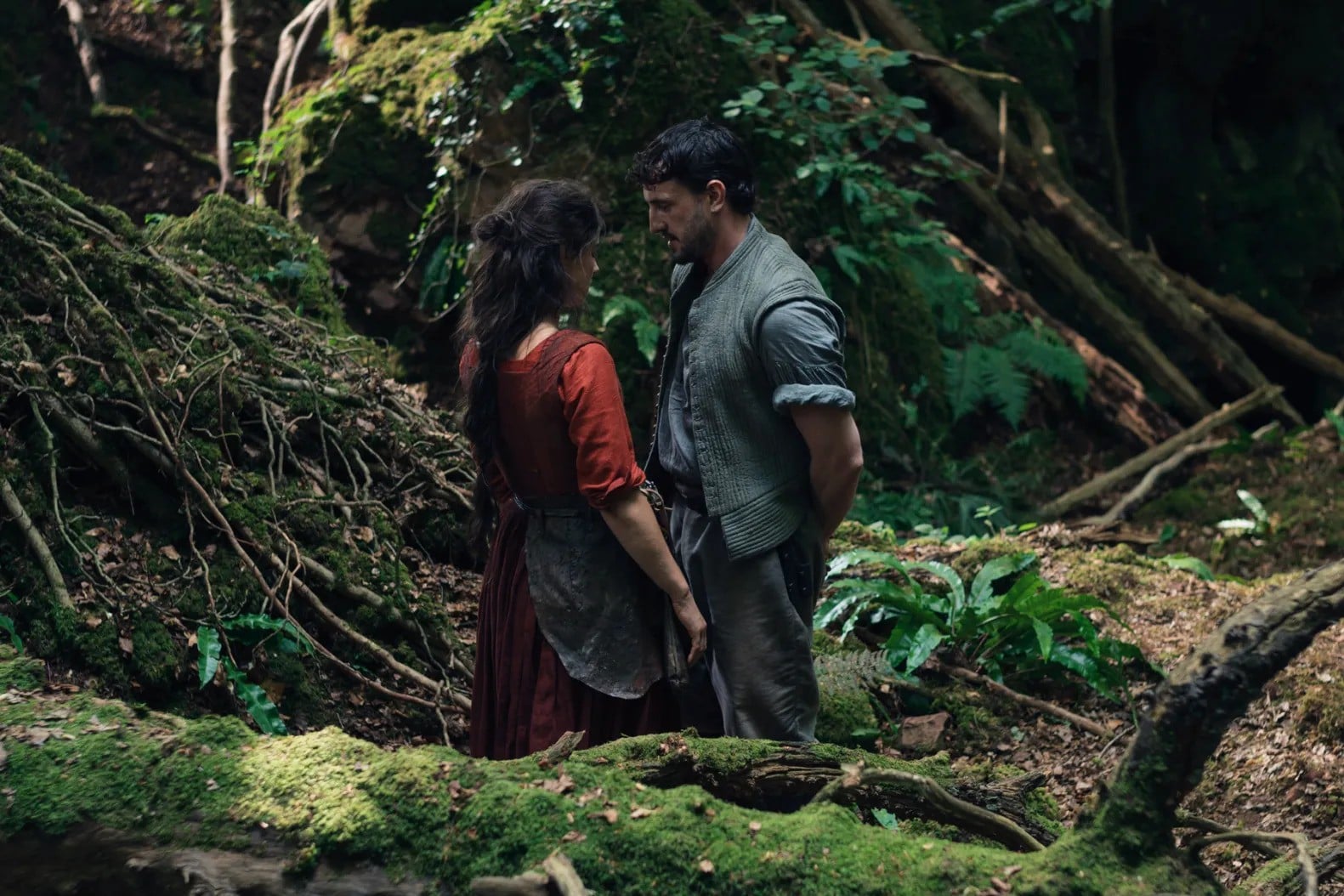
“Don’t shush me!” Agnes (Jessie Buckley) demands of her husband, Will (Paul Mescal), during a particularly heated argument midway through Hamnet, Chloé Zhao’s fifth feature film. One of the many odd verbal anachronisms in this otherwise blandly authentic late-16th-century period piece, the line also sums up the graver failures in Zhao and co-writer Maggie O’Farrell’s adaptation of the latter’s 2020 novel. Though Hamnet is concerned with bottomless grief and the unique power of art to express the inexpressible, it can’t help but telegraph its themes loudly and incessantly, its emotional register off-puttingly monotonous.
A work of speculative historical fiction, Hamnet follows the life of William Shakespeare and his wife from their initial courtship through the aftermath of the death of their son, Hamnet (Jacobi Jupe), which is suggested as a key inspiration for the creation of the Bard’s most celebrated play. (An opening epigraph notes that Hamlet and Hamnet were identical names in the period’s Old English vernacular.) Mescal’s character isn’t explicitly identified with Shakespeare until late on, but the film does weave in a few references to his work, most notably when Hamnet, his twin sister, Judith (Olivia Lynes), and elder sister, Susanna (Bodhi Rae Breathnach), dress up as the three witches from Macbeth and re-enact the play’s famous introduction.
This scene of the children and their father entertaining their mother is a rare playful moment in a mostly dour film, but even their domestic bliss feels as though it’s been set up merely to provide contrast to the traumas that will follow. With cinematographer Łukasz Żal alternating between not-quite-static, manicured wide shots and shallow-focus close-ups, Hamnet seeks not to observe the nuances of these characters and their relationships patiently, but to wring as much feeling as possible from every interaction or quiet reflection. It’s an approach that becomes overwhelming well before the family is devastated by tragedy, and contrasts markedly with the more quiet melancholy running through The Rider and Nomadland.
Hamnet, though, isn’t without the occasional moment of pathos when something convincingly human breaks through its staginess, like Will’s explosive final confrontation with his abusive father (David Wilmot) or Agnes’s emotionally tumultuous second labor, after which Judith, initially thought to be born stillborn, unexpectedly takes her first breaths. The performances from the two leads are never entirely predictable, with Mescal demonstrating a kind of elusive strangeness that suggests the superior film Hamnet might have been with more tonal variation. It’s just a shame that their characterizations are so thin, particularly that of proto-hippie Agnes, a falconer and herbal healer whose outsider status is never quite believable.
Aside from Agnes’s occasional forays into the lush forest with which she appears to feel a kind of primal kinship, Hamnet primarily takes place in the narrow streets and drab, humble cottages of Elizabethan England, offering less in the way of metaphorical potency than the vast emptiness of rural America and badlands topography depicted in The Rider and Nomadland. Those films also benefitted from looser staging and the frequent use of non-professional actors, whose performances drew attention to themselves less insistently.
It makes sense, then, that Hamnet’s best images are those that convey its ideas indirectly. Before and after his untimely demise, Hamnet is occasionally shown occupying a kind of white-lit liminal space that resembles both the afterlife and the wings of a theater, alluding to the twin themes of death and creativity. Elsewhere, a brief scene of Will observing a back-alley puppet show suggests the blurring of boundaries between the real and the imaginary in a more interesting way than the debut performance of Hamlet that serves as Hamnet’s finale.
Indeed, Hamnet’s combination of a borderline magical realism and arcane Shakespearean language with rawer depictions of familial strife occasionally lends the film an uncanny aspect that, if brought out a little more, could have been a fascinating exploration of the parents’ unreckonable loss and the consequent impact on their psyche of such an unprecedented experience. But Zhao and O’Farrell’s mostly literal-minded storytelling thwarts any deeper resonance. The film progresses steadily toward a final resolution that, while serving as a form of catharsis, seems also to demean the trauma by suggesting that it can be healed by the staging of a play, as well as diminishing the complex, visionary work of a legendary writer by implying that its origins can be mapped so neatly on to life experiences.
Since 2001, we've brought you uncompromising, candid takes on the world of film, music, television, video games, theater, and more. Independently owned and operated publications like Slant have been hit hard in recent years, but we’re committed to keeping our content free and accessible—meaning no paywalls or fees.
If you like what we do, please consider subscribing to our Patreon or making a donation.


I honestly thought this was some sort of cartoon about pigs. Thanks for clarifying.
A film can’t be everything. Thank you for the review. I agree Agnes’s “witchiness” felt too clean, but your review seems like you’re expecting the film to be a character driven mini-series and not the simple and beautiful glimpse of art/life that it was. I did not feel the film was saying Agnes was “healed” by the play, nor that his plays fit neatly into his life- that’s too reductive and not at all what I experienced seeing the film. Also, it was Judith, not Hamnet who was thought to be still-born during the second birth