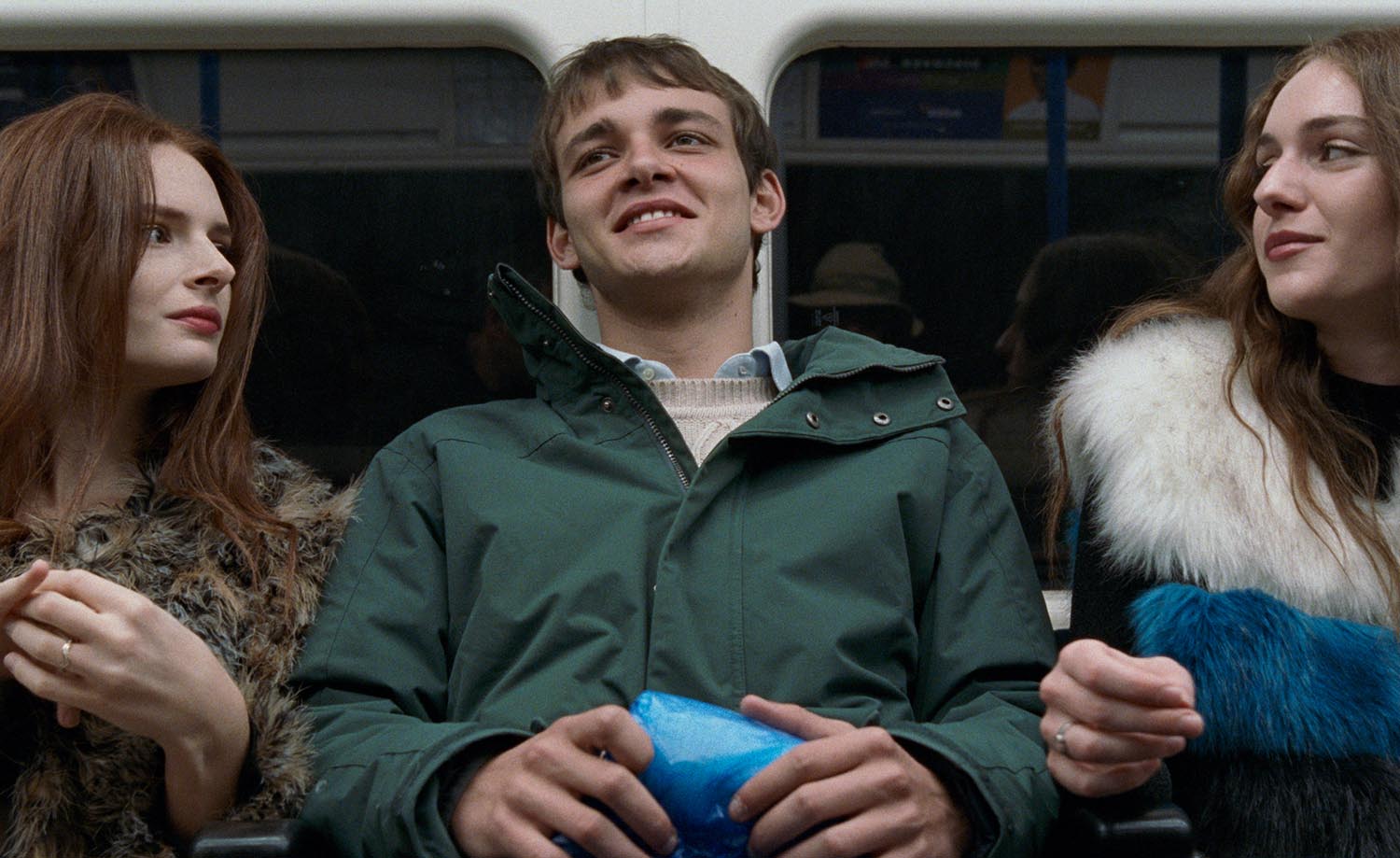
Despite itself, Giovanni Tortorici’s debut feature, Diciannove (Italian for 19), is a coming-of-age film. Only a coda, which jumps ahead to a year after the main timeline, reveals a significant evolution in Leonardo’s (Manfredi Marini) life following his first year of college: His form of rambunctious rebellion is to needle academia as a conservative reactionary. Tortorici, though, doesn’t concern himself with the grand metamorphosis that the hero of a bildungsroman often underdoes. This is the story of a character who, left to his own indolent devices, hardens in his thinking rather than accelerates in his development.
The 19-year-old Leonardo straddles a generational fault line in 2015. He rues the twilight of millennial youthfulness and the Zoomers supplanting them as the dominant cultural force, yet he also cannot help but embody some of his successors’ defining traits. The character further retreats into outmoded moralism as he advances in his studies, which reflects a wider societal shift in perceptions around young people’s supposedly inherent progressivism.
Leonardo heralds the coming of a phrase that would define the new counterculture long before it became a meme: reject modernity, embrace tradition. This small-town Italian student abruptly reverses course on his previous plans for university after some hedonistic clubbing adventures in London, where he intended to pursue a career in finance. But based on little more than an unformed gut feeling and a quick Google search, Leonardo instead turns back toward home to study 19th-century Italian literature at a hallowed learning institution in Siena.
Leonardo demonstrates clear academic aptitude when it comes to analyzing the classics, but he lacks a similar skill in understanding himself. Tortorici doesn’t attempt to rationalize the kid’s behavior, or that of anyone his age. Instead, the filmmaker identifies the common undercurrents that compel Leonardo out of his lethargy, visually equating seemingly disparate actions like the character’s caress of his nipples with his hands poring over musty pages in an old book.
In line with Leonardo’s ever-shifting whims, a spirit of restless reinvention characterizes Tortorici’s aesthetic approach. He wields snap zooms, freeze frames, split screens, match cuts, and even animated interludes to convey a tumultuous and overstimulated young mind. But unlike Leonardo, the method behind the madness is evident in Tortorici’s application of ideas.
It’s easy to see what would attract Luca Guadagnino, a credited producer on Diciannove, to his protégé in Tortorici. Especially when it comes to harnessing his burgeoning queer sexuality, Leondardo recalls Timothée Chalamet’s Elio in Call Me by Your Name. Both precocious young men struggle to reconcile the confidence of their minds with the cautiousness of their libidos.
But unlike Elio, who has the older Oliver onto whom he can project his desire, Leonardo lacks such an object for his yearning, apart from a cocksure grade school boy whose swagger captures his attention in a town square. His sensual energy emerges at unexpected and inconvenient times—including arousal while watching Salò on his laptop, as well as in response to a subway masturbator. These surprising impulses emerging from within Leonardo are the kinds of moments that would typically push characters on film to interrogate themselves. Yet in Diciannove, these urges only push the ever-sulking Leonardo further into a spiral of seclusion.
The growing vortex of Leonardo’s isolation doesn’t ultimately consume the film, due largely to Marini’s guileless performance. Drawn from street casting, Marini demonstrates comfort sitting in the dead air of indecision without adding actorly embellishment to the slothfulness. He brings an impishness to the brash Leonardo without losing touch with a sense of innocence, which is necessary to dispel the sinking sensation that the character might devolve into a violent incel.
Diciannove’s coda calcifies Leonardo’s inklings of his identity into an open declaration against his school. The sudden focus on external expression from a film so otherwise devoted to stewing in the character’s internal emotions is jarring. It’s a tacked-on ending, but Diciannove still thoroughly disavows any romantic notions of adolescence by burrowing into the nothingness that is being 19. If this transitory period can be considered a life stage at all, it’s defined by the complete lack of definition that’s on paradoxically lucid display in the film.
Since 2001, we've brought you uncompromising, candid takes on the world of film, music, television, video games, theater, and more. Independently owned and operated publications like Slant have been hit hard in recent years, but we’re committed to keeping our content free and accessible—meaning no paywalls or fees.
If you like what we do, please consider subscribing to our Patreon or making a donation.