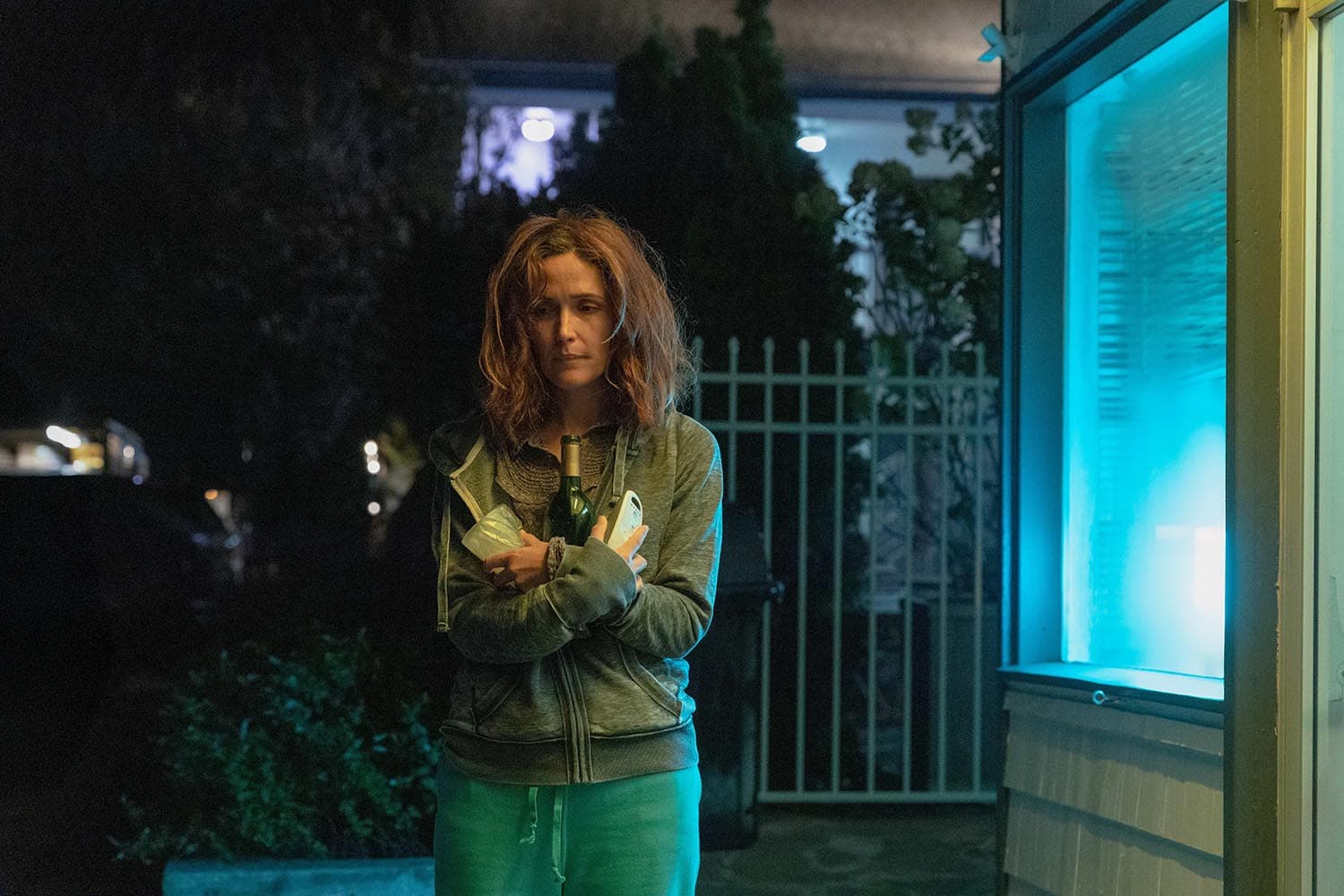
Back at the 2025 Sundance Film Festival, I was lucky enough to be in the first audience to experience writer-director Mary Bronstein’s If I Had Legs I’d Kick You. The film, which sees Bronstein drawing from her own experiences as the caretaker of a sick daughter, follows Rose Byrne’s Linda, an overstretched mother enduring a crash out of epic proportions. I could feel the energy in the room tilting forward as the two collaborators elicited a physiological response through the film’s immersion into Linda’s fraying psychology.
If I Had Legs I’d Kick You has gone on to enjoy one of the most remarkable festival runs in recent memory. Since that buzzy premiere in Park City, the film has made stops at Berlin (where Byrne won the best actress prize), Karlovy Vary, Telluride, Toronto, Fantastic Fest, Beyond Fest, New York, and London. As Byrne observed from her whirlwind tour, the film plays just as naturally for a high-minded European arthouse audience as it does for a rowdy midnight crowd.
Byrne’s dynamic performance is central to the film’s ability to achieve such crossover potential. As I wrote in my review, the actress can leverage her chops as a gifted comedienne from Apatow-era comedy, a compelling dramatic actress during the latter-day golden age of television, and a genre specialist fluent in the affectations required by Blumhouse horror. If I Had Legs I’d Kick You provides the Australian actress with the role of a lifetime in Linda, one that both highlights the extensive range of her talents and pushes her skills to new heights.
I spoke with Byrne ahead of the New York Film Festival premiere If I Had Legs I’d Kick You. Our conversation covered where she sees similarities between performing comedy and horror, what types of homework she did to understand her character, and why she finds it useful to toggle between different approaches to the craft of acting.
I’d love to start by talking about a role of yours that I don’t think I’ve seen anyone talk about in relation to If I Had Legs I’d Kick You, which is you playing Medea on stage at BAM just before the pandemic. Was playing an early archetype of a mom who doesn’t fit societal expectations—to put it lightly—helpful here?
I think it’s all in [Linda], all those roles like Medea, even subconsciously, whether you’re referencing it or not. With something like Platonic or Physical, I’ve had great shots at doing complicated roles, particularly women who have complicated relationships with being a parent. That, obviously, is very tonally different. But that play is absolutely in that sort of world.
Linda feels like the role you’ve been building toward because it pulls from so many different genres in which you excel, from comedy to drama and even horror…
Oh yeah, there are so many tropes from horror language!
From your perspective as an actress, do these feel like distinct styles of performance? Or is it all just acting?
It’s a bit of both, but I’m not consciously going, “Now I’m in the horror part.” It all comes from the same place. I think horror and comedy have a similar technical aspect of timing—that weird needle to thread. But from a character perspective, it’s always from the ground up—reverse engineering how we got to where we are, and all those fun, dorky things you do for homework.
What were your initial impressions of Linda on the page or in early conversations with Mary? Did those change as you prepared for and then performed the role?
Mary just lit the page on fire when she wrote this. It was just hot. You’re dropped into this situation that’s so intense, the stakes are so high, and the crisis is already unfolding. And my obsession was: Who was she before? Who is this person? How did she get to today? And we just went through our process of figuring out who she was, giving little hints with her appearance, physicality, and all those sorts of things, like the way she spoke.
But everyone’s going to respond differently to a crisis. You line up 10 people in a room, and a fire alarm goes off, everyone’s going to respond differently. For me, that’s the beginning of unlocking [the character]. I read the script, and I was like, “Who is this person? Oh my god, what an opportunity to figure that out. I’m terrified, but I think I have to do it.”
There’s such a dramatic shift in Linda’s demeanor whenever she’s at work and serving as a therapist to her clients. How do you handle shapeshifting like that without losing the internal logic of the character?
That was key, because otherwise it would just descend into a screaming person. That was always the question: How do we bring nuance? How do we make sure this perspective is so clear for her of what is happening and how she’s responding? My job was that space. But [the character was] also so funny, and Mary and I immediately had the same sense of humor and sensibility. We were very much in lockstep with the character. You don’t have to like her, but we had to love her.

Since you split time fairly evenly between movies and television, does the task of building a character within only two hours differ from having a more expansive canvas across multiple episodes or seasons?
Television is interesting because you develop this relationship with the audience, and then you have to start subverting it and challenging it after many episodes, seeing how far you can push it with the great characters on TV that we’ve seen over the years. Obviously, film is so different. You have to establish it very quickly. You have to get the language down much faster, and it just depends on the script and the subject that you’re working with.
Has the nature of audience feedback and television changed over time? I’m thinking back to Damages, which is the first show my family ever binged…
I love that! I have that relationship with some shows, too, where you just fall in love with these characters. Damages is fascinating, because we came out the same year as Mad Men. Shortly after that was Breaking Bad. HBO had set the bar with The Sopranos and Six Feet Under. It was the beginning of this “golden age of TV” and prestige television. And I look back now and think, “Wow, what a time to be launching that show!”
I always tell people that once they finish watching the obvious classics of the era, they have to watch Damages.
People derive a lot from that show! A lot of shows after were Damages-lite, and it never got the credit. I was like, “That’s exactly like our pilot!” A lot of people took a bit of license with it.
The film plays out so heavily in close-up that Mary has called the aesthetic as being “behind your eyeballs.” When you’re having to convey so much in tight framing, is that something where you rely on technique and preparation, or do you have to trust yourself to be authentic and natural?
It’s corny, but it’s a bit of both. And, also, it’s just my job! The camera was very close. On the first day, I was like, “I thought it wasn’t gonna be that close, okay.” I’d never done a job where it was that close, I will say that, but it’s my job. I started out doing a soap opera. It’s the best training you can get technically because you are learning 100 pages a week and shooting so much. You immediately have to be relaxed in front of the camera. That’s only something that comes with hours, like anything. The Beatles played in Germany for all of those years before they actually blew up. I will say, doing a soap in Australia in the ’90s was incredible for that.
Does it get easier once you’ve hit the proverbial 10,000 hours?
[laughs] It’s just so subconscious! I think it’s just the hours that you clocked. It’s time that you put in the bank.
A lot of this character is drawn from Mary Bronstein’s own experiences of caretaking and cohabitation with her sick daughter, and she showed you her diaries from the time. What’s the role of that kind of research compared to something like playing a real-life figure in Gloria Steinem in Mrs. America?
It was a very simple sort of thing she showed me. It was just like a schedule for the day of her daughter’s requirements at the time, and it just brought home how heartbreaking that is. I felt a visceral response to this experience. Of course, I had already, but it’s just seeing actual old papers or a journal. There’s a vulnerability to it. We researched, and we spoke to a lot of parents and mothers who have children with special needs. That was fascinating because there was such a spectrum and variety of what that looked like and how it played out in their lives and marriages. We spoke to a therapist. We did a lot of fun research, really digging in.
You’re acting opposite some people on screen, like Conan O’Brien and A$AP Rocky, who are doing things we’re not used to seeing them do. I was listening to an old episode of Marc Maron where he described your trademark at the time as “playing straight person to goofballs,” which isn’t to downplay your incredible comedic talents. But was that experience of staying rooted in a character and letting a lot of those surprising energies bounce off you useful here?
It is. Mary really wanted to give Linda some unexpected scene partners. It’s such a small cast too; it’s like a four-hander. It’s very intimate, and she had punk-rock ideas. But she worked very hard with Conan and Rocky, who aren’t seasoned actors by any means. They worked so hard to really create these characters that are very different from them and very specific to this story. For me, they were just wonderful scene partners, so fun, respectful, and curious.
Mary has been reluctant to explain the film’s surreal interludes in the void. Was that something the two of you talked about? Do you have any interpretation since it does seem to be up to each viewer?
We did, and I relate to her hesitancy because there’s a language around it that’s supposed to be ambiguous. I love living in that. I did a horror film called Insidious, and there was a sequence in that set in a place called “The Further.” I didn’t quite know [what it was], but I just loved it. I understood it. It’s part of everybody’s consciousness of being a person, which sounds lofty to say. I love that Lynchian language. I gravitate to that as a viewer.
Bringing that ambiguity back to your tackling the character at the beginning of the process, do you feel like a character on a page as someone to solve? Or can you be in front of the camera while still holding some ambiguity about them?
Again, this is corny, but it’s a little bit of both. Obviously, I do my homework, but of course it has to live in my ambiguity. People are so unknowable for so many reasons, and particularly a character like Linda feels like she lives in that space.
What have you learned about the character or the film from taking it to all these different festivals and seeing how people respond to it?
It’s my favorite part, right now. People get it. People who are parents, people who aren’t parents. Women, men, young people, old people. It’s truly reaching people’s experiences as a person, and it’s so exciting to hear people’s takes. I’m still learning about the movie, and I don’t want to give too much away. One of my best friends saw it, and she’s a parent of two kids, and she just said, “I feel seen. I feel so invisible all the time.” Other friends of mine who are not mothers have related to it and gone, “Oh my god, that’s exactly what I was like on the worst day of my life.”
Since 2001, we've brought you uncompromising, candid takes on the world of film, music, television, video games, theater, and more. Independently owned and operated publications like Slant have been hit hard in recent years, but we’re committed to keeping our content free and accessible—meaning no paywalls or fees.
If you like what we do, please consider subscribing to our Patreon or making a donation.