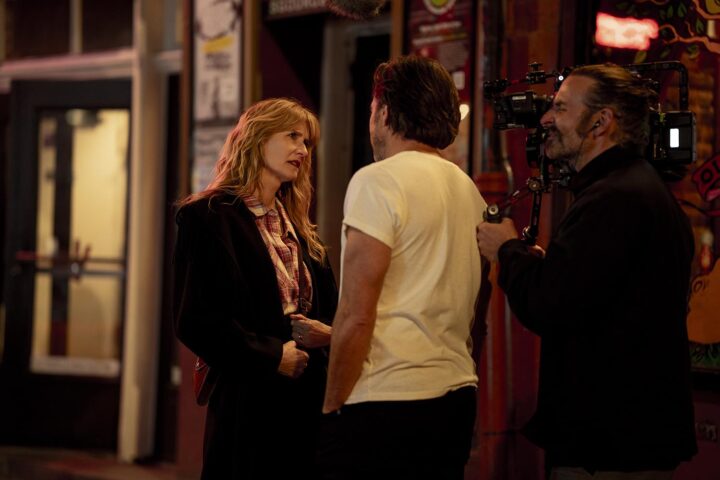
When Alex (Will Arnett), the disgruntled protagonist of Bradley Cooper’s comic drama Is This Thing On?, first stalks onto the stage of New York’s Comedy Cellar, he doesn’t have a single joke to tell. All he has is the story of his recent separation from his wife, Tess (Laura Dern). The silence echoes at first, his breathing loud and suggesting an incipient panic attack. But Alex eventually gets a few laughs with some self-deprecating comments helped along by his comedically hangdog persona. Getting a solid round of applause on leaving the stage, Alex looks like a soon-to-be gambling addict who’s just won his first jackpot.
Inspired in part by the life of British comic John Bishop, and written by Cooper, Arnett and, Mark Chappell, Is This Thing On? begins like the kind of story that’s going to take viewers into the intricate world of standup comedy. As the naif, Alex is taken under the wing of some other standups, who give tips on navigating open-mic nights and provide him access to a validating community that he’s clearly been craving. There’s an at once propulsive chaos and intimate vulnerability to the Comedy Cellar scenes, with Matthew Libatique keeping his camera uncomfortably tight on Alex’s face as he performs rather than cutting away to the audience.
In employing the same shooting technique for the later arguments between Alex and Tess, Cooper draws a straight line between Alex finding his comedic voice and how he uses his newfound love of performing to communicate the largely unspoken tensions around a pending but not yet final divorce. Alex is at first a solemn and distant grump, but once he comes into his own on stage, he starts flowering as a father to his two boys and opens up to Tess.
At the same time, Alex tries to maintain bonds with the couples in the friend group he shares with Tess—the quieter one played by Sean Hayes and real-life husband Scott Icenogle, the more boisterous and pot-stirring one played by Cooper and Andra Day. In a series of hangout scenes, Cooper shows his facility for dialogue that brings out the unique flavors of characters as they feel each other out and, in a sense, put on a kind of show. It doesn’t seem random that he plays a comic-relief character, named Balls, who’s a dreamy striving actor with more optimism than life skills. Cooper is clearly most engaged by the art and psychology of performance.
If A Star Is Born and Maestro were self-consciously heavy stories about the damage wrought by adulation—how fame, like myopia, can become a barrier to creativity—Is This Thing On? finds Cooper working in a more upbeat vein. With this no less personal film, yet one with considerably lower stakes, where art is understood to matter to its main character but isn’t framed as everything to him, Cooper gives himself room to indulge in free-wheeling fun.
Alex loves his new outlet and how it makes everything else in his life snap into focus, though he doesn’t let it define him. With a city apartment and house in the suburbs paid for by an apparently very well-paid job that we never see him doing and about which he spends only four words describing (“I work in finance”), Alex only needs comedy as an emotional outlet, not a career choice. Though Is This Thing On? has echoes of The Marvelous Mrs. Maisel, another story where a separated parent finds purpose through spilling their guts on stage, once Alex’s comedy has served its function by providing him with therapy through public confession, the film largely shifts to being a story about Alex putting his family back together.
In some ways, this is for the best, since even with the giddy thrill that Cooper brings to filming the comedy club scenes, Alex’s material is modestly chuckle-worthy at best. Cooper’s true focus is on the off-stage relationships, the chaos of family life and friend drama. Arnett and Dern have a genuine charge in their scenes together that vividly renders their characters rediscovering both a sense of purpose and what drew them together in the first place.
Is This Thing On? makes a few missteps. Either too much or too little is made of Tess’s backstory as a onetime Olympian who gave up her career to raise children. And a cameo appearance by Peyton Manning (oddly enough not playing himself, but a character who just so happens to be involved in sports) is distractingly inserted into a key dramatic moment. But overall, this is a finely observed and good-natured piece of work that carries some of the creative angst of Cooper’s other films but without the need to convince us of its main character’s genius.
Since 2001, we've brought you uncompromising, candid takes on the world of film, music, television, video games, theater, and more. Independently owned and operated publications like Slant have been hit hard in recent years, but we’re committed to keeping our content free and accessible—meaning no paywalls or fees.
If you like what we do, please consider subscribing to our Patreon or making a donation.