Noah Baumbach made his feature debut in 1995 with the acidic postmodern dramedy Kicking and Screaming. Thirty years later, the filmmaker’s shrine to the enduring power of movie stars, Jay Kelly, marks the culmination of an artistic evolution. As Baumbach’s later filmography revisits familiar themes with a greater sense of empathy and understanding, this represents the moment when the filmmaker has gone fully soft.
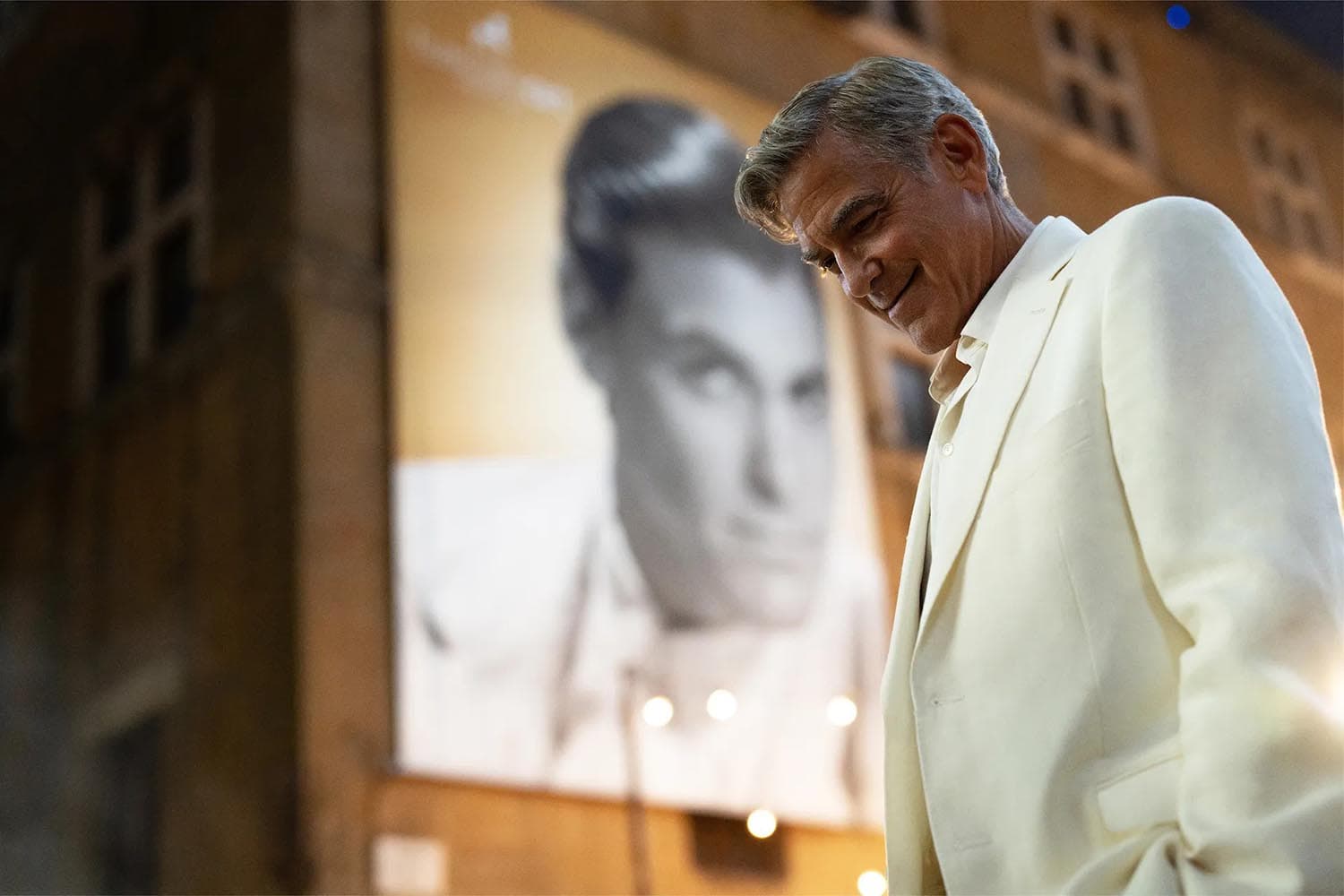
Baumbach manages to pay homage to old-fashioned big-screen icons like the eponymous Jay Kelly, a thinly veiled fictionalization of star George Clooney, without running over into adulation. But the film, which Baumbach co-wrote with Emily Mortimer, also dips too far into schmaltz. Still, as Baumbach sells the sappiness in Jay Kelly with the same sincerity of his convictions as in his more acerbic works, the film holds together as a lightweight delight.
Baumbach’s film follows Jay’s reluctant journey toward accepting a career achievement prize at a film festival. Jay fears that accepting such laurels will only further cement the public’s impression of him as an actor whose power overshadows his acting abilities. When Baumbach first introduces us to Jay, the actor is working to dispel the notion that he can coast on that power by asking his director for another take. In fact, as flashbacks to his earliest acting days reveal, Jay has always been steadfast in his desire to push himself to interpret a scene.
Yet as the chaos of the production swirls around him, that hyper-fixation on his work could also be seen as a means of tuning out the on-set chatter. Jay Kelly is as much about Jay as it is about the coterie of attachés who are needed to keep his world in orbit. If there’s any trace of Baumbach’s more caustic impulses in the film, it surfaces when he’s skewering the foibles of this absurd cottage industry that exists to polish the sheen of one man’s star.
The team’s best laid plans fly out the window after an encounter between Jay and an old acting school buddy, Timothy (Billy Crudup), who intimates that Jay took the career that was meant for him. Combined with a brush-off from his teenage daughter, Daisy (Grace Edwards), ahead of her departure for college, this moment causes Jay to spiral. Soon, he reverses his rejection of the film festival tribute and embarks on an impromptu European trip that just so happens to map neatly onto the itinerary of Daisy and her friends’ post-grad celebration.

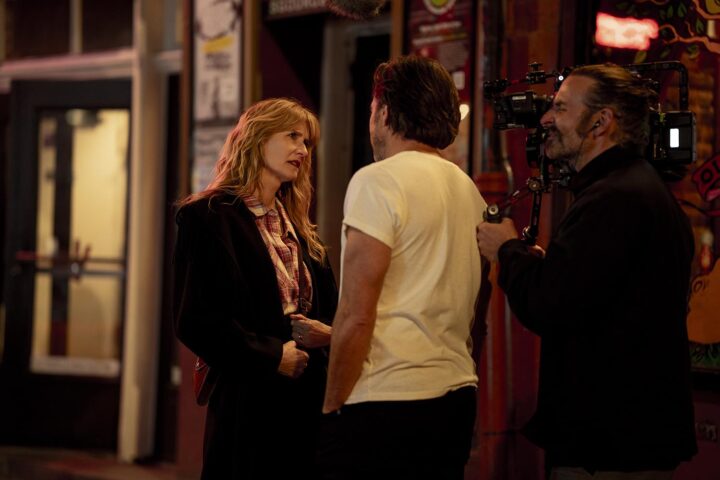
Everyone from Jay’s long-suffering manager, Ron (Adam Sandler), to his burnt-out publicist, Liz (Laura Dern), and, of course, his bodyguard, Silvano (Giovanni Zeqireya), tags along. Soon, unplanned changes in the itinerary are driving them all to a breaking point where they must weigh if it’s still worth burying their heads in a phone at the expense of their real life. Ironically, a trip designed to edify Jay just exposes how frayed his network of support has become.
Jay Kelly keeps a witty but wistful clip as the delegation narrows to just Jay and Ron, with the straightforward voyage broken up with flashbacks to moments of triumph and failure for the actor. Jay doesn’t merely reminisce on his career as if watching scenes from a movie made about his life, he enters them like a spectator and mutters commentary to himself. These bits exploring the porousness between memory and reality recall Ingmar Bergman’s Wild Strawberries, though their poignancy doesn’t make up for their clunky deployment.
The presence and performance of Clooney lend significant gravitas to scenes that otherwise coast on pleasantry. But the overarching mood of the film is still too agreeable to gin up any conflict that might move the narrative off an obvious course. And if there’s any doubt about the emotional direction in which Jay Kelly might be headed, the soft piano keys of Nicholas Britell’s overbearing score re-enter to assure us that we should be feeling warm and fuzzy inside.
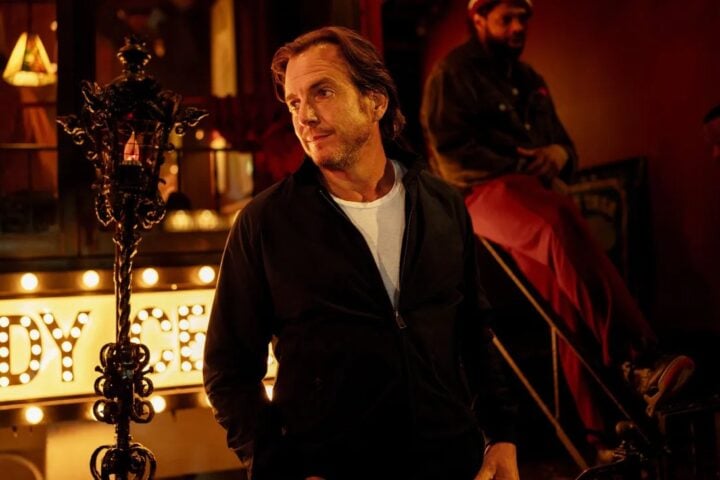
The film finds some novelty, as well as some justification, for its romanticization of movie stars in its other megawatt presence: Adam Sandler. The comedy legend has shown sporadic interest in playing with a more dramatic or sentimental range of his register, although he’s never given himself over so fully to his sweeter side as he does in Jay Kelly. Ron is one of the few people who can claim to truly know the man inside the star machine, and Sandler’s ability to effortlessly embody that familiarity serves as a guide to help the audience gauge Jay’s behavior.
Sandler shows the weathering effects of a manager working overtime to build Jay’s career through his enthusiastic but exhausted demeanor. His performance might appear far removed from his default comic shtick, but it’s consistent with his reputation off screen as a family man and mensch. Jay Kelly accomplishes for Sandler what it wants to do for Clooney: recognize a man for his larger-than-life persona while also applauding his talent as an actor.
Since 2001, we've brought you uncompromising, candid takes on the world of film, music, television, video games, theater, and more. Independently owned and operated publications like Slant have been hit hard in recent years, but we’re committed to keeping our content free and accessible—meaning no paywalls or fees.
If you like what we do, please consider subscribing to our Patreon or making a donation.