
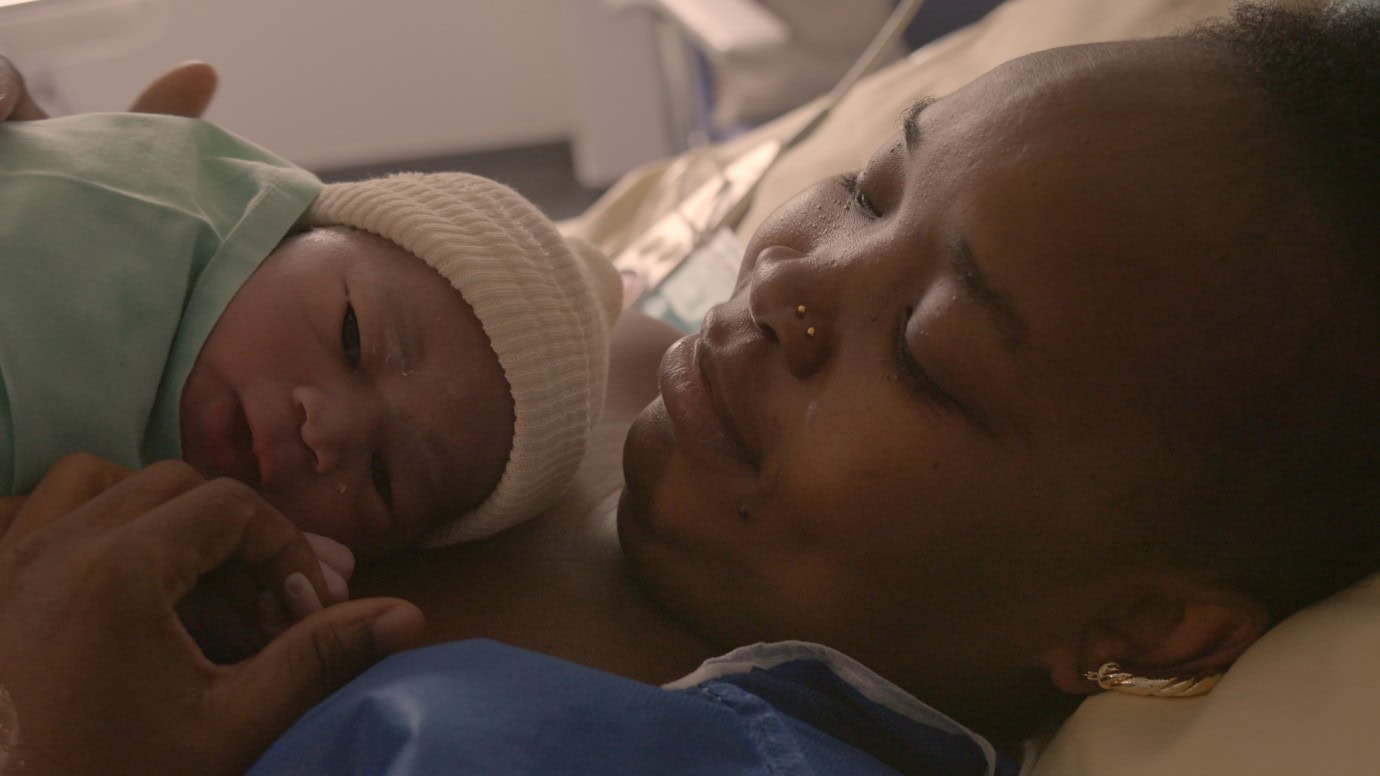
Few films are likely to elicit such a strong physiological response in the viewer as the wonderful, and overwhelming, new documentary by Claire Simon, Our Body. A bodily reaction would only make sense for a film that centers itself around the potential and limitations of the human organism—alongside the technological advances aimed at extending its possibilities. Simon’s film may be seen as a field-redefining intervention—that field being cinema—as its meticulous probing of the power, and ultimate powerlessness, of the human body unfurls alongside a similar exploration of what cinema is still capable of.
Simon’s plunge into a gynaecology clinic in Paris where patients go in order to bring life into the world, or to prolong their own lives in the face of an alarming diagnosis, is a tour de force that renders the qualification of cinema as a two-dimensional experience all but nonsensical. It’s difficult to sit through this intimately epic film’s 168 minutes and not feel like one has had one’s every organ and limb overturned by its tentacles. And this sense of having been capsized by the film is also shared by the filmmaker herself, whose presence brackets Our Body.
We first sense Simon’s palpable anxiety in the opening sequences, where the French director confesses to dread that a documentary set inside a hospital may cause her own body to fall ill. The audience may laugh at the notion that cancer could be infectious, as it did during one of the film’s Berlinale screenings. But Simon’s confession, unusual considering her fondness of self-effacement in such works as The Competition and I Want to Talk About Duras, is foretelling.
For it is, indeed, through the making of the documentary that Simon herself discovers cancerous growths in one of her breasts. An uncanny, and ever so somatic, mirroring surfaces at the tail end of the film, once Simon has already established Our Body to be about so much more than the filmmaker herself, despite her eventful forays into the essayistic in a film that’s otherwise much closer to Frederick Wiseman’s self-effacing methods. But while Simon’s fly-on-the-wall approach bears a kinship to Wiseman’s, especially as she observes patients’ discussions with their doctors and conversations between hospital staff, its sensibility does not.
There’s something much more ebullient, and non-cerebral, about Our Body than we might see in even Wiseman’s most successful works. Simon’s film submerges the viewer in what is at once a life-affirming elixir that reminds us that to be alive is a sublime luxury and an unbearable truth-unveiling serum that tells us that everything tends toward death, from spermatozoa to the woman in her 80s being told that there’s nothing else to do but go into palliative care.
Simon’s film is, in this sense, akin to iconic film works that have tapped into the celebration of life in overpowering ways, such as Stan Brakhage’s Window Water Baby Moving and Artavazd Peleshyan’s Life, even as it goes far beyond their triumphant ethos. Hers is a realistic celebration fused with pre-emptive mourning. Our Body never shies away from the contradictions and complexities of what it means to be alive—that is, to also be in a process of dying, haunted by and even defined by the ultimate disposability, if not insignificance, of our human body.
“We have never seen these images,” said Simon’s daughter, feminist philosopher Manon Garcia, sitting alongside her mother in the Q&A session following the Berlinale screening that this critic attended. Garcia’s point gets to the heart of what’s unprecedented about Our Body. Namely, the way it so nakedly stages the encounter between the viewer and the human body writ large. No varnish, no poetry. This revelation arises like a kinship operation exposing Simon’s body, her subjects’, and the viewers’ as all but the same fledgling force in the face of disease and death. We know so little about our bodies—and so little about our care—mostly because we cannot bear to look at the human body without fantasy, or disavowal of its actuality, mediating the gaze.
Looking at the body for what it is, an assemblage of systems whose survival is always hanging by a thread, is nothing short of a horrific proposition. Simon doesn’t try to find a silver lining, or to sugarcoat the blow of such truths that we’re all one diagnosis away from the certainty of suffering and finitude. Yet Our Body offers, in its unwavering commitment to staring at the fragility of life in the eye, a solace devoid of romanticism or spiritual self-delusion. This solace emerges from Simon’s ill and aging body. As the film ends, her new life begins. She’s at the end of her own treatment at the clinic and her hair begins to grow back.
Simon’s brief appearance, walking out of the site of her film and that of her care, as a subject of both, suggests different kinds of miracles—that of technology that allows for cathartic renewals and an underlying resilience to the otherwise delicate body of humans, but also a cinematic one. Simon’s willingness to put her body on the line, predicated on an act of filmic happenstance and the embracing of a sort of loss of authorial control, make room for the account of so many patients, women and trans men alike, whose testimonials seem to be as life-boosting as the robotic arms, the digitized IVF labs, and the operation rooms where caretakers play Erik Satie. For instance, a mother who testifies to the frightful experience of giving birth, when she kept asking the doctor to see her baby all while having the baby in her very arms. Or a young Senegalese woman, pregnant with her 66-year-old husband’s child, who’s asked whether she’s circumcised, looks at the doctor in the eyes and says, yes, as if for the first time.
Since 2001, we've brought you uncompromising, candid takes on the world of film, music, television, video games, theater, and more. Independently owned and operated publications like Slant have been hit hard in recent years, but we’re committed to keeping our content free and accessible—meaning no paywalls or fees.
If you like what we do, please consider subscribing to our Patreon or making a donation.




Obstetrics involves care during pregnancy, childbirth, and the postpartum period. Gynecology deals with reproductive health and the functions and diseases specific to women and girls.
Apart from the genital mutilation this misnamed movie has more to do with obstetrics.