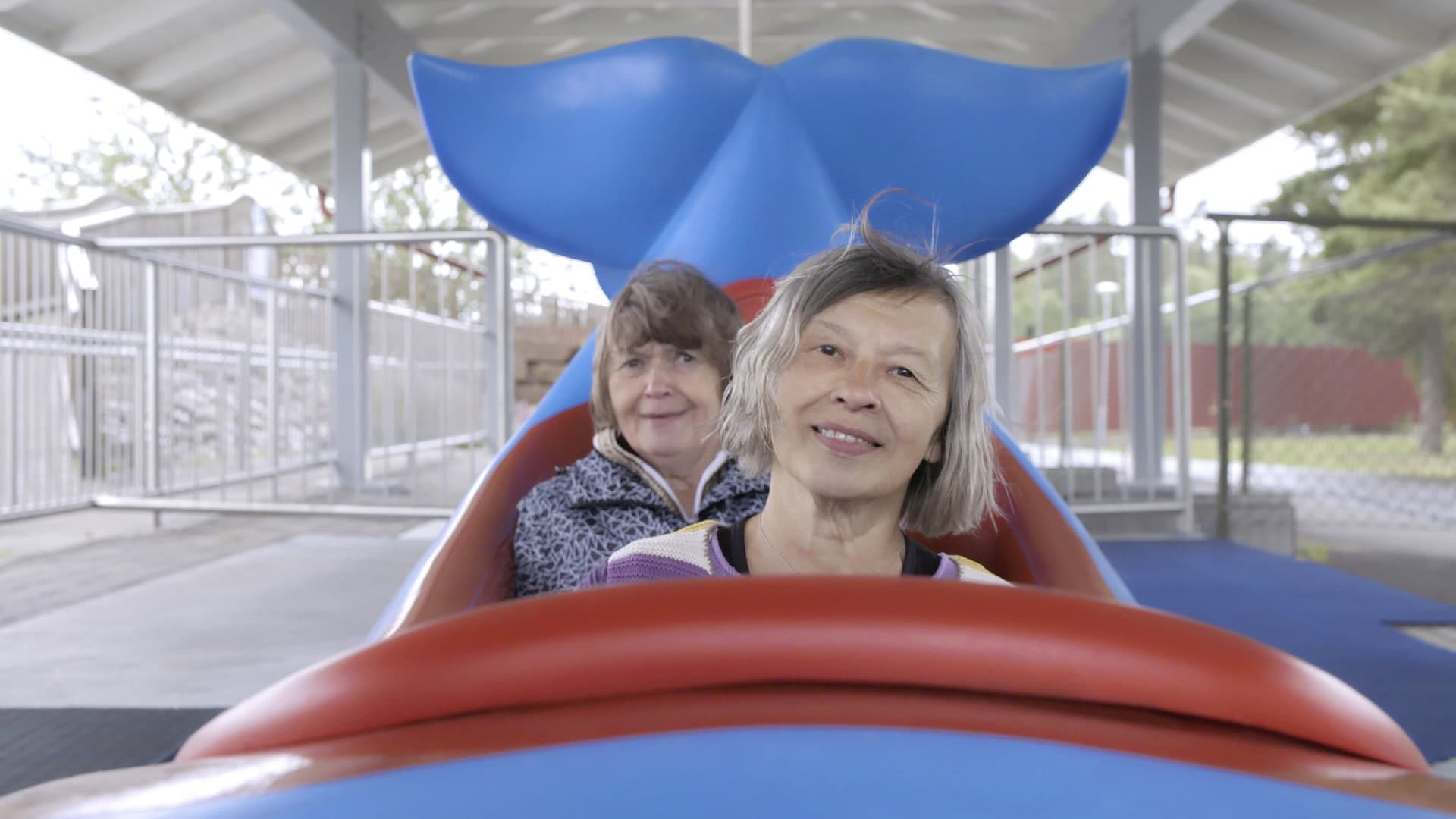
It all begins with a broken bone—a tailbone, to be exact. It is that of May, an older woman from Norway who’s visiting one of her sisters, Kari, in Gullspång, Sweden. The accident strands May at Kari’s house, to the point that she decides to buy an apartment of her own in the same town. This all may seem like too banal of an affair to merit a documentary. Yet this is the allure of director Maria Fredriksson’s unpredictable The Gullspång Miracle, which skillfully unfolds what initially seems like an ordinary tale of lives being lived by the most ordinary of people, little by little, into a dramatic tale of mythological proportions.
May finds the apartment that she’s looking for, only for things to take a strange turn when she bumps into the seller, Olaug, at the notary’s office. May insists that Olaug looks exactly like one of her other sisters, Astrid, who took her own life 30 years prior. The similarity is so striking that May and Kari start thinking that Astrid didn’t kill herself. After all, they were never allowed to see her body in the casket. Then the sisters suspect that Astrid and Olaug, both of whom were born the same year and nicknamed Lita, were twins separated at birth.
This latter theory makes sense when they consider the German occupation of Norway—they grew up there, some 600 miles from Gullspång—and the Nazis’ interest in experimenting on twins, which drove Norwegian families to hide them. Through purposefully obvious reenactments of the sisters discovering three paintings inside Olaug’s home and interviews with Fredriksson, the women use their memories, some sharper than others, to decipher age-old family secrets, but only if the deciphering can heal old wounds, not produce new ones.
We learn in The Gullspång Miracle that just a few days before her death, Astrid randomly asked one of the sisters whether she had ever also felt some loss inside her, even when surrounded by loved ones. It’s a feeling that’s always haunted Olaug as well, so it’s only natural that she becomes enticed by the possibility of having found the reason for her existential malaise. Once the mystery about the women’s connection is revealed, or so we think, it seems as if there’s no more reason for the camera to linger on their lives. But the more it does, the more the mystery gains astonishingly new contours, and Fredriksson pieces it all together in operatic ways.
The narrative keeps growing startling new emotional dimensions, as well as socio-political ones. When Olaug meets all of her newfound siblings in their farm in Norway, for instance, it’s startling to witness how much they lack the emotional resources to welcome her, much like her original family, from whom she always felt alienated. The Norwegian relatives even propose that Olaug sleeps in a caravan next to the house. From this encounter, it also becomes increasingly clear that an abyss of suspicion, and deep-seated class resentment, separates the siblings from Olaug, the classical music-listening urbanite. The more Olaug insists on finding out the proverbial truth, the more the other siblings want to run away from it.
The Gullspång Miracle, then, steers clear of the feel-good vibes pedalled by the genealogy series Who Do You Think You Are?, suggesting that the telling of any family history is more fantasy than facticity. The various twists of the sisters’ story places the documentary in kinship with Sarah Polley’s Stories We Tell, for the way it teaches us that identity writ large relies on a series of fragile misrecognitions that cinema can only hope to expose and complicate, not resolve.
To the question “Who Do you Think You Are?,” the only truthful response would be extracted from the verb “[to] think,” as certainties could only amount to defense mechanisms against the uncomfortable feeling of realizing that we’ve always lacked something that we will never really have. Supported by the strategic aesthetics of a murder mystery, Fredriksson’s film is actually a philosophical account, and a delightfully immersive one at that, of the shaky ground—a mixture of lies we’ve been told and lies we’ve told ourselves—that human existence stands on.
Since 2001, we've brought you uncompromising, candid takes on the world of film, music, television, video games, theater, and more. Independently owned and operated publications like Slant have been hit hard in recent years, but we’re committed to keeping our content free and accessible—meaning no paywalls or fees.
If you like what we do, please consider subscribing to our Patreon or making a donation.