American independent movies have been the lesser over the last 11 years for lack of a new film by Hal Hartley, the beloved filmmaker’s Kickstarter-funded Ned Rifle being his last release to this point. Fortunately, Hartley’s fans rallied around another project in 2023, and are now being rewarded with Where to Land, arriving in theaters this week.
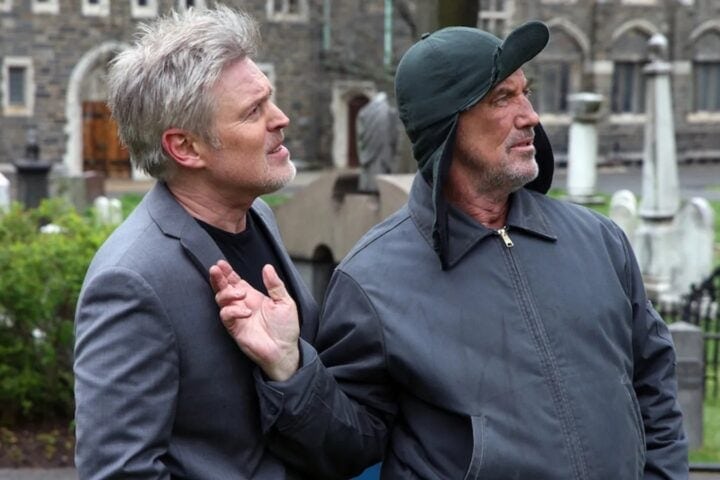
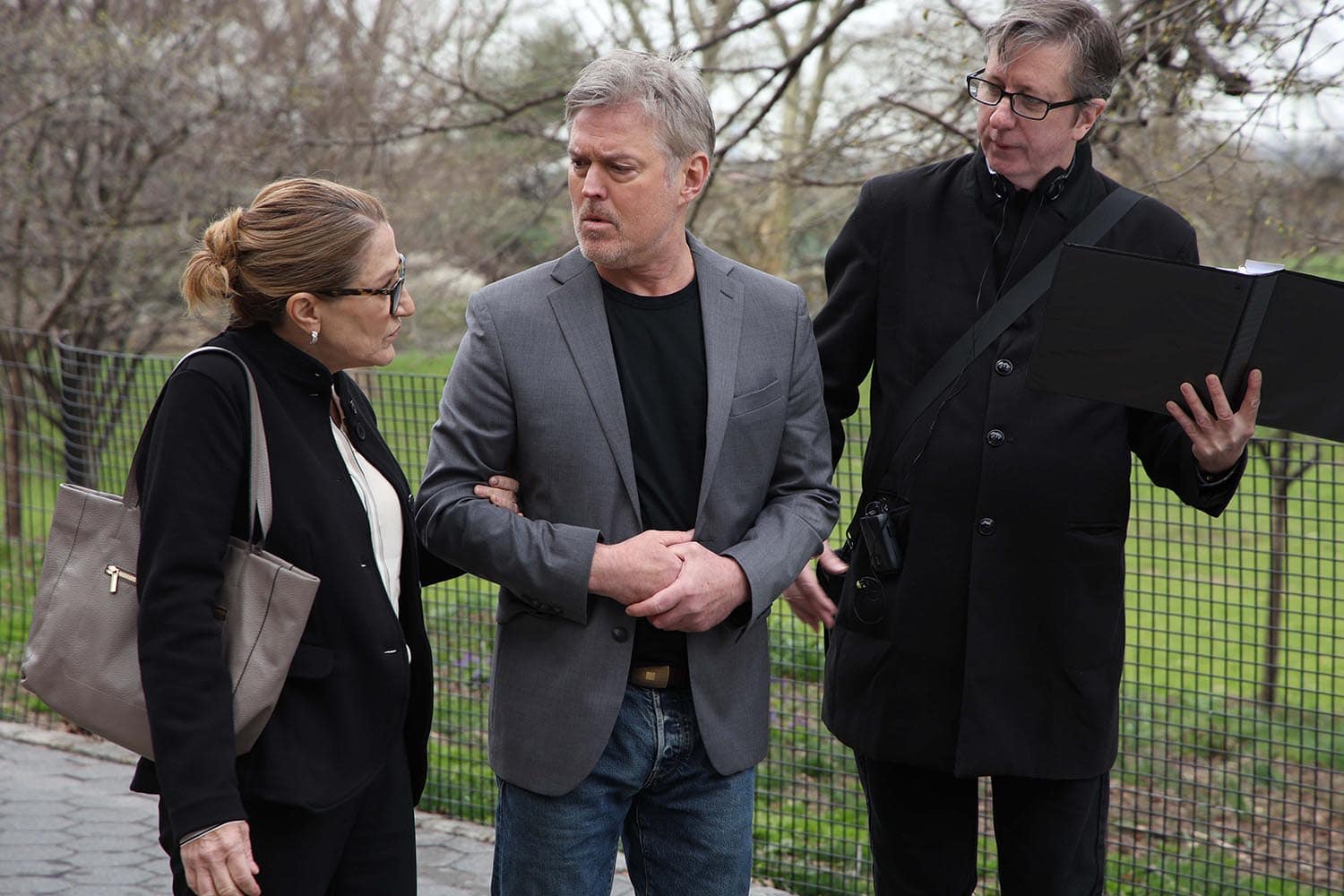
The film follows film director Joe Fulton (Bill Sage) over a three-day period as he composes his will (for legal reasons) and considers taking a job as the groundskeeper of a church cemetery, a confluence that leads his television star girlfriend (Kim Taff) and precocious niece (Katelyn Sparks) to believe Joe is actually dying. Though it’s among his most light-hearted and charming works, Where to Land’s ruminations on the quintessentially Hartley subjects of art, labor, commerce, aging, and mortality have rarely been far from my mind since my first viewing.
Ahead of Where to Land’s theatrical rollout, I spoke to Hartley about the film’s origins, fundraising, drawing from his own life, and plenty more.
Are you in New York right now?
I am, yeah. I’m at my place. Actually, I’m right in the room most of the story takes place in.
I was wondering if that was your place! So when Joe Fulton is drawing up his will and itemizing all his possessions, those were really your possessions.
Well yeah. In around 2015, 2016, I had to do that. Just like he says in the story, my lawyers have been telling me to do this for a long time. Mostly because I have these movies, you know, which I own. And that could be complicated if I get run over by a bus, [which would mean that] somebody’s gotta figure out what to do with it. So I finally did that, but I was so entertained by the whole meeting with the lawyers. It was so simple, and it almost seemed silly, you know? They said, “You just gotta go home, make a list of everything you own, and who you’d like to leave it to, and that includes the films and all that.” So I think even when I was riding the subway home, you know, from that meeting in 2015 or so, I was concocting a story.
There’s this idea about accumulating things in the story, with the Elizabeth character, played by Kathleen Chalfant, asking whether Joe’s artistic output is just another form of accumulation.
What I wound up concentrating on in the writing was an initially funny, simple, materialistic situation for Joe, which during the course of the day really becomes a meditation on what life is, and that death has to be part of [it]. So it goes from the quotidian to the philosophical.
Speaking of materialism, you funded this movie through Kickstarter, as you did with your last feature Ned Rifle. Did you always know that you wanted to do this through Kickstarter, or did you look for other funding?
Actually, I don’t think I’ve ever written a script with so little intention of producing it at the time. I was writing a novel, a short novel called Our Man, which hopefully will be published early next year, that I turned into script pages. I was working on the book, and I set it aside because I made Ned Rifle. And then after Ned Rifle, I got back and I went to the book again, and I thought, “Well, you know, I feel like some of these scenes can be great as scenes.”
The screenplay [turned] out to be quite different than the book. [And] when I was done and I started handing it around to friends, people responded to it very powerfully, including Bill Sage and Bob Burke. So that encouraged me, and then I decided to do the Kickstarter, because we had done the Kickstarter for Ned Rifle in 2013. And that was extremely difficult because I had never done such a thing before. But we did succeed [in the end], and knowing that made it easier for me to decide to do another Kickstarter for a new film.
I would imagine there’s a lot of freedom that comes with having your own funding, but there must also be a whole different set of challenges that go along with it.
Yeah. It’s a lot. I mean, it’s a different hat you put on when you’re fundraising, and, yeah, there’s lots of challenges. They’re actual people you’re dealing with—not corporations or something. So, you know, you have to be very politic. Some of these people are giving you $10,000, $5,000, you know, and you just want to treat them respectfully. But it goes all the way down to the people who are just giving you $25 and want a book or something like that. I think what made the first one very difficult for me was that it’s really quite public. And I’m not very good that way. I’m not a very public person. So it was a strain. I had to, like, be public for those 30 days.
Joe Fulton is also the name of the lead character in Meanwhile, but that’s a different character played by a different actor. Recurring characters are nothing new to your movies, but is there something embodied in the idea of that character that you wanted to explore further? Or is it just a name?
I mean, somewhere along the line I said, “Maybe I should always have a Joe Fulton character and he’s played by somebody else.” But it’s been a jokey name for me for years. I remember reading in a magazine or something how porn stars get their porn star name by combining their middle name and the name of the street they grew up on. I think I read it out loud in the office when some of us were hanging around. And everyone started [coming up with] their porn star [name] and it was hilarious, you know? So mine was Joe Fulton. My middle name is Joseph, I grew up on South Fulton Avenue. But it also sounds real. It sounds like a real name.
Meanwhile was kind of a quasi-project. It was a thing in itself. Even while I was shooting it, I was making notes of making a whole number of films that star Joe Fulton, like different kinds of adventures. Almost like, I guess, I was thinking along the lines of episodic TV. And it took me a while to realize that. And I did pitch Meanwhile as an episodic TV thing for a little while. It didn’t go anywhere, but when it came to making this, it just felt right to use Joe again.
By making him a movie director in this case, you’re kind of inviting some autobiographical readings of the film. One character calls him the “elder statesman of American romantic comedy,” which isn’t necessarily how I’d describe you, but there does seem to be some overlap.
Yeah, I didn’t want to call him an independent filmmaker.
He certainly seems a little more commercially oriented. But did you have any trepidation about making something that feels more autobiographical?
No, I didn’t. I felt it was all right, because, I mean, it’s not autobiographical, but it’s personal. I may have taken particulars from my experience, but they were particulars that are, in a sense, very general. Or, if they weren’t very general, I tried to make them more general. Like where I live, you know, and I have an ex-wife who’s a very good friend. And I have nieces and nephews. And I have an older friend like Elizabeth. So I wanted to bring all that in and talk about things that really matter to me. I think that the things that people discuss in the film, all of them, are much closer to my experience than even the particulars of Joe’s life.

Right. Because this character is taking stock of his life and wondering whether he can either be more useful to the world or just more personally fulfilled if he’s doing something else. And you’re a filmmaker but also a writer and a musician, and, of course, it’s been a long time since your last movie. Have you also been finding meaning outside of your usual avenues in that way?
Well, certainly outside of filmmaking. I spend a lot more time now writing prose. But there’s that incident at the graveyard in the book, which I turned into a much larger scene. The book is very much about a 53-year-old guy over the course of three days while he’s considering making I guess what I would call a career change. He would like to just do something. In that case he’s not sure what it is, but it’s probably some kind of manufacturing or something like that.
But in it, and, and this comes right from my life, I mean right from my notebook, I walked by that cemetery where we actually shot one day on my way to the subway, and I saw this man somewhat older than me just going about his work as a groundskeeper. And I stopped and observed just how he worked with his tools, and how there was this dignity. This simple dignity about his job, and I thought, after a lifetime in the movie business, you know, I was like, “Wow. I would love to have a life that’s that clear, where the imperatives are that clear.”
Now I spend every day hassling one way or the other with possible financiers or distributors, it’s constantly negotiations and stuff like that. And then as time went on after I made Ned Rifle, I thought, “Yeah, I’m not going to do this anymore,” meaning independent filmmaking where I raise the money [for a film] and I produce it, and even distribute it. I thought, if somebody wants to pay me to do it, I felt like that would be terrific. I would do that as long as it’s on my terms, and I didn’t have to compromise too much. And then I got work as a gun for hire, by Amazon to direct these episodes of a show called Red Oaks. And that was quite nice. That was my best-paid job ever. I got to do what I know how to do. I wasn’t the boss. That was cool.
That’s interesting, because one of the things I love about your movies is that you often have characters who have very rich intellectual or creative lives but who do fairly menial jobs. In Henry Fool you have Simon Grim being a garbage man and a poet, or Robert Burke being a mechanic in The Unbelievable Truth. And in this movie you have a filmmaker who’s considering becoming a groundskeeper, and a building super who wants to be a socialist city councilor.
I think nobody was more surprised than I was that I was eventually able to make a living doing what I loved. I just assumed from the time I was a kid that, you know, you do what you gotta do to pay the bills, take care of things. And the things you love, you know, you, that’s why they invented the weekend. But even as a teenager, I was surrounded by people who just told me I was out of my mind to think that way because they were very supportive. And my friend, who Elizabeth is named after, is my friend’s mom. And she was very important to me and, you know, she’s like, “You’ve gotta stop thinking that way because you’re talented, you’re focused and you’re a good kid.” But it was easy to forget that kind of encouragement.
So even when I came to New York and when I was beginning to make films, I sort of couldn’t believe it would actually amount to a career. But it did. So I’m kinda sensitive to those kinds of characters. And I always need, as a writer, to know what a character does for a living. Even simple things. Does he or she like their job? That tells you a lot about who they’re going to be. Will they stick with that job or not? I like to start from contradiction. This is their inside, that’s their outside. This is the world they live in, this is what they think about it. And I always assume that people, like the superintendent Oliver in this, he’s got a life, an intellectual life of his own.
Mortality is at the center of this movie, but not in a morbid way. It’s about people assuming a guy is dying when he’s not. Did that come from the conversation about drawing up the will, or has the subject been on your mind for longer than that?
Of course, having to draw up a will, yeah, that would bring those things. But in those years, I was also taking care of my dad, who passed away in 2015. I spent half of each week out on Long Island with my brother and my sister. We had to usher him to his end. He died at 90. But I’d say I had been thinking about it for many, many years, philosophically, but maybe not in, like, actual material terms during the day, you know? But also, whether you’re making your will or not, as you get older, you do think about those kinds of things more. You’re more alert to aging, [and] you find yourself making decisions about certain things much more easily than you did when you were 30 years old. And there are many more options—like anything’s possible.
Joe Fulton certainly seems renewed at the end of the film.
Yeah. And it’s always other people. In a sense it’s somebody else’s project, right? He’s interested in his niece, her creativity and her intellectual life, and his friends and family kinda manage to draw him back into something that he’s actually good at. Who knows? He might really suck as a groundskeeper at the cemetery, you know? But he’s quite good at romantic comedies.
I have to ask about the interview scene between Joe and the woman writing the book about his work, because I saw myself in that scene while preparing for this. She really has a very particular interpretation of Joe’s use of irony, and I know you’ve said in the past that you don’t like people using the word “deadpan” to describe your dialogue. Did that scene come from your real experiences?
I think I dreamed up a pretty extreme kind of situation here. But the thing about irony was important. I wanted to get that out of the way. I have certain ideas about how irony works and why I use it. So in a kind of a backhanded way I’m having her tell him what his irony is and it’s like news to him. “Deadpan” is just too broad and too easy. I prefer “lack of an obvious interpretation.” I think a lot of the time people equate irony with cynicism, which I’ve never been involved with. Irony is interesting because it highlights contradiction, and that’s what I’m interested in. Contradictions in a person, in a character, in their character or in the situation. It helps us think. It’s a way of inviting the audience in to see different aspects of the situation.
I’m glad you brought up cynicism, because this feels like an optimistic movie despite touching on dark subjects. Joe feels artistically renewed at the end, which I guess is a backwards way of asking whether you share that feeling, and what might be coming next from you. Are you more motivated to make movies again?
Not really. I mean, like I said before, I don’t wanna do it this way anymore. But I did say that after Ned Rifle too. I think this was really well done, as was Ned Rifle, but if I’m going to do it again, I want it to be…I want to have more money. And be more secure, a little bit. You know, this kind of thing, I earn my living doing this, but now I have to wait. You know, the film’s gotta go out, and I can make a living from it later, you know? But I wouldn’t mind being paid. I don’t want to compromise my intentions or my manner of work to meet some corporate idea of excellence. Now, I think there’s a, to quote Godard, “A clear continuity of all forms of expression.” So, for me, it’s not such a big break that I’m writing, that I write novels and short stories. It doesn’t seem like a complete break with filmmaking.
Since 2001, we've brought you uncompromising, candid takes on the world of film, music, television, video games, theater, and more. Independently owned and operated publications like Slant have been hit hard in recent years, but we’re committed to keeping our content free and accessible—meaning no paywalls or fees.
If you like what we do, please consider subscribing to our Patreon or making a donation.