As an only child when the 1998 remake of The Parent Trap hit theaters, I can understand the fixation at the core of James Sweeney’s Twinless. A fellow younger millennial, Sweeney came of age during the cultural omnipresence of twins like the Mowrys and the Olsens. That initial seed of interest flourished over time into an exploration of what it means to have, as parents say, a built-in friend who both completes you and is you.
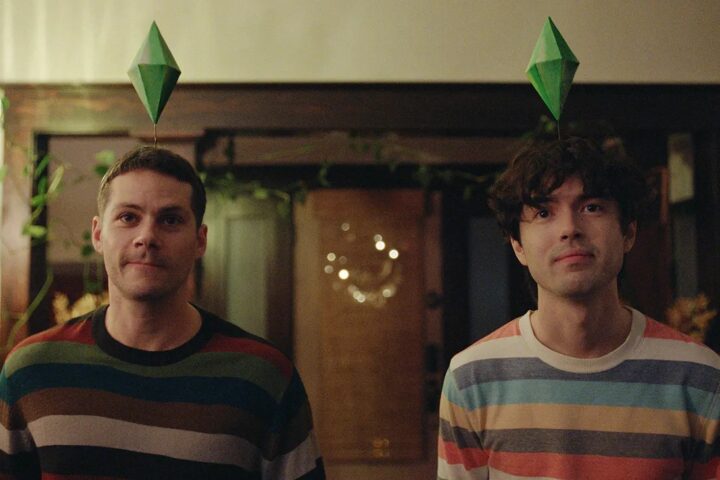
Considering that the bond of love between twins is so intense, its loss is uniquely devastating, as Twinless poignantly explores. In addition to serving as writer and director, Sweeney appears in front of the camera as Dennis, a man adrift and looking for comfort in a support group for twins who’ve lost their other half. He finds such solace in Dylan O’Brien’s Roman, who’s still trying to regain his footing following the death of his twin brother Rocky. The unconventional friendship that emerges between the two characters takes viewers on the emotional rollercoaster that is processing grief: funny, serious, sad—often all at once.
I caught up with Sweeney and O’Brien at the tail end of a long press day, which led to some humorous but harmless slip-ups during the chat. The duo provided fascinating insight into how they understand the relationship between twins, what the film’s long gestation process gave to their partnership, and why the tonality of Twinless veered toward polarities.
I feel like I should start with my two degrees of separation connection to Twinless, which is that a friend of mine has identical twin brothers who appear in the film with their bikes as Dennis sees nothing but identical twins. Why was it important to have real twins involved in the process, and what did they add to the film?
James Sweeney: I guess it was just for my own personal joy! We also cast all twin actors in the support group, including background talent. Obviously, in the scene of illusion frequency, we see twins everywhere, and you needed to have [them]. I guess you could have done it with doubles, but that would have been more expensive in VFX. But there were a lot of interesting conversations that we had in those support group scenes, just listening to all these twins talk about their experience being a twin.
How did making this movie change the way either of you thinks about what it means to be a twin? I feel like they’re such a paradox: both halves that make a whole, like a married couple, but also unique individuals.
Dylan O’Brien: The initial impetus was the fixation on that type of loss. For me, it was the first thing I was struck by. Having this experience totally shifted my perspective, thought, curiosity, and fascination with this experience on this planet. A good friend of mine has six-year-old twin girls, and I was just with them for three or four months of the year. I wouldn’t have observed them in the way that I did if I hadn’t had this experience. I saw the little world that they’re in, and I dove into this fascinating curiosity of their whole own language. You can’t snap them out of it. Sometimes, my friend will be like, “Sometimes I’ll call them six, seven times. I’ll be right there screaming at them, and they’re on this other frequency.” Seeing it in such an early stage of development, you understand the connectivity and closeness that they feel into adulthood.
JS: With twins, everyone has their own experience. But in a way, it’s just love [between them]. You can be the luckiest love in the world, but maybe because of the expectations of having that love, if it doesn’t work out like that or if you diverge in different paths—or, worst-case scenario, you lose your twin—it can be extremely heartbreaking, and there can be lots of conflict. I think it really runs the full spectrum of just humanity in general.
James, you first wrote Twinless 10 years ago, and Dylan, you came on board five years ago. How did that time in gestation change your relationship to the film?
JS: My first film, Straight Up, was also exhausting trying to get produced. There are times when you go, “Why am I even making this film? Is it that I love the story so much, or is it just that I’ve been pushing this hill up a boulder for so long that I don’t know how to do anything else?”
DO: [chuckling] “Hill up a boulder,” that’s awesome.
I wasn’t gonna say anything…
JS: That’s the myth of Sisyphus!
DO: It’s too late in the day for this.
I don’t know how you guys do this for so long.
DO: Hours on end, it’s wild! You start to go to mush and not even realize it. It’s like your brain gets microwaved. And you’re like, “Wait.” I can’t believe you pronounced what you pronounced after saying “hill of a boulder.”
JS: Hill up a boulder?
DO: That’s what you said!
JS: Boulder up a hill.
DO: Yeah, but you said “hill up a boulder!”
JS: Was that what I said?
DO: [laughing] Yeah! For me…do you want to get to another question?
No, I want to hear your answer!
DO: We keep talking about this, where, at the time, we were struggling in terms of… [laughing, to Sweeney] You just spit too!
JS: Oh, no!
DO: He’s falling apart! In the time that it took to get this movie made, which at times felt so hopeless, we felt crazy and doubted ourselves. You can have all kinds of negative feelings when so many people are saying your movie doesn’t deserve to get made. We don’t believe in this, particularly both of you. It’s so much rejection, but it’s so funny how much it ended up being in service to us at the end of the day. Not just in our being able to really create a foundation of trust, rapport, and friendship going into the process, but in our relationship to the piece as a whole and my relationship to the characters. I ended up having these guys swimming around in my head for four years before I got to do something. I think that goes such a long way in the closeness that I felt to them and the understanding of my assignment going into it.
JS: It also liberated us from expectations of what the film needed to be.
DO: Nothing to lose!
JS: It was exactly the film that we wanted to make.
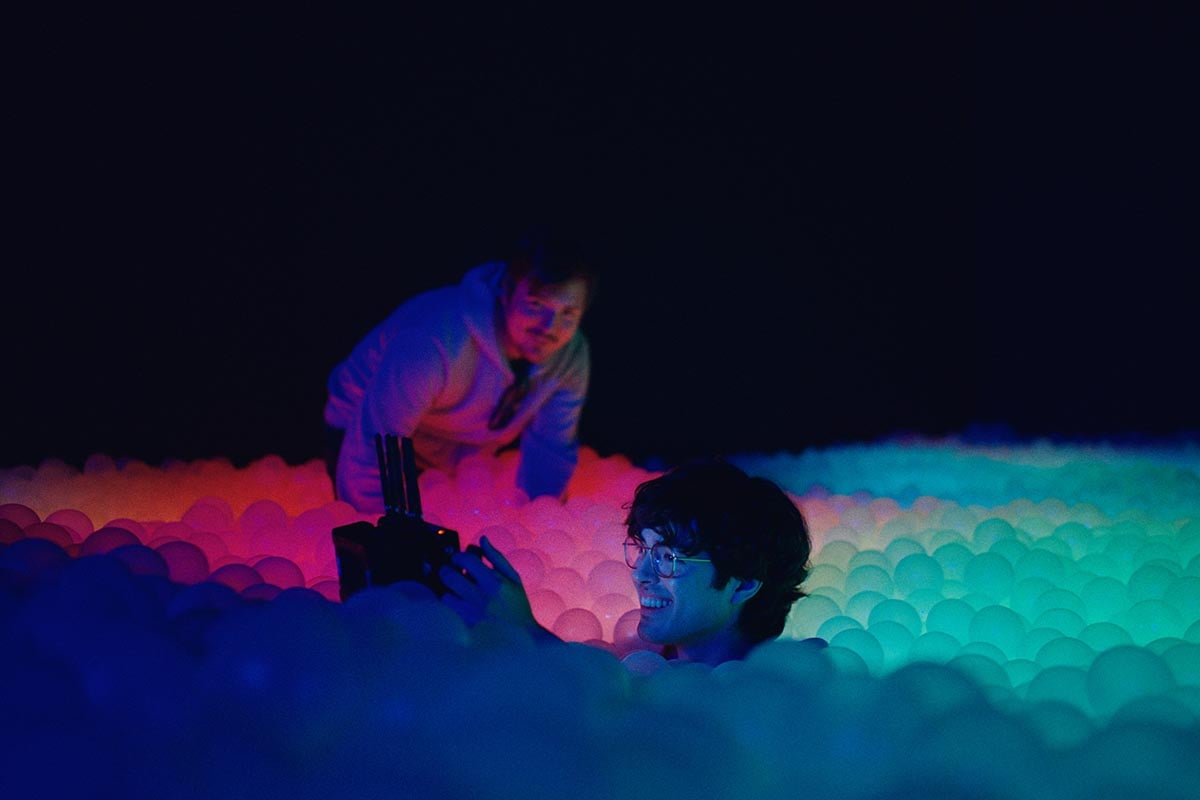
Dylan, you’ve said that you tend to approach finding your way into a character more physically than cerebrally. What were the unlocks for Roman and Rocky?
DO: So much shifts when you finally get on the ground, especially for me. I actually learned that it was so useful for me to have the cerebral aspect. I did spend a lot of time thinking about these guys, and especially about really tiny nuances. On any given day, I could randomly see something in a friend, and because I had these guys in my head for so long, I’d be like, “Oh, that’s so Roman.” Things you collect like that eventually just start to build. In terms of getting into the role physically, when you get on the ground with the costume fittings and start having the hair and makeup conversations, I told James my grand plans for a physical metamorphosis in the two and a half weeks between filming the different characters and how it all went to shit.
JS: How many push-ups and sit-ups were you doing a day?
DO: I did 600 push-ups a day for Roman at one point. The most I did in a row was four days in a row of 600 push-ups and 600 squats.
JS: I’m sorry I made you talk about it.
DO: No, it’s fine! I like doing physical things in preparing and then having no one on set ever know that I did them because that’s usually how it always goes. But [I wanted] to create some type of physical difference between the guys. Then, of course, the way that they carry themselves speaks from such an emotional place and such a place of experience on their different paths.
Similar to the myth of Sisyphus, the film references Shel Silverstein’s The Giving Tree, a story that holds profound allegorical weight for those who read it as kids. What did that mean for each of you in relation to the story and the characters?
JS: There was an early iteration of a scene where Dennis refers to himself as “The Taking Tree.” What The Giving Tree speaks to about unconditional love is inherent in the idea of twinship. That’s something that both Roman and Dennis grapple with and yearn for in their own personal lives. That’s what draws them together: They see this kindred spirit. Obviously, the relationship devolves into two different directions, but they’re both searching for somebody who will accept them for all their complexities and flaws. I think that’s the beauty of friendship.
DO: And vice versa. All of a sudden, the emptiness of not having that person to share and give all that love [from] themselves to anyone is a huge thing for Roman. All of a sudden, so much of this energy and love that he designated to one outlet in life disappears.
Twinless has such a unique and delicate tonal balance. To achieve that, were you each playing scenes in a lot of different ways on set to have more options in the edit, or was the angle always clearly defined before the cameras rolled?
JS: I love that, “unique and delicate.” I’d say there was an awareness of needing to keep track of and then modulate the tone. Throughout the filming process, I tried to hire talent that had that latitude to play with. I will say, Dylan, as a performer, was a bit more consistent and really the medium of the tone, whereas I think Aisling Franciosi, who plays such an optimistic and chirpy character in contrast to her previous work, and I may have provided more options because some of those tones could play in terms of the broadness of humor. It depended on the scene, or even pacing-wise. Some we would try at various paces because we were so aware of pacing and momentum throughout, and we wanted to give ourselves options in post. Our assembly cut came in at 150 minutes, so there was a lot of refining in the post-production process.
James, you’ve described Straight Up as “a love letter to the in-betweens.” Did a similar sense of grace for people who might be unsure of how to make sense of their feelings extend to Twinless? I’m thinking about the big revelation at the end of the film when both Dennis and Rocky show such a wide range of emotions.
JS: That’s such a lovely observation, and very insightful. I don’t know that I’ve thought in particular about Twinless as a film about in-betweens. But now that you say it, I do remember speaking in terms of our visual grammar and production design about wanting to live in liminal spaces. Which is, I guess, a synonym.
DO: [laughing] We’re dying. “Twinless was liminal. Straight Up was in between.”
JS: There’s your headline.
DO: Get it right!
JS: I think Twinless leans more into duality and polarities. We lean to the edges more in terms of directions and tones. We push it. I’d say I try not to judge my characters. If there’s any sort of ambiguity that exists in the film, it comes from a place of empathy, trying to meet the characters where they’re at, showing them as they are, and not necessarily making any indictments.
Did the reactions to Dennis as a character surprise either of you folks? Some people seem to speak about him as inherently unsympathetic or even the villain of the story, and I think it’s much more complicated than that.
DO: Damn, where are those? We’ve been really surprised so far, and at a lot of these Q&As, people we’re personally speaking with have had such empathy for his experience in a way that was such a success for us. That was obviously a goal, but such a tough achievement.
JS: I guess the people who think I’m a villain are hiding from me. Because of the feedback we got throughout the process of trying to get this film produced, I think there was an acute awareness that not everybody was going to receive Dennis. If anything, I’ve been so pleasantly surprised that so many people relate to him. Even if they don’t personally identify with him, they will at least understand or empathize with the decisions that are made in the film. I think it’s because you see that there’s so much goodwill in their friendship.
DO: I really tried to help with that with my scene at the end. If I have an arc of forgiveness at the end, you could see that [empathy] could be there. So much is guessing.
JS: I will say, I was pretty consistent in that last scene, too, because we were both so certain at that point. We constructed our shooting schedule in a way that we shot that scene the second-to-last day of filming because we felt like it could be informed by all the scenes that we filmed prior to that. We wanted to leave space for letting the film reveal itself to be the film it needed to be.
Do you believe in the possibility of something being “emotionally true but factually false,” as Dennis says in Twinless? Can something that starts as a lie become real?
JS: We see that it is a self-fulfilling prophecy in and of itself with Roman’s character. He grows up with this identity, thinking he’s a lesser twin in some way. He reinforces that concept when the reality is that he shares, literally, the DNA with Rocky. I think so much of who we are is the narratives that we tell ourselves.
DO: I…can’t follow that. [laughing]
Since 2001, we've brought you uncompromising, candid takes on the world of film, music, television, video games, theater, and more. Independently owned and operated publications like Slant have been hit hard in recent years, but we’re committed to keeping our content free and accessible—meaning no paywalls or fees.
If you like what we do, please consider subscribing to our Patreon or making a donation.