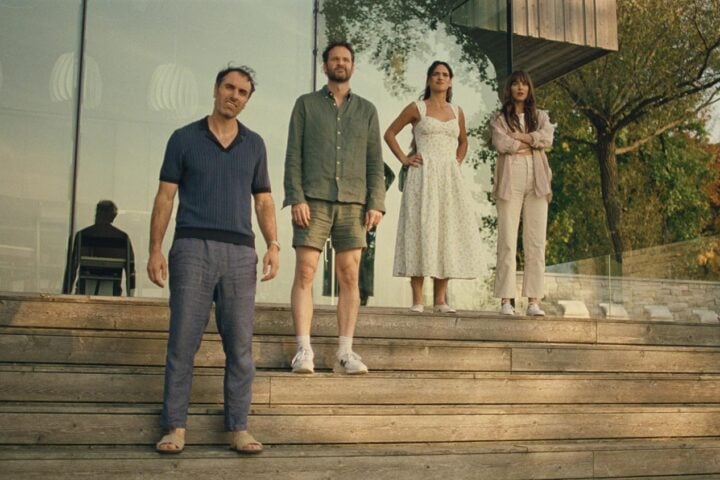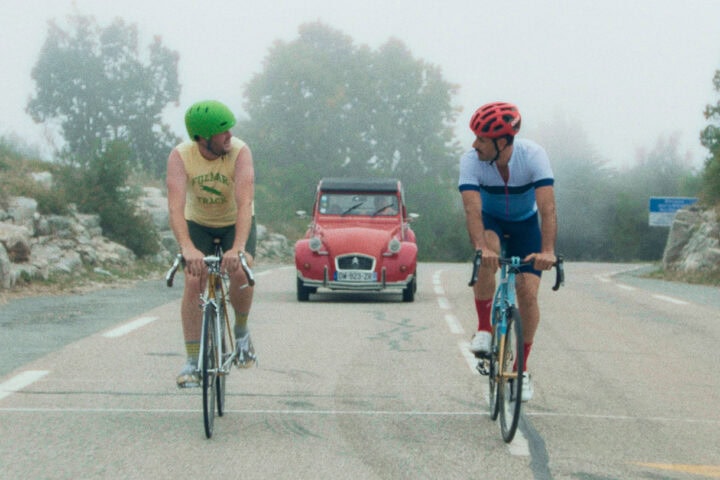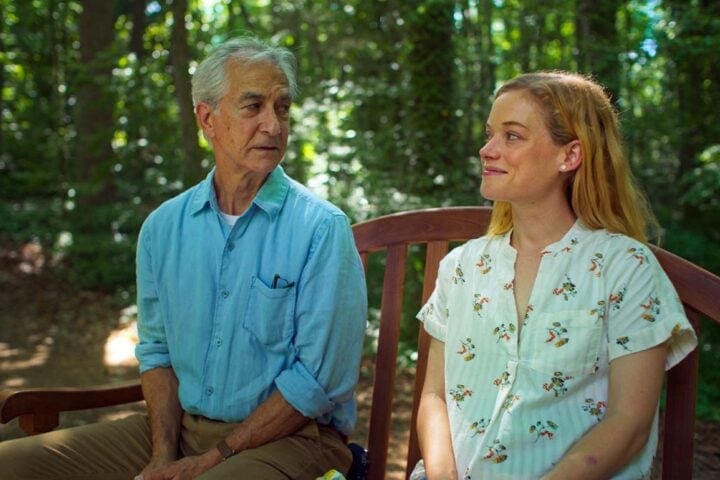
“We’d be lying if we said we weren’t aware of the similarity,” says director Michael Angelo Covino in response to one of the many intriguing parallels I observed between his two features, 2020’s The Climb and 2025’s Splitsville. Covino’s on-screen avatar sets the plot of his debut in motion by sleeping with the fiancée of his longtime best friend, played by his creative partner, Kyle Marvin. In their follow-up, you could say that Marvin gets to even the score, as his character beds the wife (Dakota Johnson) of Covino’s character, causing a stir despite the couple declaring their marriage to be an open one.
“But I don’t think that was the impulse to make the film,” Covino continued. “It just happened to be the arrangement that felt most fun to explore.” While Splitsville shares a great deal of thematic and stylistic tissue with The Climb, Covino and Marvin continue pushing themselves as writers, producers, and actors. Their latest work finds new angles to explore the relationship comedy through the lens of the vulnerable, verbose male characters they play.
Splitsville, which gives as much weight to a sight gag as it does to a scintillating zinger, follows two couples as they navigate the complexities of infidelity and non-monogamy. It’s a premise that might seem like a reaction to recent trends in relationship dynamics, but the film’s perspective on courtship and commitment remains as classical as its visual style. It’s a comedy designed to stand the test of time, not simply respond to the era in which it was made.
I caught up with Covino and Marvin ahead of Splitsville’s theatrical release. Our conversation covered how they balance visual and verbal humor, why shooting on film was such an important creative decision, and what went into conceiving a few of the script’s most offbeat jokes.
One of the things I remember from chatting with you about The Climb is that after your world tour of the film, the one moment that traveled everywhere was Gayle flipping Kyle’s dick. Did that inspire just how present the member is in Splitsville?
Kyle Marvin: [laughs] It definitely fed into it!
Michael Angelo Covino: It’s gonna get a cameo in everything. I think that’s still my favorite subtle dick moment out of the two movies. I think that’s still better! This one is more overt, but that one’s more classy.
There were moments in The Climb that would take us from the plausible into a fantastical, impossible dimension within a single shot. Did the response to some of those choices inspire you to take it even further in Splitsville?
MAC: We did a little bit of it in The Climb, like that transition from fall to Christmas, where it’s an in-camera thing. I just love being cinematically playful with a film like this that’s dealing with things in very fantastical ways, going to heightened emotions, and going off the rails in certain ways. I think it’s complementary filmmaking that’s reminding the audience that you’re watching a movie—[that something is] here to be fun and inventive.
I don’t know that we’ll do it on every movie, but it communicates with the story, the performances, the absurdity of the slapstick comedy, and the ridiculousness of the places it goes. It goes to an 11 in certain areas, and to allow the film to communicate with that in some way, or breathing life into the film from a different angle, felt right for this film. Certainly, from a selfish point of view, it’s fun to problem-solve those things and come up with those ideas. They’re doing outfit changes in-camera, running into the other room, and then taking off their clothes and putting on something else. That was just a fun challenge for Adria and Kyle.
KM: It’s also about efficiency. You don’t really need to linger in these moments in order to get the movie from point D to point F. You can just compress it all into this more creative, abstract version of it that becomes more compelling and thrusts you forward.
MAC: What’s the other option, to just do like a traditional montage where you chop it up? We could do that, but it had the potential to feel stale. We’re doing something where the audience is asking, “Wait, what am I watching? Did time just pass?” [Making them] where they’re a little bit disoriented felt right for that moment in the film.
It’s impossible to talk about the comedy here without talking about the staging of the visuals. Was that built in at the writing stage as it was in The Climb?
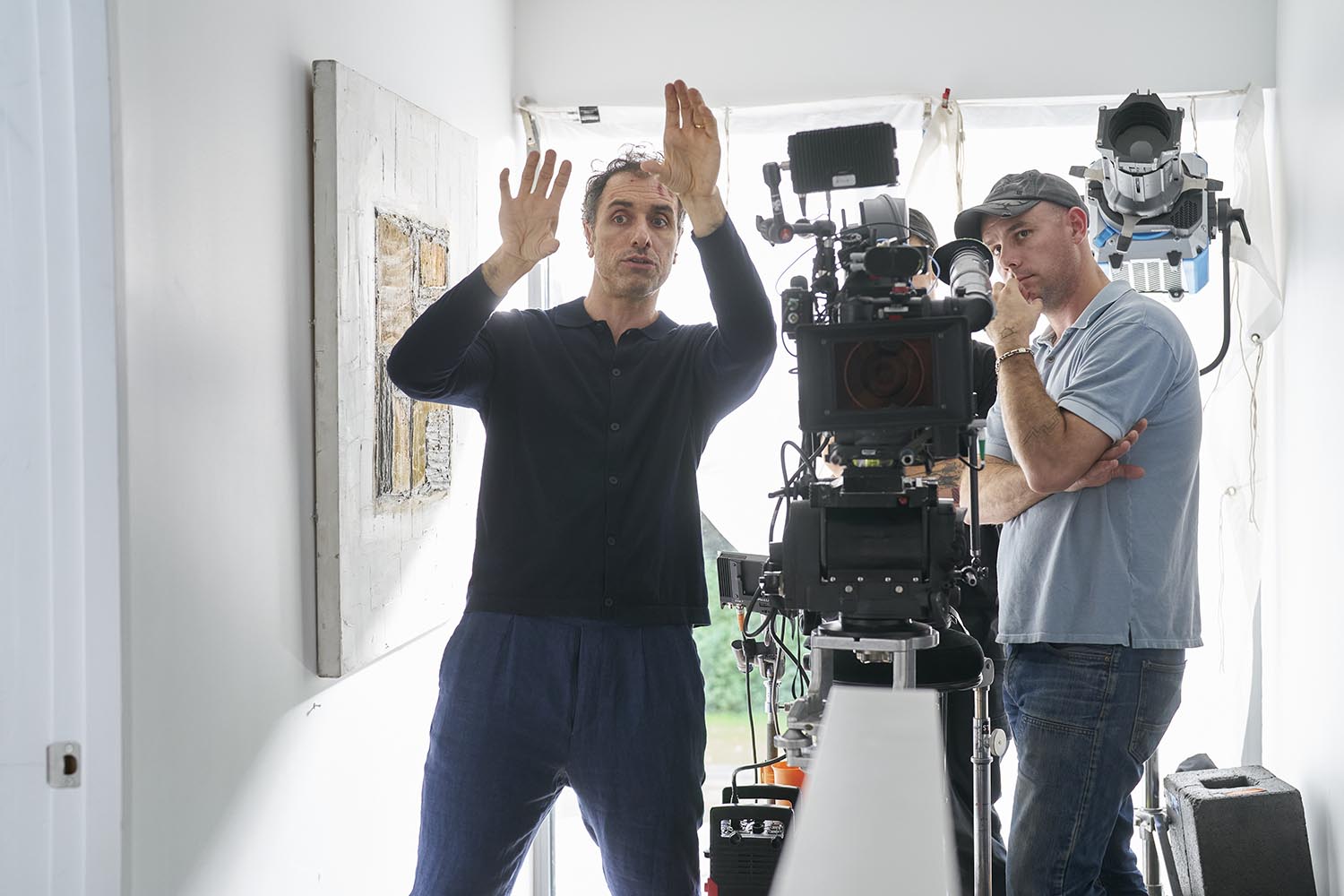
MAC: There were a lot of scenes that were written very descriptively that Kyle and I talked through. And then there were other things that we would go into prep and maybe hadn’t quite figured out the visual language. Or, frankly, because we needed the location first. It’s so location-dependent. For instance, we had a whole visual language for that whole apartment sequence, and then we had to find that loft apartment. We had written it for one apartment, and then we found that one that was like a tree house with the double levels. We were like, “Oh, let’s reorganize the whole thing for that.” You come in with an idea, and then you have to adapt it to the logistics that present [themselves]. You have a DP by that point, so you’re sort of bringing him into the fold and finding how we’re going to execute and bring it to life.
Is there a specific alchemy of when you’re leaning into visual humor as opposed to verbal humor? Do they complement or counteract each other more often?
MAC: I don’t think they counteract each other at all. To me, it’s all complementary if done right. I really struggle even thinking about a scene if I don’t have a point of view on the visual approach. There’s something that feels very unexciting to me as a director, even if I have a great dialogue scene, if we don’t understand what the camera perspective is. It’s just another layer of storytelling that excites us as we’re talking about it.
Even something as dumb as the apology scene, where we’re all sitting around. It’s an easy thing, but we save that wide shot of the broken table to the end, and it gets a chuckle. Because we get caught up in the subjective emotions of these people and their conversations they’re having, we forget that they destroyed this whole house. That’s really low-hanging fruit and simple filmmaking. It’s not rocket science. But something that we remind ourselves of is what’s going on physically in the environment, what’s going on with the characters, and how we can pop into the subjective and then pop out to the objective to give context to these ridiculous people.
Was rehearsal still as big a part of the process for getting Splitsville right as it was on The Climb?
KM: I don’t think it operated the same way as The Climb. I will say that there was a tremendous amount of freedom because Mike had such a specific perspective on scenes. We would run scenes from the perspective that he was interested in looking at it from, and that gave us time to find our way through those scenes and spend time not saying, “Hey, you have to get in there for the coverage because I need six shots in order to accomplish this film.” You’d feel this pressure of not really finding the scene. He would wait until he had the scene from that perspective, and then [he] was like, “Okay, where else am I interested in seeing it from? Or maybe where I’m not?” Then, we would either move on or he’d move into something where he was interested.
MAC: We just didn’t have a lot of days on this one. If I had all the time in the world, I would have really loved to rehearse and be more methodical with it. This was a film that was shot in 24 days, and we just had to be very deliberate on how we covered a scene. I had to have a point of view like, “Okay, this is the way the scene is going to look. We’re going to make a decision a little bit in advance, and it’s going to go from here to here.”
With both scenes, we were framing them up, and I wouldn’t move away from a scene until I knew I had the coverage of how we wanted to watch the scene in the edit. That sometimes worked and sometimes didn’t work, then we had to adapt and adjust. But, for the most part, I went in with a strong point of view, like, “This is going to live in singles for this section. We’re really going to get lost in these two people’s conversation.” A lot of moments in the film are in these wide-angle close-ups that we didn’t necessarily do in The Climb at all. That was like a very conscious choice, and in my mind, an aggressive choice. This was either going to work or not work, but the goal was to thrust us into this distorted subjective [point of view].
No filmmaker wouldn’t rather have more days or budget, but does having to be so precise unlock something different for you as a filmmaker? Was it liberating?
MAC: I don’t need liberation; I need days. We’re very free to make the movie we want to make. We shot film, and we probably could have traded days for film if we wanted to shoot digital…but we didn’t. It was all a conscious choice. We had the right number of days to make the movie, clearly. But in those constraints came magic and energy. It’s gonna come out the way it’s gonna come out. We prioritized the shots we needed to prioritize to get it done. Maybe in that way, it was freeing in just letting it go and going, “We have no margin for error.”
KM: I will say that we are ambitious with our days, no matter what. If we had more days, it would just be more ambition. It’s not from a sense that we would have relaxed at all.
MAC: I would have put a scene back in that we cut.
Why was film so important that you were willing to trade days for it?
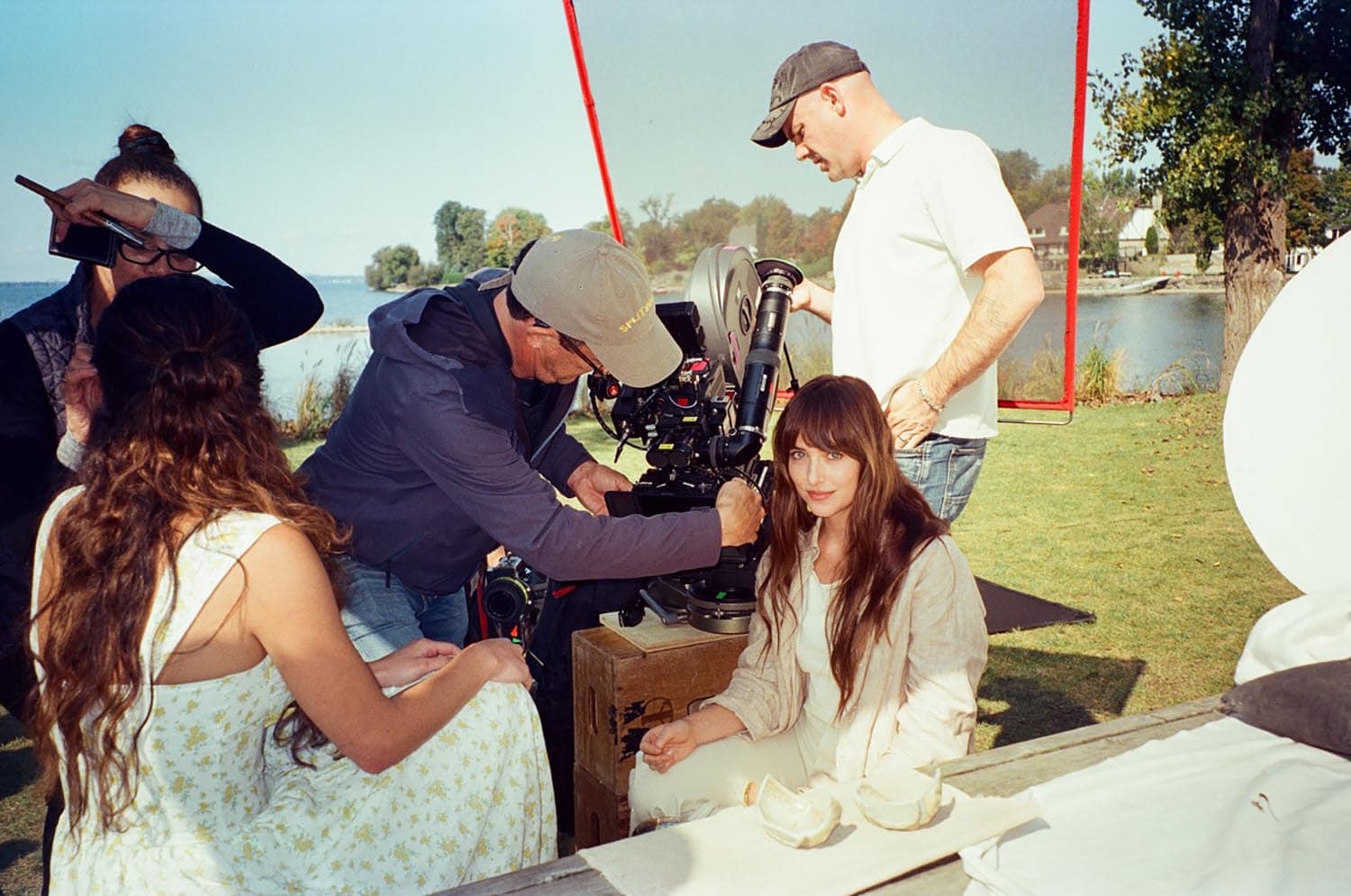
MAC: It’s a couple of reasons, but mainly, we’re trying to make a timeless film like ones from the ’70s that dealt with subject matters and themes like this. Digital technology is incredible, but it’s a race toward clean images, high resolution, perfect lenses, and so much information. This is a film about imperfection. This is a film about humans being very flawed, vulnerable, and messy, and the grain and texture of film communicates that in a very real way. This is a film that hopefully is just as resonant in 30 years as it would have been today [if it were made] 30 years ago. The cinematic ambitions of this are to see it in a theater with these lush, beautiful images [shot] with natural lighting coming in through floor-to-ceiling windows. We said, “Look, this is important. Let’s plant the flag and shoot it this way.” If we don’t do it, who’s going to? If filmmakers don’t make the choice, film is going to go away.
Polyamory and non-monogamy seem to be growing in popularity in the real world, but what we see on screen in Splitsville seems to operate in a world that treats infidelity like a classical screwball comedy. Was there any thought about cheating out toward the real world and acknowledging the moment we’re in?
KM: No, I don’t think it’s as interesting to us. I think the timeless nature and subject matter are more compelling, if only that it’s more interesting at its core. The point wasn’t like, “What is everyone talking about? Let’s make a movie about that.”
MAC: All of a sudden, we saw that New York magazine cover, and that was the first time I went, “Wait, are we making a movie that’s zeitgeist-y?” And people were like, “Yeah, this is a thing right now!” I was like, “This is a thing?” It completely flew over our heads in that way. There’s a new name for all these things, but these are not new ideas.
KM: It’s universal. A polycule is just a new version of something they were doing back in—
MAC: —Greek orgies. For a long time, human beings have been struggling with monogamy and coming up with alternatives to it.
There’s a fight at the point in the film where there would normally be a lot of dialogue. Are you conscious of the genre tropes you’re subverting? Is that a starting point for an idea or concept like that?
KM: That we’re conscious of. We were conscious of what romantic comedies do and what’s expected as an audience in those moments. It was exciting for us to do something different.
MAC: That was our jumping-off point for the story. Once we had that idea for the fight scene, that revelation of “they slept together, and I can’t even communicate because I’m so upset, I just react violently,” and the opening scene with the car crash, those two scenes and ideas became the building blocks that said, “We have to make this movie.” It felt subversive in some ways because [audiences] know when that’s revealed, then there’s gonna be a long conversation. Well, we don’t really follow zeitgeist-y things to a place where we would even be equipped for [that conversation]. It requires so much research to figure out how to talk eloquently about that stuff!
KM: That conversation would have taken the whole movie!
MAC: And that was just not interesting to us. Not because it’s not an interesting thing. I would happily write a scene that over-intellectualizes and talks about that stuff, but it didn’t feel right for the character. The truth is, the character is talking about things and saying how okay things were, but he’s a contradiction of himself. That felt way more human.
We’d be here all day if I could ask about every single gag in the film that I want to know more about. But I have to ask about what went into framing that shot of the school principal behind the triptych of the portraits with Nelson Mandela, himself, and MLK…which then just goes completely uncommented on.
KM: That was there from the writing stage because we found it so hilarious.
MAC: It’s a school built around the premise of non-violence, and he keeps saying it. So he’s put up the portraits of the three great proponents of non-violence, which are Mandela, MLK, and him. It’s just one of those things that tickled us because that character doesn’t get a lot of screen time, but it fills in a ton of backstory for the type of person who would put his portrait up.
How did the Fray, of all bands, become such an integral part of multiple scenes?
MAC: Well, we’re fans of the Fray. But we talked a lot about how it’s a band of a very specific time. There was a three or four-year period where you would turn on the radio, and all you would hear was the Fray.
KM: I think people associate relationships with music so easily. Everyone’s like, “Oh, that’s our song!” We had to harness that in this movie because it’s such an organic part of everyone’s relationship experience. There’s a moment of music tied to their relationship.
What led you to end the film on an image not on any side of the “love trapezoid,” but of Paul’s son and a friend out on their jet ski?
MAC: It felt like adjacent to the main story, but, in some ways, telling for us about what actually occurs. We are these like flawed humans who flail, make messes, yell, shout, and scream. When there are kids in the mix, they’re just there observing and letting it seep in to imbue them with behavioral traits that you don’t realize. It was this idea of acceptance of the methods of life, but also awareness that this is going to be perpetuated in the future. We see all these people walking around who are perpetuating their parents in some form or fashion. It felt poetic to us.
Since 2001, we've brought you uncompromising, candid takes on the world of film, music, television, video games, theater, and more. Independently owned and operated publications like Slant have been hit hard in recent years, but we’re committed to keeping our content free and accessible—meaning no paywalls or fees.
If you like what we do, please consider subscribing to our Patreon or making a donation.