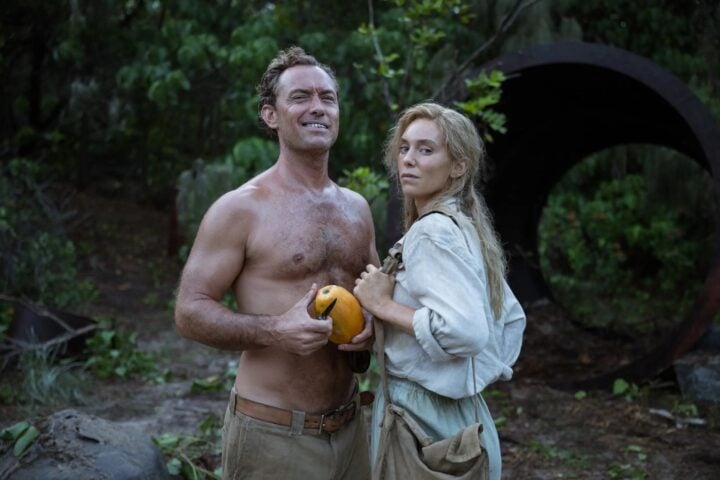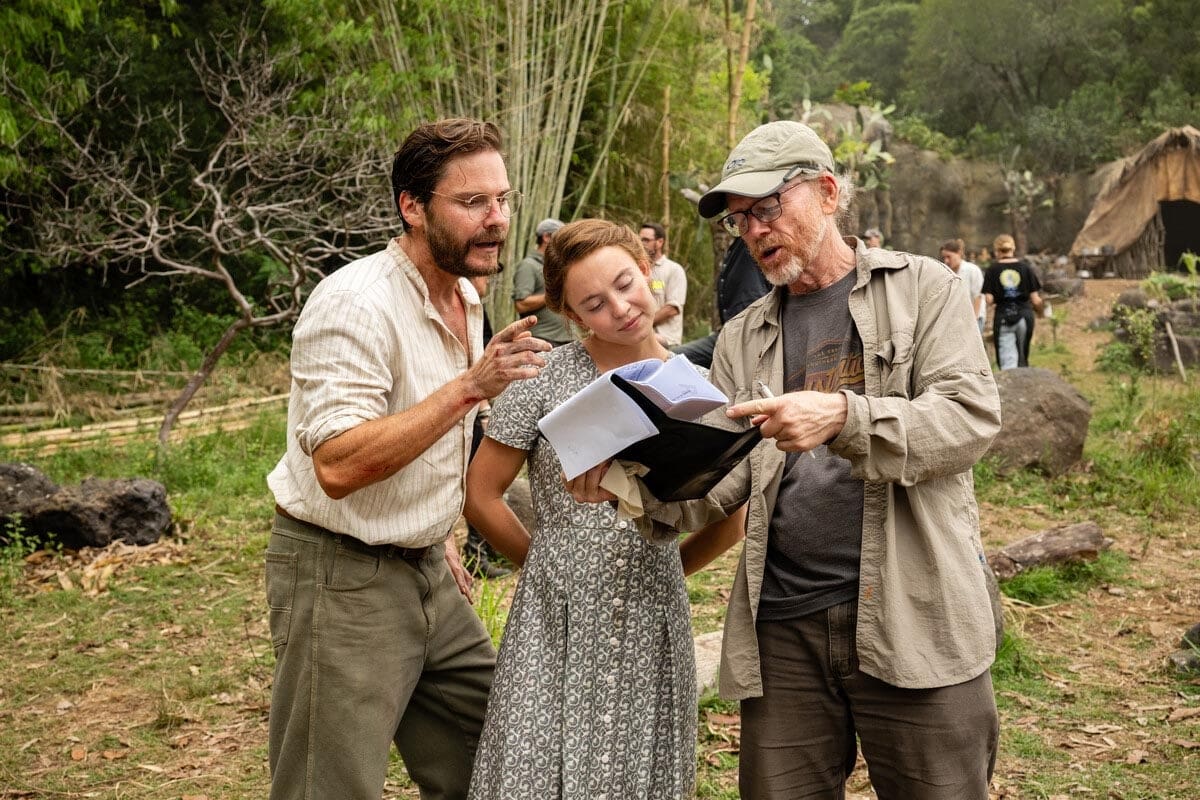
Ron Howard is drawn to dreamers, and at the center of his survival thriller Eden, which is based on the true events of the Galápagos Affair, is a man who dreams bigger than most: Dr. Friedrich Ritter (Jude Law), who moved to the Galápagos isle of Floreana in the 1930s with this wife, Dore Strauch (Vanessa Kirby) to write about his radical philosophies.
Ritter claims that “pain is truth,” and he soon begins to suffer. His dream of utopia becomes a nightmare when others begin descending upon Floreana, from a couple, Heinz (Daniel Brühl) and Margret Wittmer (Sydney Sweeney), who hear about the Ritters’ exploits, to the Baroness Bosquet de Wagner Wehrhor (Ana de Armas), who shows up with her lovers (Felix Kammerer and Toby Wallace) in tow, wanting to build an exclusive hotel on the island. As Ritter pits everyone against each other, his paradise turns rotten. Food and animals are stolen, and things reach a breaking point as bodies disappear or start piling up.
With Eden, Howard whips up a pressure-cooker atmosphere from his characters’ jealousies and feelings of despair, meeting them at their fraught level in the way he balances different tones. Throughout, the director wisely lets his actors shine in scenes like a luncheon that becomes a nasty game of truth-telling, or when de Armas’s baroness is humbled when she fails to seduce G. Allan Hancock (Richard Roxburgh), a visitor to Floreana. Both Law and de Armas deliver engaging and, at times, unruly performances, with Kirby and Sweeney providing strong support as their characters display their scheming natures as the meaty story unfolds.
I recently sat down with Howard to talk about Eden as a reality check for dreamers. Our talk covered what drew him to the story of the Galápagos Affair, his visual approach to the story, and the essential human need that his characters seek to fulfill.
So many of your films are about dreamers, and Eden is no exception. I’m curious to know how you first learned about the Galápagos Affair.
I was taken from the first I learned about the story, which was in a museum in the Galápagos. I saw a handful of the photos, some of which we are using at the end of the movie. You’re very precise. It captivated me because they were dreamers and things went horribly wrong—for most. That fascinated me. It’s a true-crime thriller. Once we knew about it on our family vacation, it’s all any of us talked about—the mystery of what might have happened and why. It was very much about believing in a possibility and investing totally in it. They were all in—then it twisted. That’s tragic but fascinating. One of the most searched phrased on the internet is “off the grid,” so people romanticized that idea then, and we still do today.
A documentary was made about the Galápagos Affair in 2013, and several books have been written about it. Did they at all color how you approached Eden?
I liked the documentary. And at the time I saw it, I was into this story and thought about it as a movie. I didn’t have a script, but I was beginning to write about it as an outline. For a movie version, we would have to have theory and commit to it and present that. Noah Pink and I spent time analyzing the accusations and the subtext, and what’s underneath the finger pointing that Margaret and Dore and others on the island—we interviewed a few people—were engaging in and we came up with outcome as the most logical in our lives and most entertaining.
Do you think Ritter believed his own bullshit? The baroness has her own agenda. The Wittmers are all about family and live by their principles. Yet they and the others, Doer, even Robert and Rudy, experience despair and disillusionment.
Really, only one group is driven by love and protection and family, and that’s the Wittmers. Everyone else is there out of ego and pride and some belief in their greatness. Ritter and Dore and the baroness and her two lovers had that in common: They wanted to be superstars and change the world and be saluted for it. The Wittmers were people society had abandoned, and they were struggling. They believed they could thrive if they could get away from all that crap. Unfortunately, society travels with us because we are civilization.
Do you see yourself in any of the characters?
I’m more like the Wittmers, but I relate to and know what was motivating everybody. I didn’t think anyone was evil. There were no bad guys. There were people who made decisions I didn’t agree with, and some of those decisions were awful and devastating, but I did have sympathy for all three of these units who hoped that they could do better by going off the grid.
It’s all about getting a better life, but how does that work in the context of an ostensibly utopian society?
Maybe to get a better life, you just have to look in mirror and look around you, and build from within, and I think they were trying to build from without.
The outdoors scenes feel quite claustrophobic. How did you set out to visually conjure such a pressure-cooker atmosphere?
Floreana is a desert island, and it’s pretty oppressive. You wouldn’t land there and say, “It’s Eden.” It’s stark, and it’s not lush. Mathias Herndl, the cinematographer, and I wanted to convey that feeling that even though this is their hope, they’re kind of deluding themselves for thinking this place is Eden. It was hard, brutal, and not inviting. Exotic, yes. It was important to get the nature of the Galápagos and the feel of those islands into the film, but I never wanted the audience to be fooled for a second that this was a heavenly destination. You see it on Sydney Sweeney’s face—how shattered her character was from the beginning. “This is where we are living now?” And yet her husband is pretending it was going to be great. That look, and that atmospheric approach, was right. We had to let the landscape be as oppressive as it could be.
How would you adapt in that environment?
I wouldn’t go. I wouldn’t last long. That’s not a dream that I would ever embrace. We did all feel that Jude Law was the one guy who had a shot. Jude wanted to live out there on the set. But nighttime in Australia, where we filmed the dialogue scenes, is when all the venomous critters come out and take over. The insurance company was not going to let Jude live on the location, which he found a little frustrating, but he was committed.
What, to you, is at the heart of the power struggles explored throughout the film?
I feel like these characters aren’t being entirely honest with themselves. The Wittmers basically fled. They’re refugees in a way. The baroness and her lovers, and Ritter and Dore, are committed to a narrative that’s supposed to add up to them being great. Ritter is the next great philosopher, and the baroness is the entrepreneur who wants to create a grand hotel that will be the social epicenter of the Pacific. I felt it was about them discovering the truth about themselves and their reality. Some do and some don’t. That was the crucible; that was the gauntlet. This test was exposing them and their own truth that they either had to come to terms with or not.
This film does feel a little different than your other films, which are more life-affirming. Is that perhaps a consequence of making a true-crime thriller?
People are a little surprised this is coming from me. My movies based on real events have been pretty celebratory. They’re truthful, and there’s darkness in the stories, but this is cautionary tale, which most true-crime thrillers are. But that scene where the baroness is trying to seduce Hancock, the birth scene, and the lunch scene—you learn so much about the characters in the matter of a few minutes—I love the whole journey. It was fun to stage and shoot.
Do you feel as if you walked away from making this film with some understanding about humanity?
Understanding the truth about ourselves and the environment we live in is important. Running away from our problems and society’s problems won’t put us on a path toward solutions. It’s tempting to stick your head in the sand, but it won’t lead to growth and societal improvement.
Since 2001, we've brought you uncompromising, candid takes on the world of film, music, television, video games, theater, and more. Independently owned and operated publications like Slant have been hit hard in recent years, but we’re committed to keeping our content free and accessible—meaning no paywalls or fees.
If you like what we do, please consider subscribing to our Patreon or making a donation.