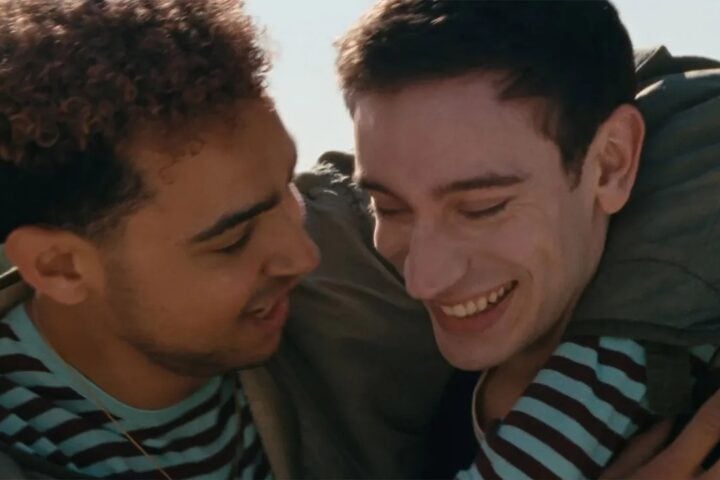
“Did you like that?” Whether he knows it or not, writer-director Alex Russell has recreated the core dynamic of his debut feature, Lurker, by asking me this question at one point during our interview. The relationship between an artist and their admirers is often envisioned as a one-way, unequal dynamic where one party produces and the other consumes. But there’s a more complicated cycle of mutually reinforcing validation that his film explores to provocative, and often frightening, ends.
At this moment in our conversation, Russell flipped the traditional flow of an interview and asked for my thoughts on a theory he floated about tweaking The King of Comedy. His contemporary take on the obsession of fandom centers on a retail worker, Matthew (Théodore Pellerin), who will seemingly stop at nothing to ingratiate himself with an emerging pop star, Oliver (Archie Madekwe). The filmmaker shared his interpretation of the seminal Martin Scorsese film after Lurker’s premiere at Sundance: that the objectivity of the filmmaking allows the audience a layer of separation from the cringeworthy character of Rupert Pupkin.
In Lurker, though, Russell sought to shift the style into a more subjective register that encouraged viewers to see their most vulnerable and vicious selves reflected on screen. “I really stand by that,” he reaffirms months later as we’re chatting ahead of Lurker’s theatrical release. Though set in 2018, his thrillingly ambiguous take on parasocial relationships pinpoints the nature of engagement with culture in our present moment. Russell’s depiction of Matthew’s ascent, in all its perversity and pleasure, achieves his stated goal of flipping the point of identification for audiences willing to look at the darkest parts of their psyche.
Beyond chatting about how he updated The King of Comedy for today’s world of fans and stans, Russell also discussed what he thinks about social hierarchies among groups of men, how an improvised line from Théodore Pellerin improved the film’s climactic monologue, and why a cryptic scene involving the two leads wrestling came to epitomize a shifting power dynamic.
The cast of Lurker has spoken about how the screenplay had such clarity, but the film is full of ambiguity. Were you defining that and aligning with the actors, or were you giving them latitude to make those decisions for their characters?
Truthfully, it’s a combination. They had latitude, but we all understood and had many conversations about what every scene was about. It’s very simple if you think about it in terms of who’s looking at who, who wants to be looked at, and for what. Thankfully, I had actors who’re so expressive in their eyes that the less they said out loud, the more we could understand just by where they were looking. That was the theory and intention going into it. As far as ambiguity, there’s clear text and subtext if you read the script.
Theo’s ability to move his neck in that first scene, just the way he’s trying not to be seen looking, is important. As a viewer, you’re trying to figure out where this guy’s head is at. That’s so much of the fun of Lurker: trying to wrap your mind around what this guy is thinking and what he’s going to do next. I know what he’s feeling, but you can never predict exactly where he’s going to go with it. The perfect example is him taking his pants and boxers off [the first time Matthew is invited backstage]. That’s such a social risk, a Hail Mary of “Is this going to impress them, or am I never going to be invited back again?” You feel those clear stakes scene to scene. But all the actors are hyper-aware of these dynamics, and we just had to catch their eyes a lot of the time.
Théodore is great at acting opposite a screen. It scans that he’s processing information in a way that doesn’t feel fake, and you can see the stakes reflected in his face. How do you direct that kind of performance?
I don’t think I directed that stuff much. I never forced him to act without seeing the thing. The first take would work, and then we would play with how crazy he was feeling at that time. What’s interesting about the moments you’re pointing out is that they’re private. What you want out of those is to reveal how much emotion he’s going to show when he’s not in front of the people that he’s calculating around. Seeing something on a screen at home, you’ll see the real him.

Havana Rose Liu’s Shai, the manager, is the one major female presence in Lurker. She feels very strategically deployed, especially in cutaways.
She’s also very strategically removed. At first, she functions like training wheels. Right after Oliver gets off stage, he’s testing Matthew like, “Well, what did you think musically?” Matthew says some bullshit like, “It was really you up there.” It’s just a little bit of a look from Shai, who’s just like, “Okay…” That’s your moment as the audience to key into what’s going on here if you haven’t already. She’s also the one who has a moral compass. She has sympathy, at first, for Matthew and is somewhat protective of him.
But when she realizes that he’s a wolf in sheep’s clothing, and the one to be protecting others from, she starts looking at him differently. She’s always pointing out what’s weird while at the same time, she’s participating in all of it. I think she’s conflicted. I think she’s probably dealt with a lot with Oliver over the years, and is a little bit on the jaded side and on the way out anyway. When she ultimately does exit, she’s reached an inflection point, and it doesn’t need to be talked about. And then, [when] she’s gone, we no longer have that audience surrogate at all. The train has gone off the rails, and as an audience member, you feel like icky and complicit in the rest of the movie because of how invested you’ve gotten in these characters.
Maybe now’s a good time to talk about The King of Comedy. Is Matthew all that different from Rupert Pupkin, or has the world around us changed so much since the ’80s that he’s just no longer an outlier to us?
I’m sure, at the time, people were participating in the same type of thing. The mechanics of it have changed, and I think that Matthew is smarter than Rupert Pupkin. I’ve seen Rupert Pupkins in Lurker-y type scenarios that just fuck it up, or don’t last as long, or show their hand. What I liked about Matthew is yes, he’s desperate, but he’s disciplined. He does his homework, and he prepares. He learns [the editing program] Premiere! [laughs] I like that he’s good at it. What I wanted to imply by putting everyone in the driver’s seat is to see there’s Rupert Pupkin in everyone, whether or not you would go to the extremes of Matthew.
I always give this example: Have you ever gotten a text from your old friend and a text from your new shiny friend? Who do you text back first? That’s a social calculation, and people are always making social calculations. Some people have more shame than others. People don’t talk about it, but everyone who’s ever tried to do something outside of what they were given had to, at some point, impress some room of people. They had to put themselves out there, and they had to think about what these people might think is cool or smart. That’s all that Matthew’s doing in the first half of the movie. He’ll just take it a little farther than everyone.
How do you feel about Matthew’s monologue at the end about what the role of the fan is to the artist in contemporary times? He’s an imperfect messenger, but it does feel like we shouldn’t write off his observations entirely.
It’s powerful because there’s some truth in what he’s saying. But what I like about that whole bit is it’s possible that he doesn’t even believe any of this that he’s saying right now. It’s just that he’s saying it because he thinks it will work on Oliver, and that’s all that matters. He could be obsequious and make it work, or he could be like, “Hey, I’m the only one being real with you.”
I don’t want to interpret the monologue, but I’ll say one fun fact. When he’s like, “I just want it more, and I’m better,” the “and I’m better” was improv. But then it was so perfect that we kept it. What we realized going into shooting that scene was that this is Matthew’s transformation into a director. He’s [essentially] saying, “Just follow my lead.” And it’s Oliver’s transformation into sub. It’s just so abusive and oppressive, but Oliver is just like, “Okay, Dad, let’s just go there.” The “and I’m better” piece is important because he’s like, “I’m the one who knows best,” and Oliver has no choice but to agree in that moment. But, eventually, he does agree.
You’re getting at something interesting: the possibility of an honest lie. Can we ever build anything real out of something built on a foundation of fakeness?
Totally, but then…can this perverse honesty come out of it all in the end? And is there such a thing as pure honesty or pure lies? I think this movie is playing with those questions a little bit. There’s also ambiguity and subjectivity of opinion about what’s cool, what’s not, what’s good, and what’s bad in Oliver’s work. Nothing matters except opinion. It’s all in a vacuum. Everyone is looking for someone to tell them what’s cool.
After making Lurker, do you have any theories on why it doesn’t feel as common for men to discuss and depict hierarchies?
Men don’t want to appear jealous of each other. Girls being fake is a trope. It’s so known. Men are ashamed of voicing their sort of status anxiety because it requires admitting that you’re not where you want to be or that you’re not in a strong position.

Is that dynamic something that plays into the wrestling scene toward the end of the film?
On the day, I was interested in trying variations of who ends up on top at the end of the wrestling scene. It was a choice that, at the end of the scene, it’s not Matthew on top. Oliver has Matthew pinned, but Matthew’s laughing. Matthew has manipulated the situation such that he’s been pinned, but despite that, you can tell that he’s the one with all the power. Oliver is the one who’s the most stressed. And Oliver is, in a way, hugging him. The way I tease them having a gay sex scene there…I feel like people got mad at me for not doing it. And I’m like, “It’s just not about that.” But [on that] day, we [did think], “We’ll shoot it both ways.”
But you didn’t?
We didn’t have time! Another thing: When I was doing draft revisions, I would send them out sequentially to the actors. There was one draft where I’d accidentally cut off the bottom of a page, and that was the wrestling scene. It was the only time I got script notes from the actors. They both hit me up individually, like, “Hey, how come you cut out that wrestling scene? I really wanted to do that.” It’s just one line, “and then they wrestle,” but I just thought it was funny that both actors independently were excited to do that.
I’m asking this question in part because I’ve seen Archie in real life and was struck by his height: Is there a primal, physical thing tapping into our animal brain in these group dynamics among men?
One hundred percent, and I think the fact that he’s so tall made it easier to express that with the camera. We could just shoot him kind of normally, and he would have a little more gravity than everyone else. I always talk about this chimpanzee documentary, where I learned that chimpanzees all know what position they [occupy] in the alpha-male hierarchy. They know if they’re number seven or whatever, and I was fascinated by that because you see them form little alliances and try and get close to the powerful one. They do this thing called “grooming” where one of them will pick sticks out of the other’s hair. If they’re on an equal playing field, the other chimp will do it to them. But there will be situations where one will pick sticks out of the other chimp’s hair, and the other won’t do it back. That’s how they establish their dynamic. That base-level, primal thing that you’re getting at really is in people. If you start to look at things through that lens, a lot of things become clear. Geopolitics, territorialism, tribalism, borders, all of these things that are being fought over by men could be coming from that deep place of power.
Do you see Lurker at all in conversation with the “Forks” episode of The Bear that you wrote? Is the cure for modern man’s ails just to learn routine, duty, devotion?
I’m interested in characters who enter a new space and have to assimilate. The episode is about someone seeing other people find meaning in obsession and starting to get it a little bit and inherit a piece of it. I think you could look at almost anything that I’ve done through the lens of attention. Who’s getting the attention and why, and what they’re willing to do for it.
There’s a quote from Lady Bird where the priest says, “Don’t you think they’re the same? Love, and attention.” I tend to agree, but it’s very intriguing to see the darker side of attention through your work.
This is evil Lady Bird. I need to rewatch that. Have you seen Dìdi? Sean [Wang, the film’s writer-director] is actually in my movie briefly as an Easter egg, [and] I hope people [notice] that. I like to think that he is the character from Dìdi grown up. If you think about the period, that’s 2008, and this is 2018. That kid, 10 years later, would be a 23-year-old videographer for Oliver. I used to joke about how this movie is evil Dìdi because so much of Dìdi is him trying to be friends with this group and fit in. That scene where he’s online pretending to like that movie for a girl, there are parallels that I think are funny.
The characters get what they want from the ending and each other, but are they victorious? Are they satisfied?
I think they’re always going to want more. I don’t know if they’re satisfied, but I think they’re on their fantasy path.
Maybe the better way of asking that question would be: What is the axis on which you would want viewers to judge the ending?
[pauses] What do you think?
For me, it is: Has Matthew finally eclipsed being a fan now that he has a fan himself? Can you ever make that jump from fan to artist?
Their relationship implies that he’s made himself indispensable. It’s no longer about the blackmail. It’s no longer about him needing to be tested or to come up with cool ideas. He’s gotten to the point with Oliver where he’s the one indispensable friend. You get the context from someone asking, “What does it feel like to be nominated for a Grammy?” He’s coming up in the world, and you know that it’s because of Matthew. For Oliver, this is the deal with the devil that he’s made. If just hanging out with this guy is going to keep me on my upward trajectory and you’re going to be the biggest artist in the world, that’s a small price for him to pay.
But I think the larger implication is: What does success look like? It’s the answer to that question at the end that we don’t hear. What does it mean that this worked? What does it mean for everyone successful? When you give so much of yourself to the public, then you’re beholden to them. If you start feeding them, now you’re just a servant.
Since 2001, we've brought you uncompromising, candid takes on the world of film, music, television, video games, theater, and more. Independently owned and operated publications like Slant have been hit hard in recent years, but we’re committed to keeping our content free and accessible—meaning no paywalls or fees.
If you like what we do, please consider subscribing to our Patreon or making a donation.