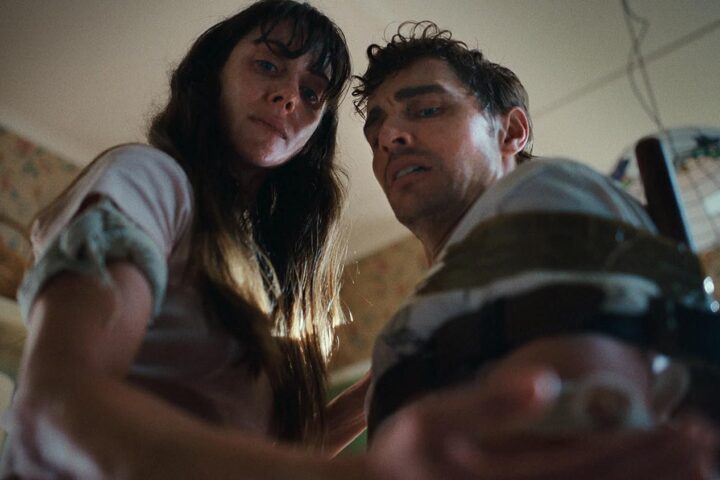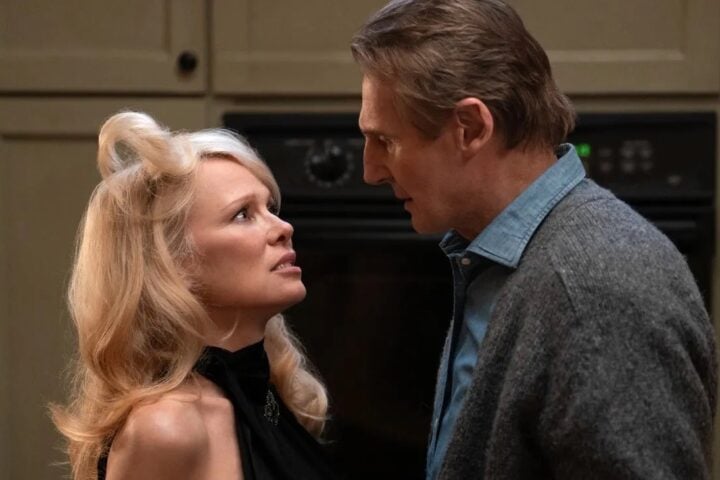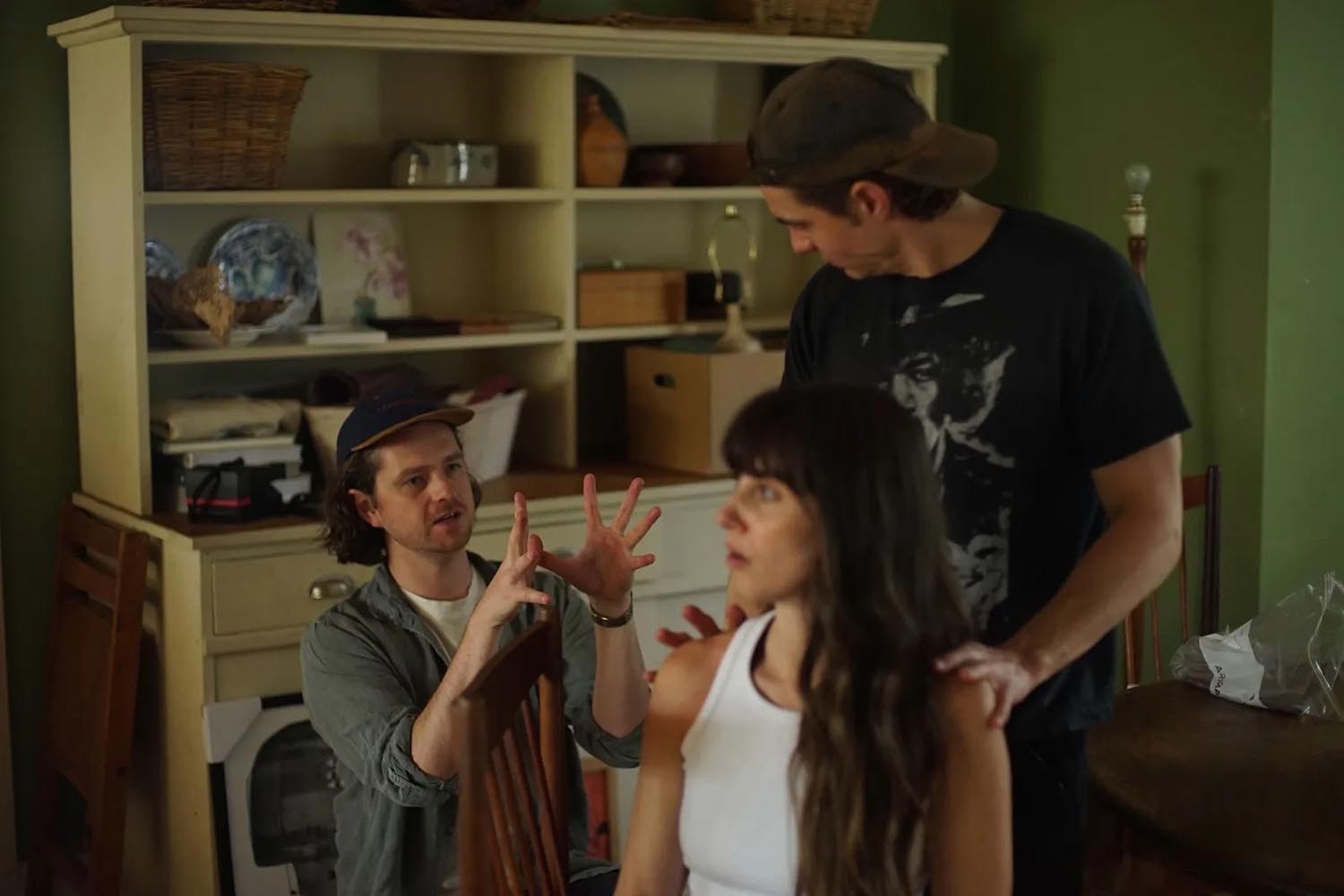
“Are we still together because we love each other or because we’re used to each other?” asks Millie (Alison Brie) to her long-term partner, Tim (Dave Franco), at one point in Together. It’s a question that many real-life couples, such as Brie and Franco, might ponder at some point. But these characters face an additional obstacle beyond the psychological dimension of pondering whether to remain a pair: a mysterious physical force that renders their ability to separate their bodies from one another increasingly difficult.
The stickiness, both literally and metaphorically, of Together’s central concept comes courtesy of first-time feature filmmaker Michael Shanks. The Aussie writer-director began as an online video creator in the early days of YouTube under the name TimTimFed, building toward short films and other narrative projects as his career developed. This history working within a more sensationalist form doesn’t weigh down his freshman film, which balances squirm-inducing effects work with a deeply human story about two people confronting their codependency.
I spoke with Shanks ahead of Together’s theatrical release. Our conversation covered why he went lighter on explaining the animating force of the horror elements, how the production pulled off the bodily contortions, and what the film’s ending means to him.
So many high-concept genre movies feel the need to over-explain the metaphor or mythology, and Together avoids falling into that trap. How did you approach what you would reveal and conceal about the forces on display in the film?
I never wanted us to be too ahead of the characters, although you know it’s inevitable that a certain amount of the film is going to be spoiled by a synopsis, poster, or trailer. But in terms of the script, when everything’s revealed and we see some of the backstory and some of the explanation, I wanted to give enough space where the brain to fill in the blanks. I recently saw Bring Her Back, and I think they did a beautiful job with it. If a film stops to over-explain its own lore, it can be a little bit like listening to somebody read a Wikipedia page.
So many movies today treat their concepts like a puzzle box that’s there to be solved. But Together isn’t about us solving a mystery. Rather, it’s about going on an experience with the characters and feeling along with them.
With the first draft of the script, I remember thinking, “What’s the source of the supernatural element in this?” And then I realized, “Well, I don’t really care! And I don’t know that the audience really cares.” But then as drafts progressed, I imagined some backstory that I really liked. Putting that in changed the script for the better, but I’m still just keeping it peripheral.
You’ve expressed fondness for silent filmmaking in the past and even made a short with a non-speaking protagonist. Did this style also influence Together?
Definitely. I feel like I do most of my direction in the storyboarding process. I always draw my own storyboards. If we didn’t have the script for the day, I would feel fine. If I didn’t have the storyboards, I’d feel like I’m at sea. I don’t know where that comes from—maybe from growing up loving animation. When I was making YouTube comedy sketches, I was always conscious of the fact that I wanted them to play internationally and not fill everything with potentially jagged Australian accents coming from me being in them. To me, what’s cinematic is using all the tools in the filmmaker’s box rather than just sound and dialogue. We have a prologue in this film where there’s no dialogue, and there are lots of sequences driven more by blocking and camera movement than it is by the dialogue itself. It’s just something that’s exciting to me.
What’s the balance of sticking to your planned storyboards and knowing exactly what you need from a scene while also leaving yourself open to surprises on set?
I heard one of the Coen brothers on the Team Deakins podcast, where he spoke about how they always have storyboards for their scenes but almost never use them. And, then, on the day [of shooting], if they have no ideas, they’re like, “Well, let’s look at the storyboards. We obviously felt this was good.” They use them as a backup, and I really like that as an idea. I really try and stick to my storyboards, but I always storyboard, because in any of the productions I’ve worked with, we have never, ever had enough money or time to shoot as extensively as I like.
So, on a scene where we’re going to do 12 setups, the DP says, “Hey, we’ve only got this many hours. We’re gonna get six setups.” And then you start crossing storyboards off. But you never want to be going, “What should we do?” If you’ve over-prepared, it’s much easier to condense and then make the case for why this shot is important and, no matter what, can’t be cut. In every production I’ve ever been a part of, I’ve always storyboarded bird’s-eye, top-down shots. I’d never been able to film one before because they’re always the first to go. In this film, I got six in!
What was the process of developing the physicality of the performances with Dave and Alison that could mesh with your vision for the effects?
It was a collaboration with our stunt supervisor because I hadn’t done a lot of that stuff before. Dave and Alison are so fit, and they both have done stunts before. Alison’s done a bunch of wrestling because of GLOW, so they really threw themselves in the deep end. We had stunt performers, of course, but they did a lot of their own stunts and physical work. We only had a few days of rehearsal, but leading up to the film, [we were] tying harnesses around Dave and Alison with this elastic rope and trying to get them to run as far away from the rope whilst we were pulling it back and just seeing what interesting movement happens.
There are moments in this film where their bodies almost become magnetic toward each other. I was keen to make it nice and scary, and there’s some contortionist work where we are intercutting between Alison and a contortionist performer—and hopefully selling the illusion that it’s Alison the whole way through. That sequence was a combination of physical stunts, CGI face replacements, and Alison’s incredible replication of a professional contortionist.

Maybe this says more about me than the film, but I found Together hilarious even as it’s not necessarily trying to hit comic-specific beats. How were you calibrating the wide range of reactions a scene might elicit?
I’ve always loved cringe comedy. A scene of tension in a scary way can often be just an iota away from that exact same scene as cringe comedy. When I started writing the script, I definitely was thinking this was going to be straight horror. I do think of it as a horror film, but the more the film goes on, the humor starts to come out because the situation becomes so insane. I was just trying to be honest as to what I would be like in these situations, and I would be incompetent, sloppy, and awkward. Writing the truth of who these characters were leaned into my background as a sketch comedy filmmaker.
To me, this is a film that’s trying to take people on a thrilling journey. I want it to be scary and dramatic, but I also want people to walk up being like, “That was fun!” Any time there’s a lapse, I was like, “How do we get something scary, unexpected, and funny to come into the scene?” There’s a scene that I’m proud of—a long, emotional scene of two people talking about something quite serious. Then, out of the blue, I crash-zoomed in on a character lurking outside and peering in. It’s not even a funny moment. It’s just a moment where the visual language of the film was getting just up to the line of kitsch there. It makes me chuckle every time I see it.
You’ve said it was helpful to cast a real-life couple in the leading roles, so how did you approach that metatextual element? Was it something the three of you could speak about openly, or did you lean on them to fill in the blanks with their shared language and knowledge of each other?
I think the metatextual element of it is really interesting, and to add another layer to it, the script is based on my relationship with my partner of 16 years in many ways. These characters have been together for over 10 years, and Dave and Alison have been in the relationship for over 10 years. They’re playing this abstraction of the relationship that my partner and I have, but in this heightened, crazy, and much less kind way. You feel it with them, as they have a history, and they bring that emotional authenticity and history onto the screen.
Just on a practical level, the things we needed them to do, we could not have asked a non-married couple to do. This was a low-budget film where we had 21 days to shoot something really ambitious. They were just so comfortable working with each other. There was a day where they both had to be fully nude in front of the camera for an entire day, and they were just so comfy and cozy in front of each other. There were days where they were physically connected via prosthetics that we had no budget to replace if they got ripped. When they needed to go to the bathroom, they literally had to go to the bathroom together, which is something you cannot ask actors to do. But they offered! They were just so game for everything.
Because they were, as producers, part of the development process, was there a process of mapping the characters from your relationship onto their relationship?
The changes to the script once they came on board were more in dialogue. Structurally, the film has always been as it is. Alison had a great idea to gender switch the character of Jamie [played by Damon Herriman]. In my first draft, this neighbor was an older woman, and Alison’s idea to change that character’s gender totally opened up another element of the film. But otherwise, we went through the dialogue and just put it in their own words a little bit. It’s still mostly as it was, but there were just some lines where they’d be like, “We’d probably say it more like this.”
I had written this in Australian [English]. In one of our first meetings, Dave said something like, “Do you say ‘I reckon’ a lot? Is that an Australian thing?” And I thought, “Americans don’t say that?” But every other line of dialogue, he’d be like, “I reckon we should do this. I reckon if we did that, then that could happen. Don’t you reckon?” And I’m like, “Oh God, I gotta take out all these ‘I reckon’s’!” There was a whole conversation about getting into the boot of a car that we changed into getting into the trunk of a car…which was then a scene that was cut!
How did you settle on the nature of the ending? A lot of horror films back off the threat of the dangerous force and reassert the social order. This is…not that.
Without getting too spoiler-y, I can say that the first scene I wrote of this whole film was a big set piece that happens in a hallway in the middle of the night. I wrote that and thought, “Okay, I like this. This can work.” Then, I zoomed out and thought, “Okay, well, what is the story? Who are these characters? What’s the emotional journey?” But I think the second scene that I wrote was the very final scene of the film. Once I knew what the premise was, I just knew that was the end. The camera direction exactly as it plays out in the final scene is written into the script on the very first draft. I just felt that was the destination, and it was never challenged by some producers. I think it’s a wild image to leave people on as the film cuts to the credits.
If this originated somewhat from your own feelings about relationships and codependency, are we to take that final shot as a statement on where you stand on those forces now? Or is it just a playful provocation?
It’s a little bit of both. I hope that if you were to take the horror out of this film, you would still have a compelling relationship drama. The central question of any relationship drama, particularly with this couple going through fraught times, is if they’re going to stay together or split up. In its own weird, abstract way, this film declaratively ends with an answer to that.
Since 2001, we've brought you uncompromising, candid takes on the world of film, music, television, video games, theater, and more. Independently owned and operated publications like Slant have been hit hard in recent years, but we’re committed to keeping our content free and accessible—meaning no paywalls or fees.
If you like what we do, please consider subscribing to our Patreon or making a donation.