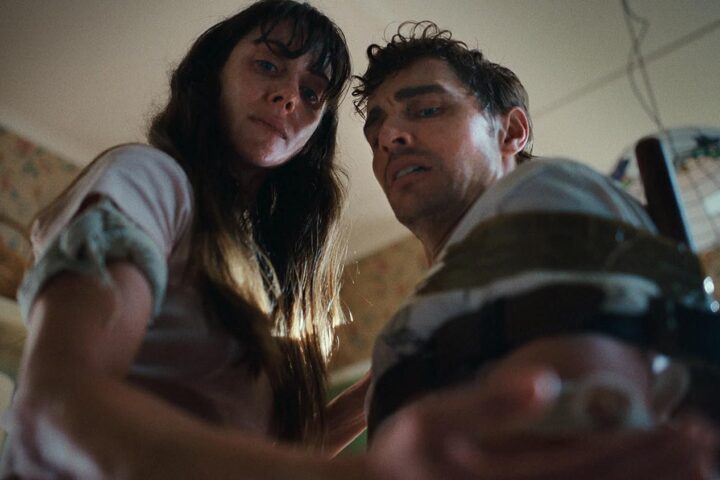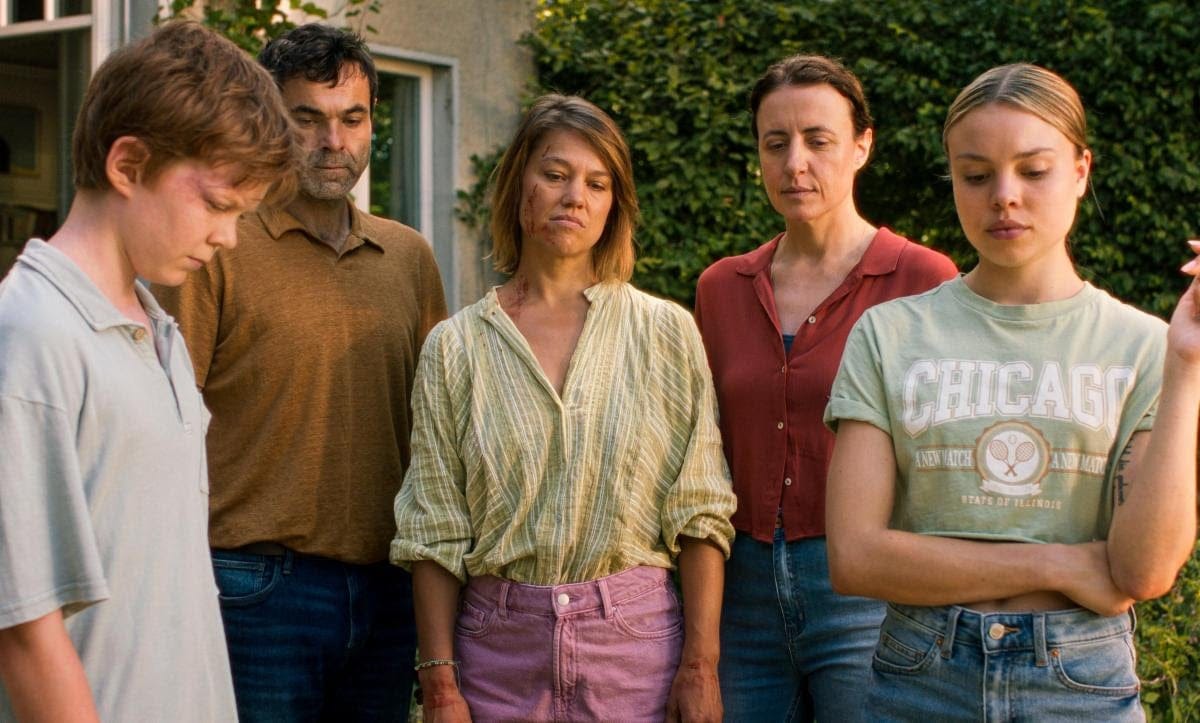
There’s a moment in The Sparrow in the Chimney involving a household appliance that implies a gruesome outcome for one of the film’s characters, and it’s sure to elicit a more visceral reaction than your run-of-the-mill slasher. This is the third film in an unofficial trilogy about domestic dysfunction by Ramon Zürcher, with much of the tension built up by the meticulously crafted The Strange Little Cat and The Girl and the Spider seemingly being released in The Sparrow in the Chimney’s stinging finale.
As a family gathers for a birthday party in the Swiss countryside, complaints about little tasks turn into passive-aggressive squabbles that ultimately lead to violence. Members of this family love to tyrannize and flirt with each other, either around the house or in the more private cabin near the lake—moments of needless cruelty or awkward romance that are never as private as the characters imagine. And as more guests arrive, more uncomfortable family secrets are revealed—until the film’s materfamilias finally breaks down and loses touch with reality.
Ahead of The Sparrow in the Chimney’s week-long run at BAM, I spoke with Ramon Zürcher about his studious production approach and how houses can aid and abet voyeurism.
How are you at handling house parties? I’m curious if the tone and mood of the party sequences are based on ones you’ve hosted.
Actually, I guess the only time I lived in a house was also my family’s house. And we never had such huge birthday parties. It was just Christmas parties, and those were rather concentrated in the interior, not so much in the garden. So, no, it wasn’t like this. This film is very personal, but the birthday party isn’t. It’s just how I would think that family would celebrate a birthday.
Animals have been a very important part of all three of your features. Is it difficult to work with these unpredictable creatures?
The easiest animal to work with is a dog because the animal trainer can really work well with clicks and with food and with their finger. They can even work with the gaze of the dog in the choreography. It’s a very mechanical technique and it’s very easy. Cats are difficult because they have different personalities. In this film, the cat was very professional. The animal trainer was amazing, and it felt a little bit like working with a dog. So, there are some exceptions.
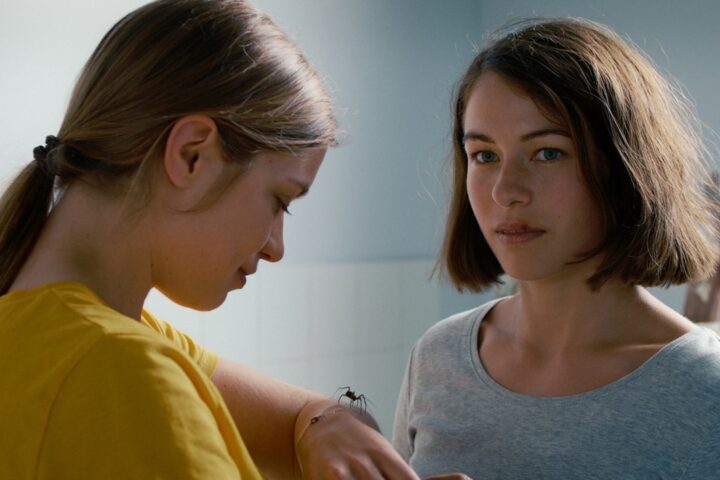
The rat was just like the cat and the dog. And for the butterflies, we shot maybe two or three scenes of them in front of a blue screen and embedded them in post-production. With them, it was important to work with temperature or with perfume because perfume guides them and the temperature makes their movement quicker or slower. They’re a little bit like spiders. In The Girl and the Spider, we always had to put the spiders into a refrigerator to make it slower because otherwise it would’ve been too quick. The other animals, like the fireflies, are all CGI.
It’s important to be structured. You have to ask whether or not an animal is [going to be on set] and whether we shoot it after we shoot the actors. You have to have a plan and you can’t be naïve about how the animals work. And it’s important because sets are always chaotic. It’s always so loud. You have to be able to build a safe space for the animals so that they can follow their intuition or their instincts and that there are not too many noises.
Speaking of another kind of unpredictability, you manage to work with that finicky golden hour light for the first hour of this film. I’m curious what you planned with your DP, Alex Hasskerl, in order to consistently capture the golden hour.
In the script, we always marked which time would be so that we could always know if it was morning, afternoon, or that golden hour and when the light sets down. And the good thing was that when we shot inside, it was always artificial lights, so we could control the light. Also, when we were outside, we could control it because we had one or two big lamps that worked like the sun. The film is real-time storytelling, and it takes place over just two days, but we shot it in 32. So it’s very important [for a production like that] to have light which can be controlled.
There were maybe three or four shots where we were very much dependent on the sun at sunset. It was the moment at the end of the film where Johanna and her Aunt Julie speak to each other about the dark past. There, it was very difficult to really get that good light.
In your films, your characters are picking up and talking about objects that are very important to them. Here, you include plenty of insert shots of objects throughout the house. What kinds of conversations were you having with production designer Peter Scherz in order to give character to this house?
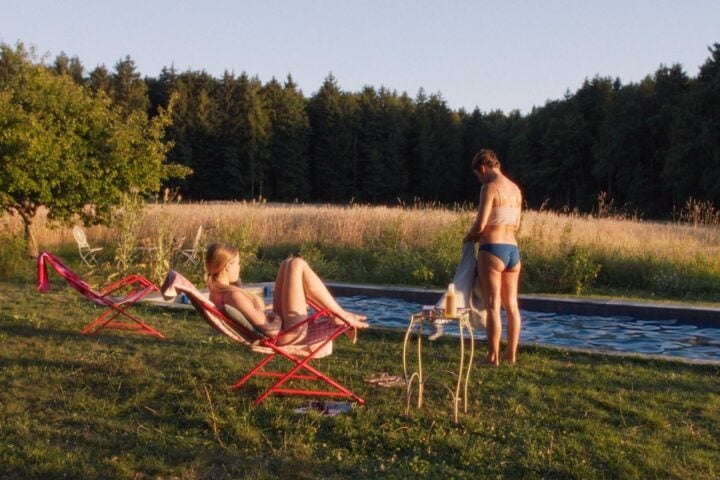
We decided that focusing on the past of the family was very important. During the film, we always observe a little bit more about the past of the family and what happened in that house years ago. And so, for us, it was important that the house has a past—that it’s not a very new house with newly painted walls, but that you feel the past a little bit.
We knew that the house is like the protagonist [of the film]. It’s not only the setting, but it’s something which makes the dead grandmother visible. That dead grandmother, who’s present like a shadow, like a ghost, is a little bit like a part of that house, right?
So, we knew that the house had to have a certain aura or patina of the past, but we also knew that the garden had to be like a paradise. That the whole house is kind of like a paradise that the spectator watching the film thinks, “Oh, it’s just a dream living there.” But during the film, you make a slow, deep dive into a family hell so that during the film there grows a contrast between that paradise setting and the coldness and the darkness of that family.
This is the biggest domestic space you have shot in so far, but I noticed that you still manage to keep everything tight, almost claustrophobic. How did you choreograph your cast and crew in order to achieve this?
We were interested in having the illusion of a prison or the illusion of claustrophobia—a little bit like the sparrow in the chimney. There’s a potential to fly, but because of the chimney we can’t fly. We are in a prison. We wanted to make it like a big chimney where birds are inside but they can’t fly because there are invisible walls. It’s like an invisible prison and it’s claustrophobic.
That has much to do with the work with Alex, the director of photography. And with the set dresser, Peter Scherz, it was mostly important that the walls weren’t white—that everything’s colored to give the house a presence, making it a little bit more visible. Sometimes we have total shots or establishing shots, but often we are a little bit closer. [There’s also] the fact that the camera is always static or a little bit slow. We edit a lot, of course, but it’s still a little slow.
I read that the house was in Rapperswil, Bern, near where you grew up. How did you scout for this house? Did you write the script before finding it?
First I wrote the script, and I didn’t know the house. There was nothing that was an inspiration or anything like that. After writing the script, we had the fundraising and looking for money. Switzerland has more than 20 regions or cantons, but a main part of our money came from Bern, and so it was important to find a house in that region. And we had a location scout who looked at different houses. But this one here was the only house which really had the patina, which had a really wonderful garden, and which really had the forest which was very close.
One positive point of this house was that we didn’t have to fake shooting the interior of the house and the garden at the same location. So we could sometimes shoot in the kitchen and let the characters come in or come out to the window. So that fluidity between exterior garden and interior kitchen could be built. And the only negative thing was there was a huge road with many cars directly near the house, so we always had to block off that road. But that was absolutely doable, so it was a big gift finding that wonderful house.
The characters in the film seem to always be watching others during awkward or tense moments. The girls witness a tragic event involving their family, and there’s that haunting image of the dog staring at the washing machine. I’m curious to hear your thoughts about this emphasis on a kind of active watching.
For me, it was to build that system of witnesses and voyeurs, of people watching each other, never knowing if it really is an intimate scene or if somebody is there behind the wall at the door watching it. I guess I’m interested in designing the family’s system of interactions, and the house is very important for that because there are social rooms like the kitchen and there are rooms where you can be separated, like the children’s rooms or bedrooms. So a house already gives you the setting for different situations—social situations and rather intimate situations.
I’m interested in the fact that I can build those social situations in the kitchen and intimate situations also, but that you never know if there’s somebody witnessing it. That intimacy is always a little bit fragile. But I guess because the whole space is an interior space, it behaves like the psyche of that family. And it’s important, for example, that somebody understands something or hears a story not because another person tells it to them, but because that person witnesses it and that changes the whole relationship [among the characters].
I’m interested in psychological issues. Dialogue, watching, hearing—those interactions are the important material of that whole family’s construction. So while writing the script, it’s always about looking where they can be and constructing that system of voyeurism.
Since 2001, we've brought you uncompromising, candid takes on the world of film, music, television, video games, theater, and more. Independently owned and operated publications like Slant have been hit hard in recent years, but we’re committed to keeping our content free and accessible—meaning no paywalls or fees.
If you like what we do, please consider subscribing to our Patreon or making a donation.