
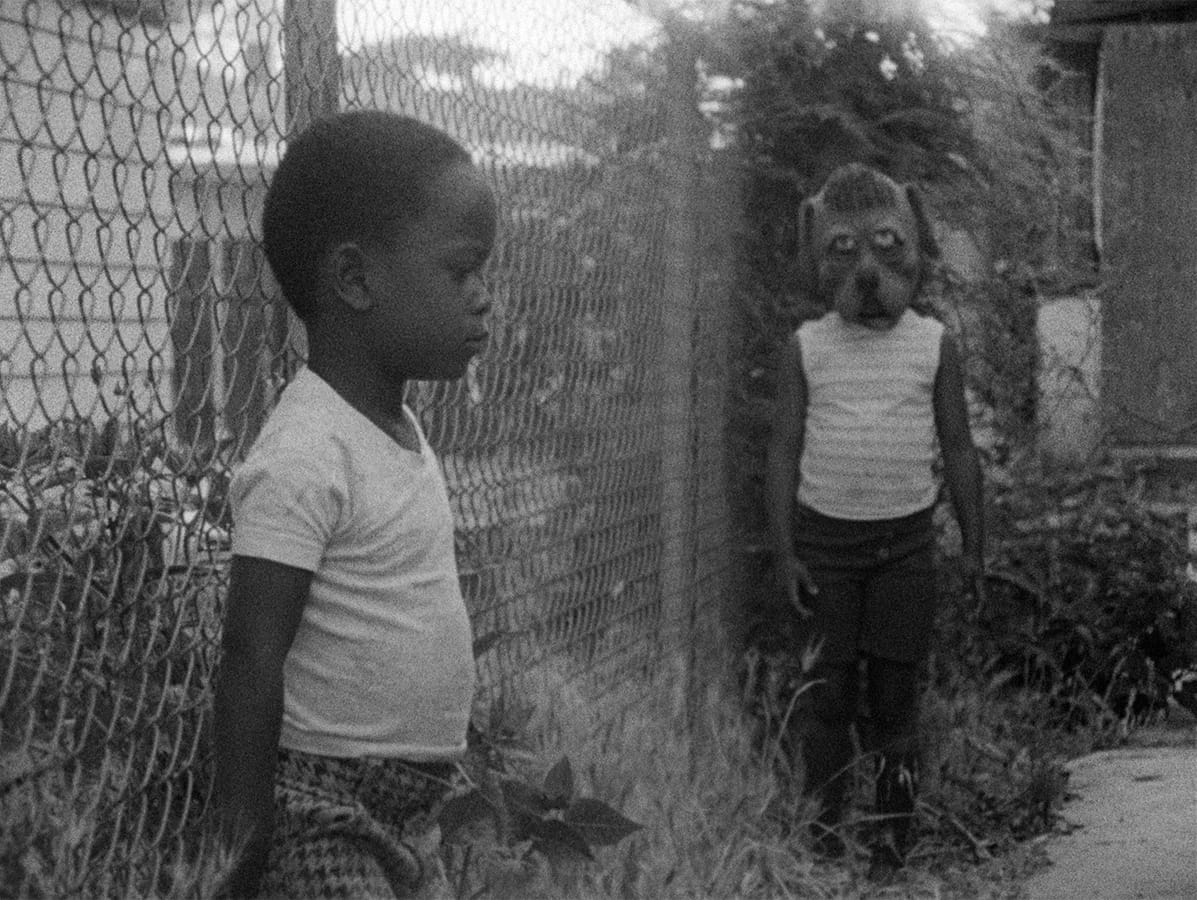
Nearly half a century after its first release, Charles Burnett finally has his landmark feature Killer of Sheep where he wants it. His rhapsodic portrait of Black life in the Watts neighborhood of Los Angeles in the early ’70s has faced countless challenges across its lifespan. Even in the limited ecosystem available for Black independent cinema in the late 20th century (especially in the United States), the film’s only assets available for exhibition were tattered 16mm prints. The costs of licensing the film’s soundtrack, which provides an aural texture inextricably linked to its visual poetry, further limited its distribution prospects.
Even after the Library of Congress designated it among the first 50 titles for the National Film Registry in 1990, Killer of Sheep was still not widely available to screen until a 2007 restoration by the UCLA Film and Television Archive for Milestone Films (funded in large part by Steven Soderbergh) helped clear the music rights. A new 4K restoration, released in theaters by Kino Lorber and on home video by the Criterion Collection, has now made this singular film, which revolutionized Black cinema in America, available to more audiences. With greater clarity of image and the ability to end the film on his desired needle drop, Dinah Washington’s “Unforgettable,” the grit and glory of Burnett’s lyrical mosaic life shines through.
I spoke with Burnett following Killer of Sheep’s Criterion Collection release in May. Our conversation covered how the challenges of production benefited the film’s form, what the project means to him today, and why it remains so important to show Black life as it is.
What still feels present tense to you about Killer of Sheep? Does anything feel like it’s become an image of a bygone era?
There are some things about it that date it for me because several people in the film have passed on, like Kaycee Moore. Every time I see the film, it has that sad quality about it. Some people who worked on the film have also passed on as well, so it has an edge to it because of that.
You shot it in the early ’70s before it premiered in 1977. Were you working on it all that time? Were you tempted to keep tinkering with it over the years?
It was [shot] on the weekends, so it wasn’t a question of time. Because I didn’t have the equipment, the film, the days, or anything like that, when it was made, it was made! It was just recently that I was able to make major adjustments in terms of coloration and stuff like that.
Clearly, the music of Killer of Sheep is an important element, given that securing the rights is the main reason that it was so hard to see for many years. How did you envision the role of music in the film? Is it a commentary on the images?
It was a factor in making the film because when I was listening to the music, I thought of certain images, what was going on in the community. Most of that music was played by people I knew in the community. It was part of the scheme of making the film.
Who did you see as the audience for Killer of Sheep?
I didn’t have a theatrical release. I didn’t go for it because of a number of factors. It was this independent film, and at the time it was made, you couldn’t show it in the theaters anyway. I just thought I’d be doing films as a hobby and making films via the money I made from another job. It wasn’t until years later that it became possible to market the film, and that was because of people like Dennis Doro, his wife, Amy, and Milestone Films, who made it happen.
Was your photographic background and interest in capturing life as it was in an unobtrusive verité style ever in tension while making the film?
The idea was to make it look like a documentary—to put the camera up in the community and catch life. I purposely didn’t go for conventional ways of making a movie, like getting master shots and coverage. I just set the camera up, and I got what I got. That was it.
Did not having some of those traditional shots present any challenges in editing?
I wanted it to look rough, and it did in many cases. It gives it a unique quality.
You envisioned Killer of Sheep to look as if it were shot by someone who had never made movies, but the film is deeply intentional in its framing. How were you reconciling these seemingly contradictory approaches?
I was interested in compositions, and there were a lot of opportunities to get good camera work and composition in spite of the fact that I wanted it to look natural. I used to work in a library, and so I used to read a lot of the photojournalistic magazines and things. I wanted to film to look like that, to some extent—like a person just put the camera up and caught all these images in the community. It reflected how it looked when I was growing up, and still does now in many ways.
You’ve mentioned that the neighborhood was populated by people who came from the South. Whenever a place is populated by people who originally hail from somewhere else, at what point does it become theirs?
One of the things about living in South Central then and now, I suppose, is that the culture is pretty much the same. It’s located at a distance from downtown Los Angeles, Hollywood, and Beverly Hills, so there’s very little influence they would have on the community except for the movies. One of the things I wanted to talk about in Killer of Sheep is how isolated [Watts] is. It was virtually a Hispanic and Black community, and in many ways, it’s still a bit like that, except that there’s gentrification that took over in some areas, which is apparent. It was a fun place to be. L.A. was a lot more undeveloped then. You could go down further toward Compton, and in between, there were ranches where people had horses. We had chickens, rabbits, and so forth. It was very much like the South—very country-like.

You’ve said that the point of making the film was to present the world without imposing your values onto the images. But when you look into them and think back to production, did you see yourself identifying more with the world of the adults or that of the children? That’s assuming you can even separate them.
I looked at it as separate, in a way, because there was a distinct difference between the areas you played in. The whole film was about trying to picture a community and its changes over time, seen through the eyes of a young kid. The elements in the film are stories about how kids are taught these habits and learned how to survive an adult world. It’s very violent; kids learn games that are almost like a struggle for kids to survive, in a way. They learn how to play rough because that’s how life is going to be when they grow up.
Were you developing the children’s stories and the adult stories in parallel, or were they almost kind of operating on separate narrative tracks in your mind?
I had [the children’s stories] as a prelude to what you experienced as an adult. The kids are developing certain habits that they learned from the adults. In the very beginning, you hear this kid getting schooled by his father about how you have to protect your brother or relative no matter what because blood is thicker than water. That’s your responsibility as a sibling, to look after your family members and brothers and sisters your age. It does two things. It helps you to survive in the community, but it also desensitizes you to certain things that you should question.
I saw many of the L.A. Rebellion films earlier this year, including ones like Passing Through and Bless Their Little Hearts that you worked on but didn’t direct. How did all those collaborations inform your directing?
At UCLA, you had to work on other students’ films. What we were trying to do was find our voice. We would have these conversations at UCLA in the daytime, and in the evening, we’d go and meet at a restaurant or someone’s home to talk about what the Black community needed. It was during the civil rights movement, so there was a need to make films that had the effect of social change and said something about the community that wasn’t said by other means.
Most of the films that Hollywood was making were perpetuating this negative image of people of color, and we wanted to correct that. We were not like the Black exploitation films, but we were looking for something that talked about who we were as human beings. We shared the same goals, and our coming together and having these moments of trying to find our voice helped us to share certain attitudes that we wanted to bring out about the community.
How has that task changed over the years? We’ve advanced in some ways and seen more people inspired by the L.A. Rebellion, but we’ve regressed in others.
It started with The Birth of a Nation and how that represented Reconstruction after the Civil War, and it really created a pattern for how Hollywood portrayed us. We were always victimized by that image, so we wanted to just prove that a different narrative exists.
Our job was very difficult because we didn’t have the voice or the means to show these films to a large audience until people like Pearl Bowser and Oliver Franklin, who put together packages of independent films, became an entity big enough to support a theater movement. We made these films, and basically, they distributed them for us on a small scale, and we showed that. They showed them in Black communities, and we were there to respond to the film with the audience. We had this dialogue between the audience, and that was the best we did.
L.A. changed greatly since Black exploitation films, and it then became profitable to make these films on a theatrical basis by studios. It was an interesting period because we didn’t know how we were surviving. We later came to survive on grants, having film shown in Europe, and getting co-productions from German television or [British] Channel Four.
You’ve said that you were showing the reality of Stan’s life. It wasn’t about escaping but surviving, and that was a positive element. Does that message still feel the same in 2025 as it did in 1977? Is that still positive?
I think what’s positive now is to show Black life as it is, who we are as people. Given these cuts to programs like in Florida, where Ron DeSantis wants to deny us our history, having films and art forms will enlighten [us about] who we are rather than keep us separated and segregated.
We’re going to live in this environment and world together, so we certainly have to know who we are and where we came from, you know—and not destroy these figures that meant so much to who we are. If we’re talking about living together, then you have to understand me as much as I understand you. We can see films continuously about white existence, but how many do you see about people of color and who they are? It’s not to make white families ashamed of what they did with slavery or anything like that, but to show how we survived, our strength, and the things that we’ve produced that have helped this country get to where it is, particularly in moral issues.
We need to deal with our contributions. We’re not just begging; we’re actually producing things that are making this country. They use the words “great again,” [but we’re] continually looking for that moment when America can fulfill its promise of making it equal. We are citizens, and you can’t deny us. Certain people want us to just disappear.
Beyond just being positive, is surviving enough when it comes to telling these stories now?
We did more than survive. If you look at Black Wall Street and things like that, we produced a great deal of the economy in this country. That’s not even taught in history; it’s disappeared. People need to know that we were productive and can be productive. To deny it, because someone is embarrassed by the issues of slavery…I look back at that period and those people who suffered under that, and because of them, I’m here. When I was going to school, they had nothing about black history or our contributions. It’s important for a kid to have that historical background, the things that we contributed, and how we got here.
Since 2001, we've brought you uncompromising, candid takes on the world of film, music, television, video games, theater, and more. Independently owned and operated publications like Slant have been hit hard in recent years, but we’re committed to keeping our content free and accessible—meaning no paywalls or fees.
If you like what we do, please consider subscribing to our Patreon or making a donation.

Thank you so much for this insightful interview with Charles Burnett. I visited the Royal Accademy of Art in London yesterday to view Kerry James Marshall extraordinary exhibition & noted that his work had been inspired, among other things, by Killer of Sheep. I have found the exhibition & this article wonderfully educational and informative. I’m sorry that I’m unable to make a donation at this time.