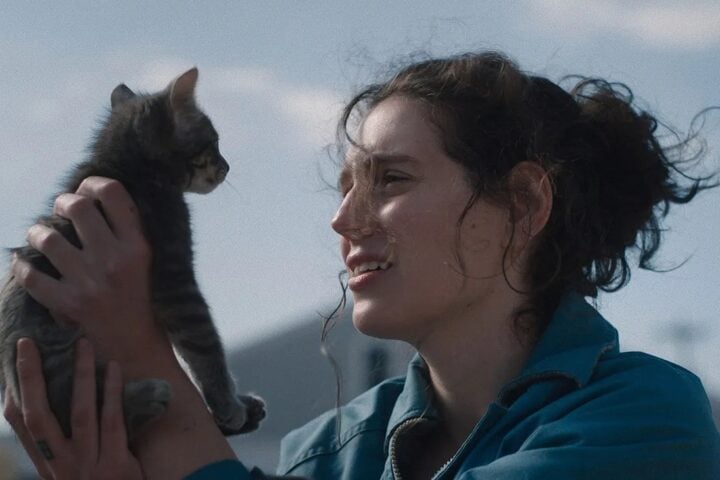
“Something pretty bad happened to me,” Eva Victor’s Agnes confesses late into Sorry, Baby. She makes this admission to John Carroll Lynch’s Pete, a stranger who helps her calm down from a roadside panic attack. Among other things, Agnes’s moment of openness elucidates Victor’s radical handling of trauma across the film.
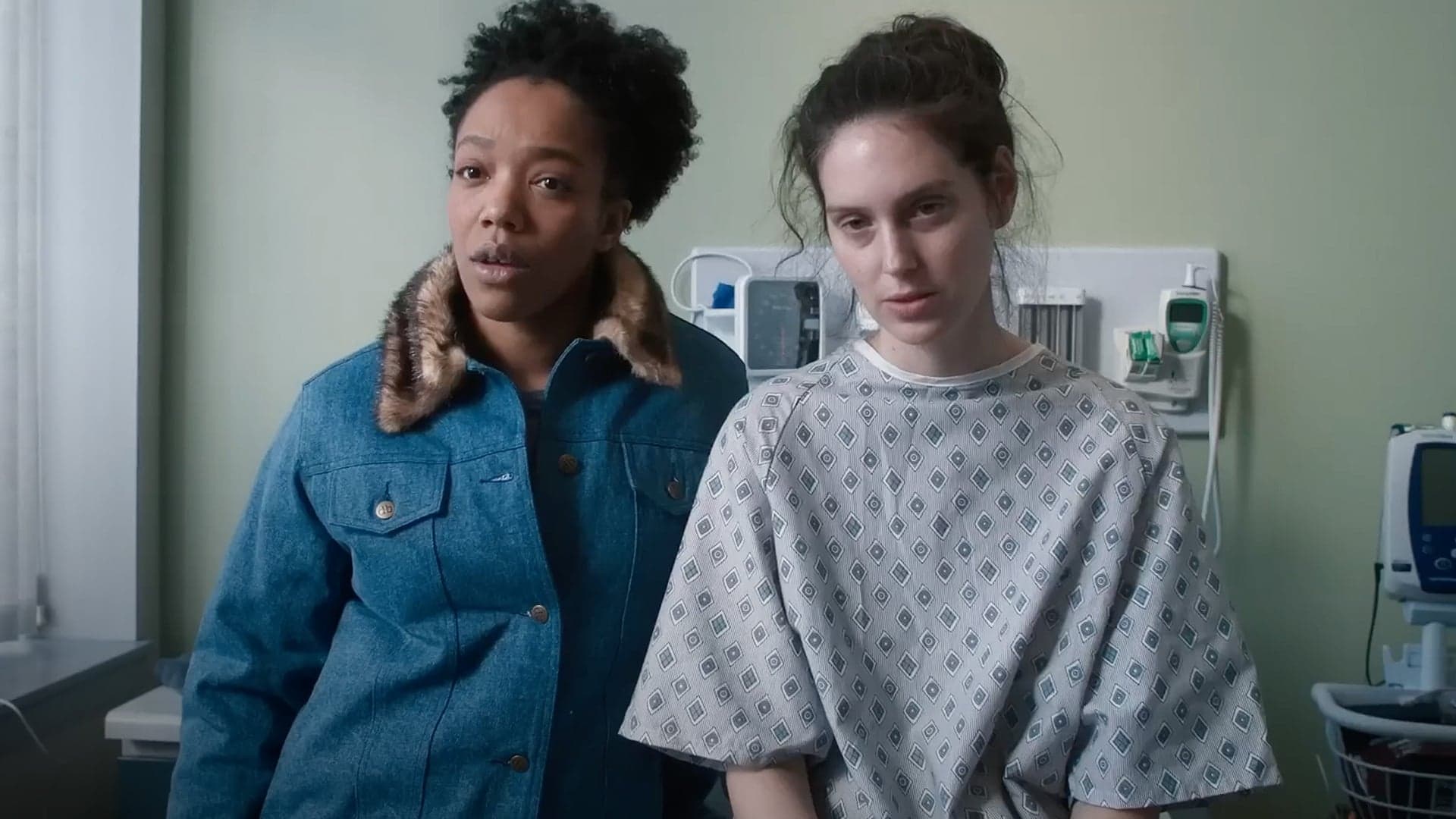
Talking about trauma can be this simple, but because the societal systems set up to respond to it are ill-equipped to handle the needs of survivors, it too often feels more like a taboo than it should be. Before Agnes’s chance encounter with Pete, she’s had no shortage of opportunities to discuss an incident of sexual violence with people who should help provide accountability, but the sterile language required to navigate doctors’ offices and HR departments defeats her. Yet Agnes finds a cathartic moment that points her toward a path of healing once freed from the constraints of the stilted vocabulary that institutions use when dealing with cases like hers.
Victor, who also wrote and directed Sorry, Baby, brings a fresh approach to the trope of the trauma plot. They treat Agnes’s sufferings and strivings seriously but aren’t afraid to poke fun at situational absurdities stemming from the “bad thing” as they arise. This dazzling film captures the ups and downs of Agnes’s winding journey with penetrating insight and piercing wit.
I spoke with Victor as they toured Sorry, Baby around the country ahead of its theatrical release. Our conversation covered where their background in online comedy still guides their artistic approach, how the film is in conversation with other depictions of sexual assault, and what creating this work meant to their healing process.
You described having kind of two parallel artistic interests as far back as college, saying, “I really felt there was this weird struggle between being in this really intense acting class and also liking to make dumb jokes on the side…”
…Are you quoting me?!
I am! To finish, you said, “I wasn’t quite sure how to negotiate those things at the time.” Is Sorry, Baby your negotiation between those two interests?
I guess so! It’s my legit negotiation between drama and comedy, and being a writer, actor, and director. It’s intense to do a bunch of things, but I think people are limiting in how they view comedians sometimes. It was a great joy to get to make something that toggled a tonal line that I was interested in toggling.
Did you ever feel that the comedy elements shouldn’t lead the way?
My instinct whenever something got too heavy was to figure out a way to heighten [it] so that we could laugh at [it]. Most of my comedy training was with an online satire website. What we were taught and what we did was finding ways to punch up and not punch down, which means making fun of people in power, pointing the finger at institutions that are causing harm, and always making sure we’re not pointing fingers or laughing at the expense of people who’ve been through something really hard. I found it to be quite natural to find humor in moments when the doctor is being rude or when the HR women are terrified. It just felt natural for comedy to exist in those places because those people make themselves into clowns on their own.
The media you were working in before making a feature, be it writing for Reductress or creating videos for social media, gave you quick and easy access to how audiences responded to your ideas. Was having that background helpful for something that gestates as long as a feature does?
I felt grateful not to have the reactions quickly. I got to spend years working on this in private. There was something intense about making a video, posting it that day, [getting] reactions 10 minutes later, then it’s over. It was helpful in figuring out what I wanted to say, and it got me jobs that I’m very grateful for. But I was craving privacy and time with this, and I wanted to make something that was slower, longer, and could contain many things within one thing. There was a real joy in privacy with this, but it’s weird because now people are seeing [the film]. It does mirror the experience, on just a longer scale, of [the fact that] people react no matter what.
Does that fine-tune your instincts even if you aren’t getting that instant reaction?
I wrote the film in rebellion against [those] people. I was like, “You guys don’t get to give me opinions on this now!” It was more trying to check in with myself about what felt true to life. If it felt like I was going for a joke when it wasn’t actually helpful, or that I was trying to make something happen that felt maybe dramatic but didn’t resonate exactly as true to life, I was constantly checking myself and making sure I was on the track I wanted to be on. Something the videos [also] allowed me to do is to figure out what my taste is. Sometimes I would make something and be like, “Well, I don’t think it’s that funny,” and then people would really like it. I’d be like, “Well, I think this one’s better, and no one likes that one.” I was trying to figure out what I think, at the end of the day, [is better] for me.

At what stage did you write the scene with John Carroll Lynch? Given the way it clarifies the thematic approach toward healing in the film, I’d be curious to know if it was more of a starting point or a destination you arrived at on the journey.
That scene was always a part of it. There were more sandwich elements to the film that had to stay on the cutting room floor, but it was [originally] the final piece of a sandwich theme. There were many sandwich moments in the film, and then this was the origin story of why a sandwich was being eaten throughout the film. Now, it doesn’t really work like that.
But the scene meant so much to me because the film really exists [among] and talks about people of a certain age…my age. I really liked having this character who existed outside of that world of grad school, especially age-wise and experience-wise. There are no parents in the film, and he existed for me as this sort of “dad for a day” guy for Agnes. There’s something really special about how a stranger can feel like a safe place because they won’t hold you to anything you say, and you can be really honest because they won’t find you later. You can say whatever you’re thinking, and you won’t scare them because they don’t care that much.
The scene was always like, “There’s a panic attack, then this man is this sounding board, and Agnes can finally say ‘something really bad happened to me’ on her own terms.” That was the moment that meant a lot in Agnes’s journey of finally being able to say how she’s feeling without someone making her, like in the courthouse or in the HR meeting.
When you’re thinking about how to portray what the film calls “the bad thing,” are you cognizant of how other works have handled depictions of assault and reacting, even if subconsciously, against the sensationalism?
Yes, I definitely wanted the film to be about the aftermath and trying to heal from violence. I really didn’t want to put violence in the film, and I didn’t want it to be central in any way. I was definitely reacting to things I’ve seen, but mainly because I think sometimes sexual violence in films is depicted so intensely and accurately that it can be very difficult to watch. I was looking for a film that I needed at a time, and I couldn’t find that film. I’m sure it exists, but I couldn’t find it. I wanted to watch a film that didn’t leave my body unable to continue watching. I wanted to watch something that felt like it was holding me through it, so I tried to really just think through what kind of visual language would my audience potentially tense up to. Or, if I were in the audience, what would allow me to continue watching the movie and feel very safe, hopefully.
Kelly Reichardt’s understated portrayals of mundane settings in Certain Women were a key visual inspiration for Sorry, Baby. How do you and your department heads make that feel like a conscious visual aesthetic and not the lack of a vision?
A lot of time and a lot of looking at images. For this one, I brought in a lot of [Edward] Hopper paintings; I felt like paintings were helpful. [Cinematographer Mia Cioffi Henry and I] spent a lot of time figuring out the lenses. We used DNA lenses, and their focus falloff felt natural but beautiful in a way that I loved. It’s just about like having enough conversations with enough visual evidence to narrow down the taste and vocabulary you’re going to be working within.
A lot of that was [also the] locations. I had a clear idea in my mind of what I wanted each location to look like. The only time we went away from the look of that was when I found something I liked a lot more than what I imagined. I was very set on having a window in the doctor’s office because there’s this shot in Safe that I love where she’s sitting on the edge of the chair, and the doctor closes the door on her. I was like, “We need a window, like Safe.” Another example of that was we got to the place where they had the perfect window at the doctor’s office, but the wall was a bright teal blue. We were like, “Can we please paint this?” It’s all about calibrating something to feel in the world, with the colors and the [seasons] and the places.
Regarding creating the film that you were looking for in the moment whenever you needed it, is Sorry, Baby a part of the healing process, or is it something that you could only do after having completed that healing on your own?
I don’t know when healing is supposed to be done, but I don’t think it’ll ever end. Maybe, that would be cool! It’s been a very powerful experience making this film. The thing about this kind of trauma is that it’s very difficult to wrap your head around the fact that this kind of violence is someone deciding where your body should be, without you deciding where your body should be. That’s a very absurd, surreal experience to realize that the rules of the world are completely not real, and whatever boundaries you think exist in the world, can be broken if someone decides to break them. Just in the act of directing myself as an actor, I was like, “My body’s going here,” and everyone around me was like, “Yes, your body’s going there because you said that.” That ability to be in control of what my body was doing was very meaningful. And as an actor, the job is to then let go of control, be as present as you can, and trust. That’s really joyful to do when the confines of that are safe. The act of performing it and directing it was very meaningful to me.
Since 2001, we've brought you uncompromising, candid takes on the world of film, music, television, video games, theater, and more. Independently owned and operated publications like Slant have been hit hard in recent years, but we’re committed to keeping our content free and accessible—meaning no paywalls or fees.
If you like what we do, please consider subscribing to our Patreon or making a donation.