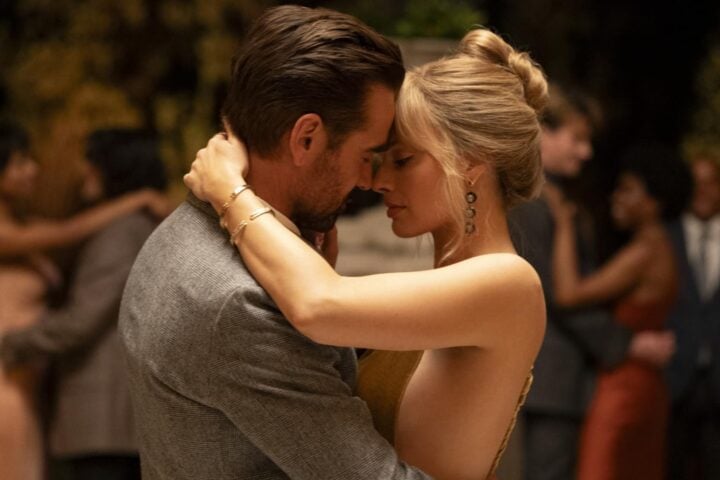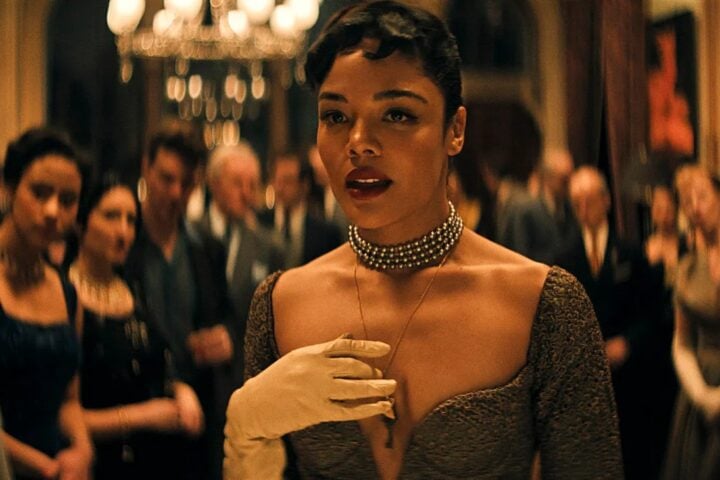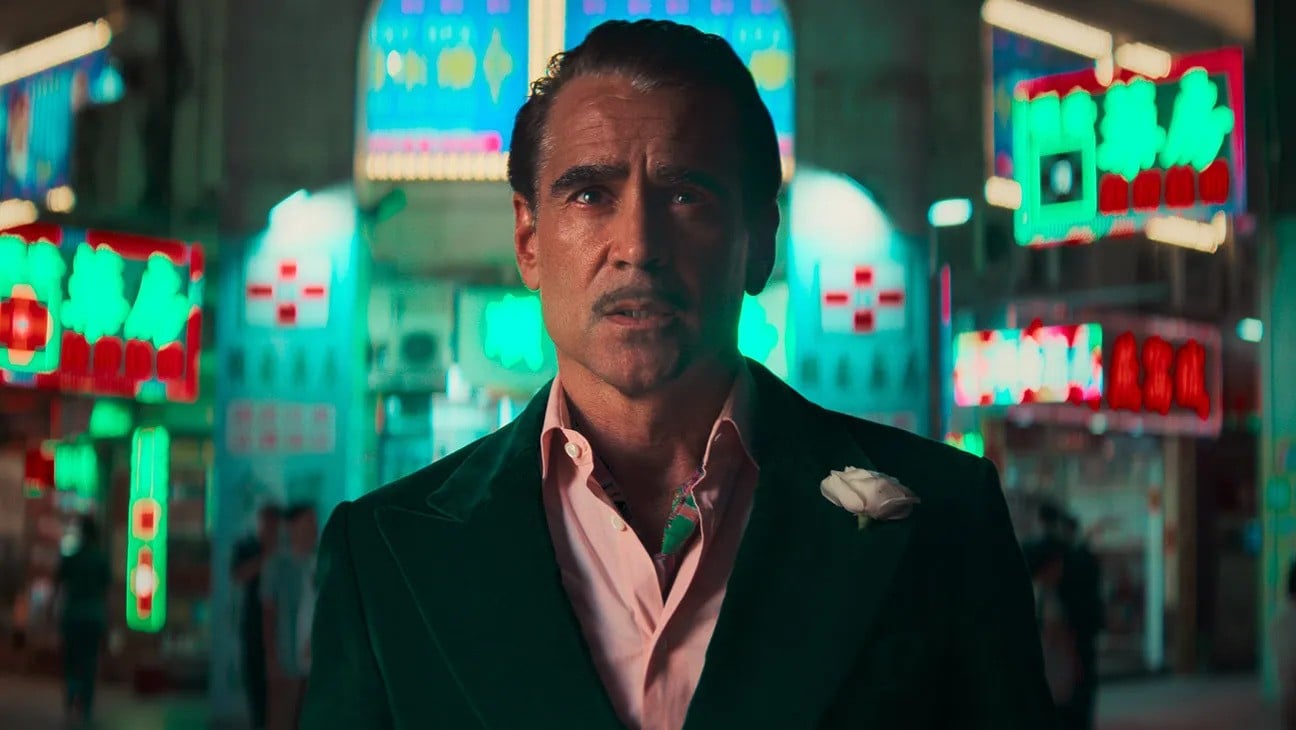
Edward Berger’s Ballad of a Small Player is a fevered, neon-drenched film about a man on the run from his crimes and himself, and it wants to simultaneously revel in the glamor of high-end gambling and critique the unending gluttony that fuels it. This isn’t an unusual tack for Berger, as his All Quiet on the Western Front has a similarly confused relationship to the industrial violence that it lasciviously depicts. But this film, adapted by Rowan Joffe from Lawrence Osborne’s 2014 novel of the same name, is all about the possible spiritual redemption of spiraling gambler Lord Doyle (Colin Farrell), and its ambivalent perspective on the greed and glitz of his world makes it difficult to invest much care in what happens to him.
The film opens on Doyle crashed out in a trashed Macau casino suite that looks like the site of a battle between the Rolling Stones and Led Zeppelin at their debauched peaks. Like everything we’re shown about Doyle, the setting is tacky yet extravagant, worlds away from the grubby bottom-feeding of a die-hard self-destructor like Nicolas Cage’s Ben in Leaving Las Vegas.
Doyle’s self-consciously doom-laden narration (“I’m a high roller on a slippery slope”) clues us in to his predicament, as does the frenetic visuals, all speeding tracking shots, distorted zooms, and candy-colored backdrops. The problem for the film is that, gymnastic camera movements and lusciously palatial casino settings aside, Doyle’s situation is terribly, repetitively, painfully banal: He’s broke, owes too many people too much money, and is running out of options.
At first, Berger plays this for dark laughs. The sweaty, pop-eyed Doyle is a ridiculous con man who wears “lucky” yellow gloves and doesn’t realize everyone can see him coming a mile away. These early scenes show Farrell at his best, bringing a comedically zesty desperation to scenes of Doyle trying to duck those looking to settle his room bill (about $45,000 so far), getting taken to the cleaners at the baccarat table by veteran card sharp Grandma (Deanie Ip), and getting double-crossed by fellow expat Adrian (Alex Jennings). By the time Doyle is hunted down by a prim private investigator (Tilda Swinton) looking to recover the fortune he swindled from an old woman and gambled away, he seems clear out of options and about to crack.
But the script turns too soon toward Doyle’s redemption. His sudden interest in walking on the path toward self-discovery might have felt more believable had it not hinged on the contrived appearance of a beautiful fixer and loan shark, Dao Ming (Fala Chen), who, after rebuffing his whining requests for a stake to win his money back, provides him with a sympathetic ear and place to crash. She’s less a character than an assortment of exotic clichés, as evidenced by her gently explaining to Doyle the meaning of the Festival of the Hungry Ghosts—where the dead are honored in part by the burning of paper money, a too-on-the-nose visual representation of our protagonist’s quandary—and a scene in which they smoke opium.
Berger’s hyperbolic direction and usage of densely layered, colorful backgrounds makes for a visual feast. He’s enamored by flashy surfaces and showing people navigate labyrinths—WWI trenches, Vatican corridors, casino floors—at frantic speed. But unlike All Quiet on the Western Front and Conclave, Ballad of a Small Player stays largely on the surface, never digging into or critiquing the nuts and bolts of the system—high-end gambling in this instance—that its hero has both gamed and been entrapped by. As a result, we’re left to merely follow Doyle as he hits one rock bottom after another until he rallies for one big last gambling spree to win everything back, Rocky-style. And a big problem with that is that there’s not much one can do to make baccarat nearly as enthralling as the filmmakers seem to imagine it to be.
Since 2001, we've brought you uncompromising, candid takes on the world of film, music, television, video games, theater, and more. Independently owned and operated publications like Slant have been hit hard in recent years, but we’re committed to keeping our content free and accessible—meaning no paywalls or fees.
If you like what we do, please consider subscribing to our Patreon or making a donation.