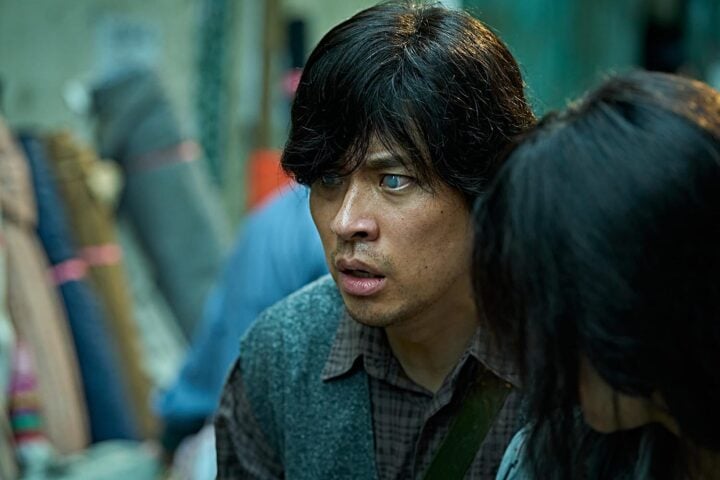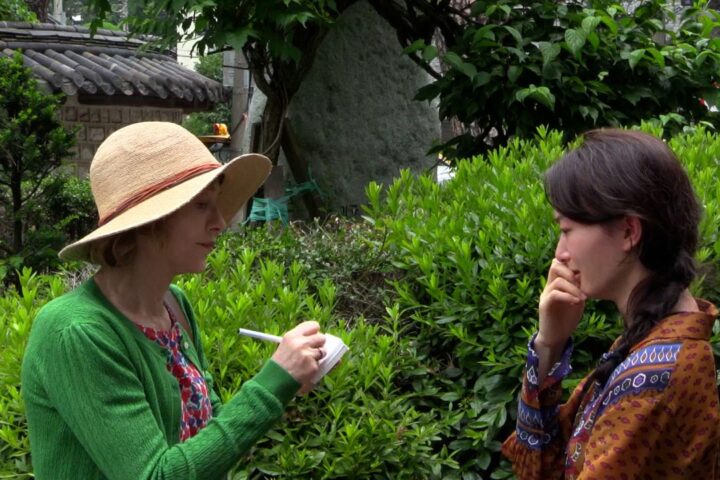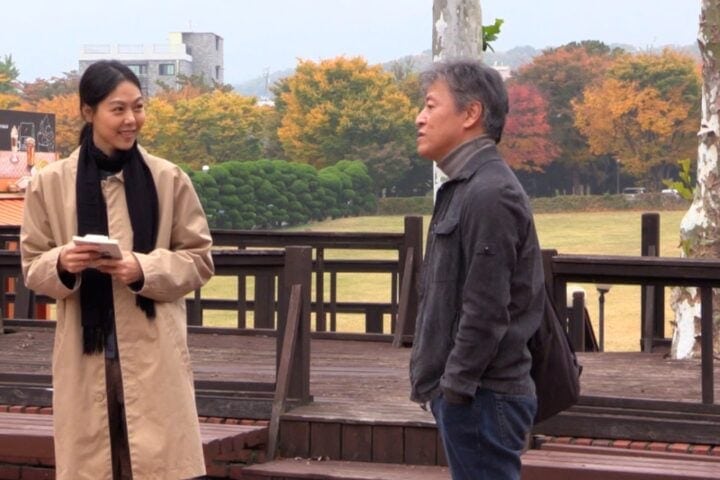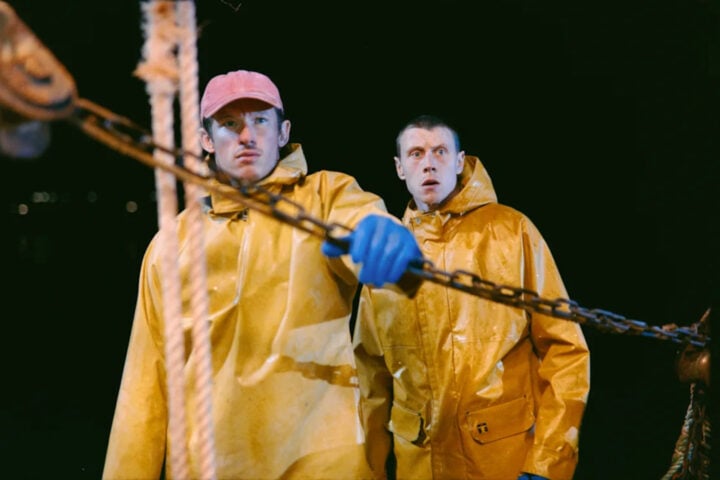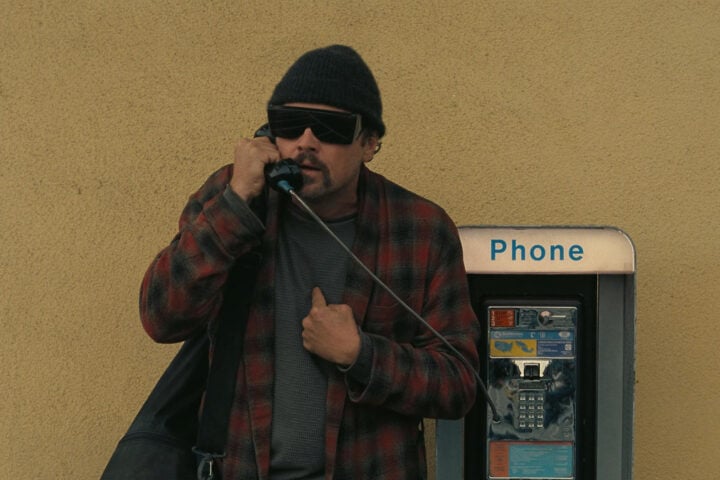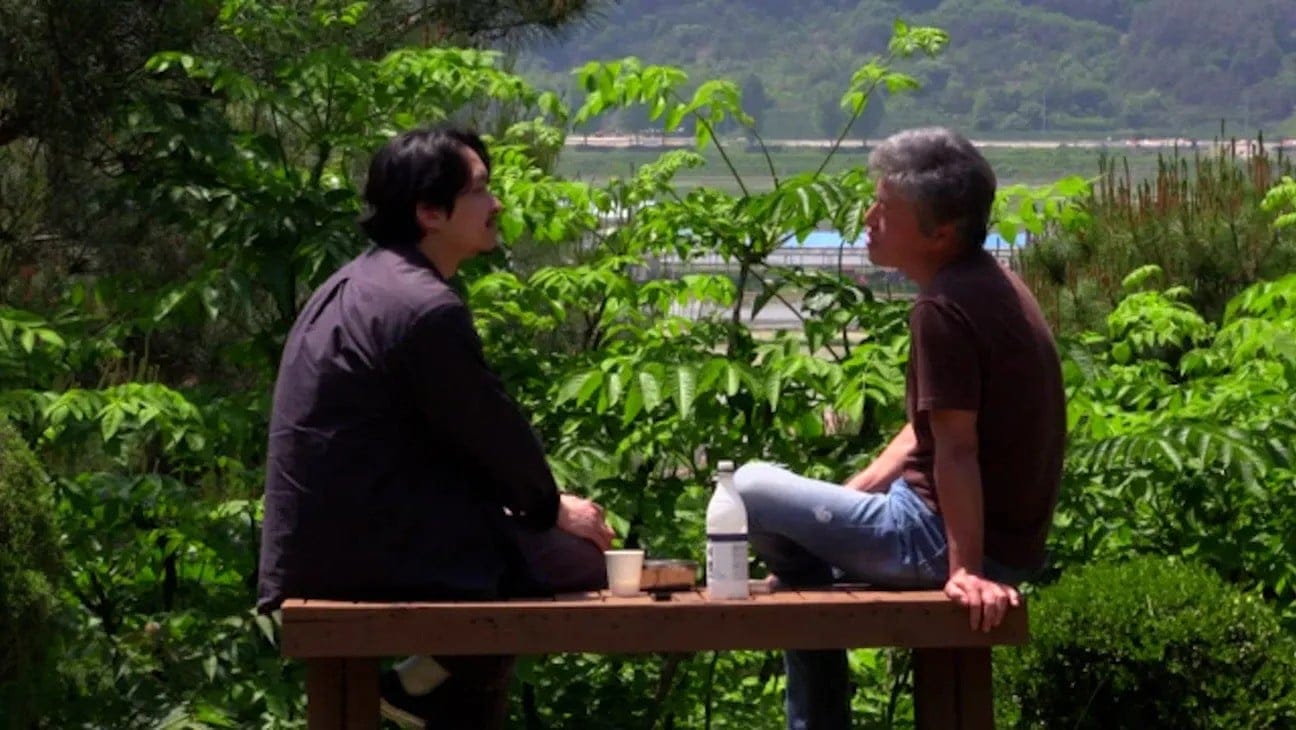
Discussions around the films of Hong Sang-soo tend to revolve around his dialogue, characters, plots, and themes more than his technique. But whereas the digital-video imagery of much of his recent fare is noteworthy primarily for its crystal clarity, the South Korean auteur opted to shoot his latest film, What Does That Nature Say to You, in a low-resolution format, with occasional blown-out backgrounds and some scenes captured out of focus. It’s an approach that’s more than merely playful, as the lack of clarity suggested by Hong’s technique here is key to the resonance of his latest examination of an artist’s life.
Ha Dong-hwa (Ha Seong-guk) is a poet who spends a whole impromptu day meeting the family of his girlfriend, Kim Jun-hee (Kang So-yi), for the first time at their home in the mountains. Kim’s father, O-ryeong (Kwon Hae-hyo), is the first of the family members he meets; he and Ha end up having an extensive one-on-one conversation while Jun-hee catches up with his sister, Neung-hee (Park Mi-so). Later on, Ha and Kim spend lunchtime and the rest of the afternoon with Neung-hee, who, as Jun-hee mentioned to Ha earlier, is currently dealing with a bout of depression. Finally, matriarch Choi Sun-hee (Cho Yun-hee), herself a poet on the side, returns from work and joins the rest of the family for a dinner that reaches a confrontational climax.
One could view What Does That Nature Say to You as Hong’s dryly comic take on Meet the Parents. As is often the case in his films, though, the tensions between the characters are buried under surface good manners—which Hong invites us to dissect through his signature long takes and stationary camera setups—until they’re suddenly brought out into the open.
One point of contention involves Ha’s denial of his privilege. His father is a prominent attorney, but Ha is so determined to live what he considers a pure artist lifestyle that he refuses to live under the man’s roof, much less take any of his money. It’s Neung-hee’s desire to push Ha on this subject that leads to the climactic outburst. A post-dinner debrief between O-ryeong and Sun-hee sees them bringing their feelings out into the open, and suggests that Neung-hee isn’t the only one skeptical about the long-term viability of Ha’s approach.
That lifestyle is arguably the real subject of What Does That Nature Say to You. Ha’s stated intention to live as minimally as possible in order to maximize his pursuit of beauty is a classic rationale used by a starving artist, and across customarily intimate scenes, Hong gracefully orients the film around each family member’s perspective on Ha’s beliefs.
The more practical Jun-hee has presumably come to accept and even admire Ha’s opposition to compromise, given that she’s been with him for three years. They have an opposites-attract relationship that finds a parallel of sorts in the relationship between O-ryeong and Sun-hee, with the former even saying at one point to Ha that while he has learned about life primarily from books, Sun-hee’s wisdom has been gained from hard experience. It’s very easy to see Neung-hee’s depressive nature as a counterbalance to Ha’s idealism.
During one conversation with O-ryeong, Ha admits that he often keeps his glasses off because he likes things to look a little blurry. That admission can be seen as the rationale for Hong, again serving as his own cinematographer, to shoot the film out of focus to varying degrees, a formal gimmick he employed for the entirety of 2023’s In Water. In one scene, Hong zooms in so close to two characters on a bench that half their bodies are cut off by the left and right sides of the frame, lending a sense of discomfort to the intimacy of the interaction. Such moments of wholly visual disorientation exist alongside ones in which Hong’s camera lingers on a picturesque sigh—the way Ha himself might do upon noticing something that struck him as, well, beautiful.
In other words, Hong’s technique alternates between inhabiting his protagonist’s perspective and standing outside of it. We are thus allowed to appreciate the sincerity behind Ha’s intentions while wincing at his naïveté, the way Jun-hee’s family does both subtly and directly. But though Hong doesn’t spare his protagonist from criticism, nor does he outright condemn him for his faults. If What Does That Nature Say to You’s final scene suggests anything, it’s that growth would appear possible for the seemingly hopeless romantic at the film’s center.
Since 2001, we've brought you uncompromising, candid takes on the world of film, music, television, video games, theater, and more. Independently owned and operated publications like Slant have been hit hard in recent years, but we’re committed to keeping our content free and accessible—meaning no paywalls or fees.
If you like what we do, please consider subscribing to our Patreon or making a donation.