Steven Lisberger’s 1982 film Tron barely contained enough story to hang together as more than a collection of then-pioneering computer-generated effects, and the belated attempt nearly 30 years later to turn it into a franchise with Tron: Legacy proved even more threadbare, given the Joseph Kosinski film’s wonky gestures at emotional stakes. Now, Joachim Rønning’s Tron: Ares, the latest entry in a series that began as a cash-in on the early video game craze, makes an even bigger miscalculation by chasing after contemporary social relevance.
Legacy approached the possibility of artificial but sentient life with optimism, but Ares is steeped in the increasing anxiety about A.I. In an expository prologue of news updates about runaway technological growth, the film, as written by Jesse Wigutow, awkwardly sets up a battle between “good” and “bad” tech CEOs vying for monopoly over the future of mankind.
The former is Eve Kim (Greta Lee), who has taken over the original video game company Encom, while the latter is Julian Dillinger (Evan Peters), grandson of the villainous CEO of the first film. In order to make programs a reality, both CEOs require a code developed by Encom’s original lead programmer, Kevin Flynn (Jeff Bridges), with Julian dreaming of lucrative military contracts for an endless supply of corporeal A.I. personnel and equipment, and Eve aspiring to a more vague ideal of producing things in order to better humanity.
If Eve and Julian’s contest for Flynn’s IP sets Ares’s plot into motion, it’s largely sustained by some of the synthetic lifeforms who are created in their wake. Specifically, much of the film revolves around Ares (Jared Leto), a military program developed by Julian who’s tasked with hacking and stealing Eve’s research, only for it slowly come to question its directives as it becomes, of course, more sentient and curious about humans.
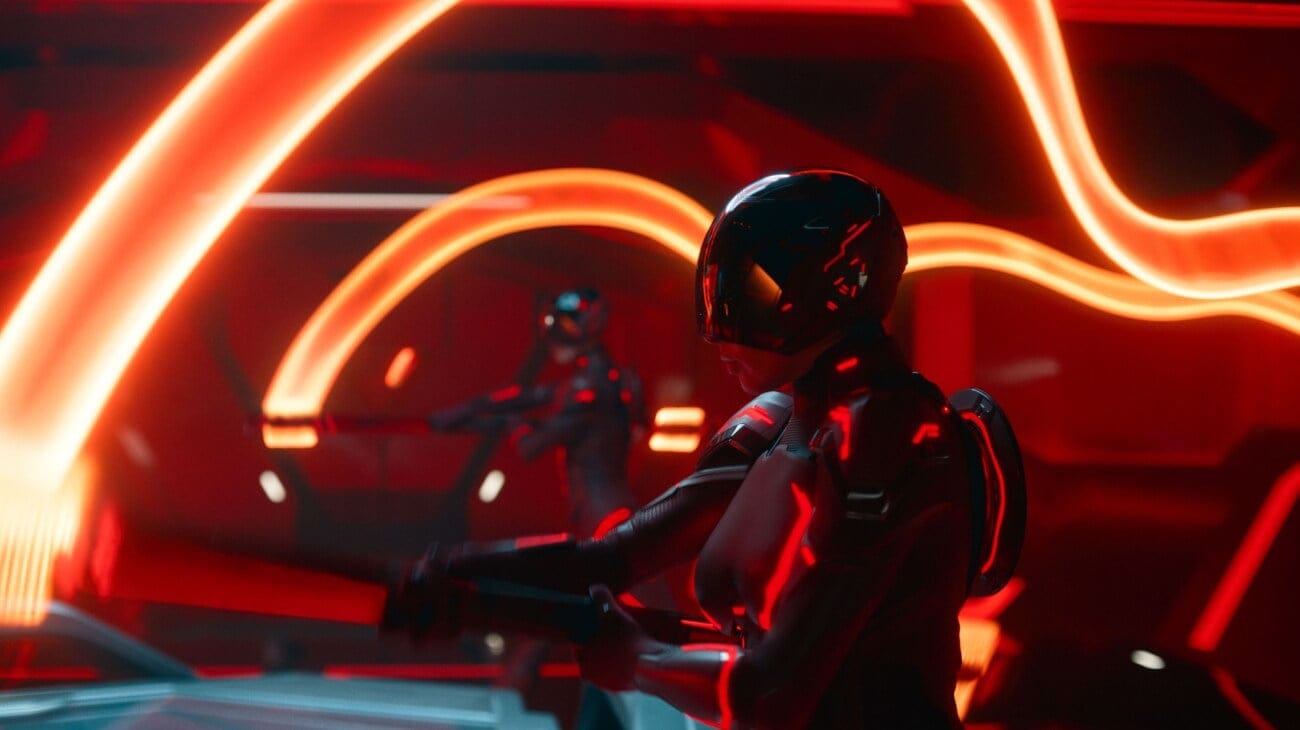
For all the existential questions it raises about A.I. ethics and synthetic life, Ares is defined largely by how stubbornly it adheres to the same action template as the first two films in the series. Whether inside the “Grid” of the digital world or on the streets of the real one, the action is dominated by gladiatorial skirmishes involving sharp-edged flying discs and chases between force field-emitting light cycles that comes to quickly feel redundant. Furthermore, extending such combat into the real world results in so much collateral damage that’s so readily traceable back to Encom that it’s inconceivable that Julian could stay out of prison longer than a few days.
The characters are defined by their plot function, and exposition is often delivered in reams of stilted dialogue by Ares as it recites details about itself or others that it’s gleaned from data aggregation. Eve is piled with sympathetic biographical details like a terminally sick sister, while Julian is transparently evil. Ares’s own stumbles toward sentience are so simplistically traced that you might think you’re watching a Star Trek: The Next Generation episode from 30 years ago. The signposts of his evolution come in such forms as curiosity about Eve’s empathy and, befitting the inevitable ’80s nostalgia of a Tron movie, a fondness for Depeche Mode.
The true legacy of the Tron series is perhaps less defined by its showcasing of innovations in computer-generated effects than by the musical scores by electronic luminaries. Adding to this history are Trent Reznor and Atticus Ross, operating under the Nine Inch Nails moniker to reflect the industrial flavor of their score. There’s a sultry, grimy feel to the music here that’s absent even from the propulsive but sleek robo-funk of Daft Punk’s Legacy soundtrack.
As the film’s second half sinks ever deeper into ’80 retromania, Reznor and Ross set out to demonstrate their own nostalgia, throwing in more and more sounds redolent of that decade into their score. They even make the occasional nod to their own work, like a cue that sounds like a dead ringer for a motif from The Social Network’s “In Motion.” There’s a cheekiness to the composers’ deft incorporation of older styles into their present-day approach to soundtracks, but after a time even their cleverness exposes the film’s hollowness. For a story that seeks to champion the unpredictability and finite quality of life, Ares ultimately feels trapped by the inertia of working within the parameters set by its no less flimsy predecessors.
Since 2001, we've brought you uncompromising, candid takes on the world of film, music, television, video games, theater, and more. Independently owned and operated publications like Slant have been hit hard in recent years, but we’re committed to keeping our content free and accessible—meaning no paywalls or fees.
If you like what we do, please consider subscribing to our Patreon or making a donation.