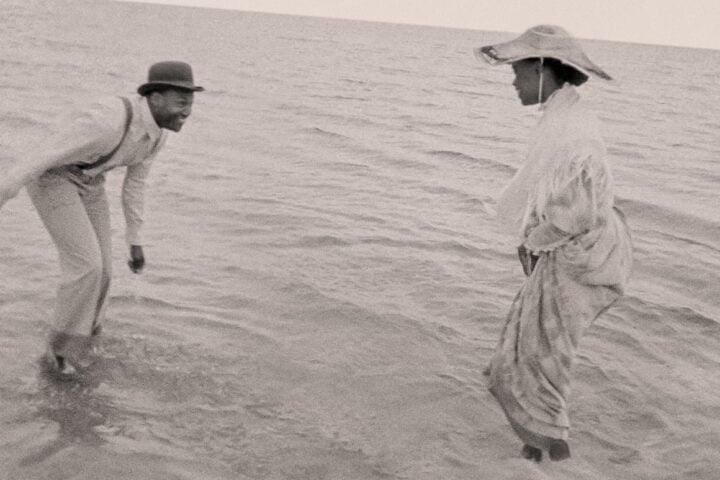
Jean Epstein’s Finis Terrae begins as an ethnographic documentary about seaweed harvesters toiling away on Bannec, an islet off the Brittany coast. They glean plants out of beach shallows, then dry and burn them, all so that the resulting ash can be used in glassmaking and ceramics. Epstein takes great care in capturing the minutiae of the labor from start to finish, emphasizing the grueling physical exertion of workers whose numbers, one suspects, have steadily dwindled over generations.
By the same token, Epstein was also one of the great impressionists of 1920s French cinema, and he inserts numerous dreamy, almost mythic, flourishes into the even more realistic scenes early in the film. Seaweed tossed up from the sea into boats seems to hang in the air and billow as much as it does on the surface of water. The editing mingles images of mist rising off the ocean at daybreak with those of smoke billowing from burn piles to create an overwhelming fog that hangs over the area. And when one of the workers, Ambroise (Ambroise Rouzic), gets a cut on his finger that becomes infected, Finis Terrae briefly takes a turn toward the hallucinatory, keying itself to the blood-poisoned fever visions of the man as his health collapses.
Ambroise’s ill health prompts Jean-Marie (Jean-Marie Laot), with whom he enjoys an alternately affectionate and contentious relationship, to devote all of his efforts to getting Ambroise back to their Brittany village for treatment. At this point, Epstein’s film slows down somewhat, settling into a simple story of men battling the elements as Jean-Marie attempts to get his friend to safety after transport from Bannec to the mainland is briefly interrupted.
Even so, Finis Terrae continues to unfurl via gorgeous imagery. The choppy surf of the ocean instantly conveys the challenge that awaits the men, and the foreboding crags of the barren island emphasize how little comfort and shelter the land offers as an alternative. Among the most arresting images are the recurring glimpses of the harvesters’ wives and mothers back on the mainland gathered nervously around a pier waiting nervously for their men to return.
This vision of the women, adorned in black as if already in mourning, is a tacit indication of the perils that have always awaited humans who rely on the ocean for their livelihoods. While much of the film’s second half lacks any complicating incident, Epstein consistently ups the sense of unease and danger simply from capturing an environment in all its hostile indifference.
Image/Sound
Sourced from a new 4K restoration by Gaumont Film Company, Eureka Entertainment’s transfer looks fantastic for a century-old film shot on location. Only a few instances of lost detail are evident in the more under-lit scenes, but otherwise the image is stable and free of all but the most minor signs of print damage and age. Close-ups are rich in texture, be it the lines worn into tired faces or the increasingly grotesque infection on Ambroise’s finger. The soundtrack crisply renders a score by Vincent Courtois that’s defined by a modernistic dissonance and odd meters that deepen the uncanny, alien quality of Epstein’s nature photography.
Extras
Eureka’s disc comes with a trio of interviews and video essays by critics and scholars. Scholar and critic Pamela Hutchinson provides an overview of Jean Epstein’s life and a précis of his stylistic touchstones, while film scholar Eddie Falvey probes into the thematic undertow of Finis Terrae, finding within not merely a sensuous ode to the untamability of the natural world but the repressed sexual energies of its characters. Joel Daire, heritage director of the Cinémathèque Française, draws heavily from Epstein’s own writings to position the film as a breakthrough for the director’s ambitions for a new form of cinema, and a landmark in experimental cinema. A booklet contains an essay by film professor and Epstein expert Christophe Wall-Romana that highlights the director’s mercurial blend of realism, impressionism, and melodrama, as well as excerpts from Epstein’s writings that lay out his philosophies of filmmaking.
Overall
Finis Terrae receives an impressive A/V transfer that belies the film’s true age.
Since 2001, we've brought you uncompromising, candid takes on the world of film, music, television, video games, theater, and more. Independently owned and operated publications like Slant have been hit hard in recent years, but we’re committed to keeping our content free and accessible—meaning no paywalls or fees.
If you like what we do, please consider subscribing to our Patreon or making a donation.