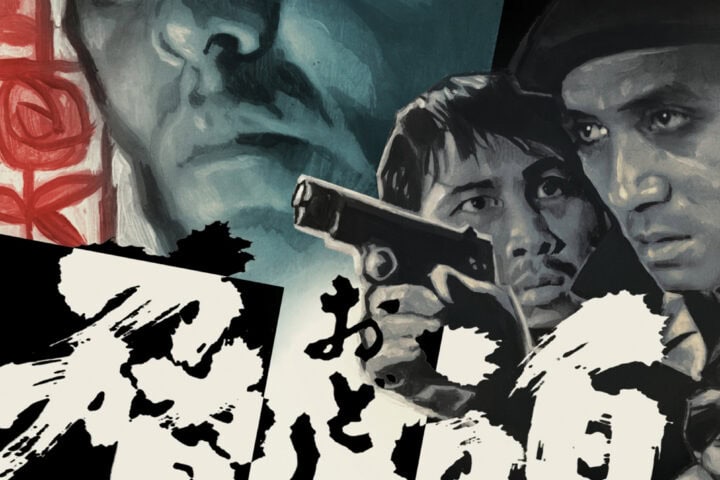
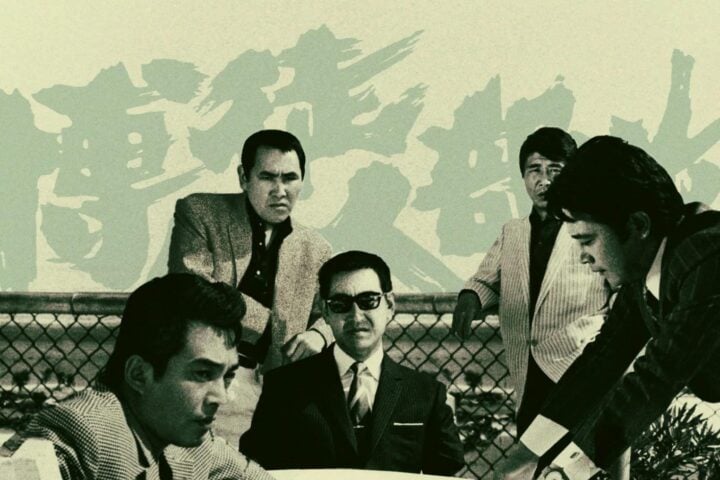
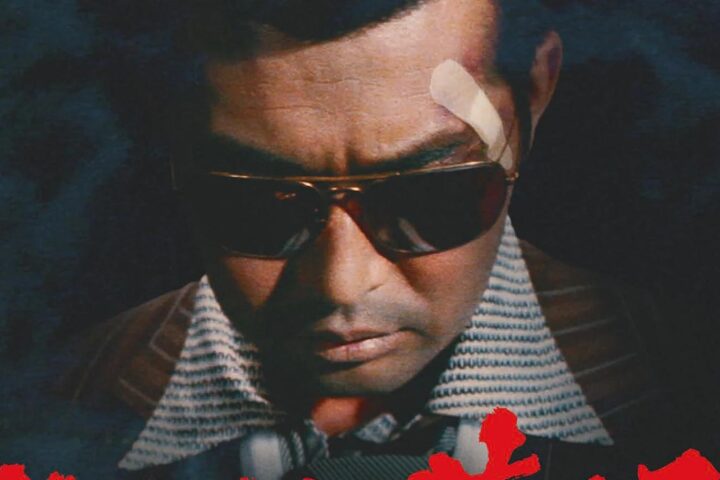
Murakawa Tôru’s The Beast to Die begins with a flurry of violence as a man, Date (Matsuda Yûsaku), murders a cop and a band of gangsters with equal indifference. For the rest of the film, Date progresses through a series of assaults and robberies with an impulsiveness that jars with the seeming absence of pleasure that he experiences. Only in its closing stretch does the film suggest a motive for Date’s actions, but by then the accumulated horror of his crime spree has cast any sense of meaning adrift.
Date’s nebulous connection to the world around him extends to scenes of his more quotidian daily activities. The only thing that we see the man take any interest in is classical music, and in an early scene that has the makings of a meet-cute, he strikes up a conversation in a record store with a woman (Kobayashi Asami) he saw at a Mahler concert. Despite her obvious interest in him, though, Date can only study the album she shows him, more taken by its contents than anything she has to say. Even his fixation on classical music appears more of a compulsion than a source of pleasure.
Matsuda had long been a superstar in Japanese cinema by the time of The Beast to Die, his rakish, cocky demeanor such a byword for coolness that he would be the primary influence for Cowboy Bebop’s Spike. Here, though, his marquee looks and badass mien are corrupted; the actor lost 10 kilograms for the role, which gave him a gaunt appearance, and Date constantly walks in a hunched, nervous pose more befitting a Gothic monster than an unflappable antihero. He moves through the film like a shadow, scarcely noticed by the world around him.
By happenstance, and only in the most warped sense, Date establishes a meaningful connection to a young waiter, Sanada (Kaga Takeshi), who may be even more prone to fits of violence than his mentee. Though Murakawa’s direction is, up to this point, keyed to Date’s personality, Sanada’s entrance into the story shakes up the film’s aesthetic, with more intense, close-up framings befitting the waiter’s more eager, self-gratifying approach to violence interspersed with the more darker, distanced compositions that convey Date’s perspective.
Together, the men sink ever deeper into depravity, and along the way, the detective (Murota Hideo) who tails them often finds himself more fascinated by their behavior than eager to stop it. The closest the film offers to a motive for Date’s nihilism is his background as a war journalist in Vietnam, where exposure to atrocities numbed him to the human race. Still, The Beast to Die does suggest that Date’s brutality might reach a point to shock him back to empathy, a note of bleak hope befitting one of the darkest neo-noirs from any nation.
Image/Sound
Sourced from a 4K restoration by Kadokawa, this transfer maximizes the coldness of the metallic color schemes of the cinematography, particularly its icy blues. Black levels are presented with depth and accuracy, most evident in the shadows that abound throughout, and detail is fine even in long shot. The mono soundtrack lacks any perceptible issues and cleanly renders dialogue and sound effects with no muddying overlap between the two.
Extras
Radiance’s disc comes with three new interviews, one each with director Murakawa Tôru and writer Maruyama Shoichi and a third with mystery novelist Jordan Harper. The latter offers an enthusiastic appreciation of the film and Japanese noir, while the other two subjects discuss The Beast to Die in relation to their respective careers. Murakawa particularly focuses on the film as his final collaboration with Matsuda Yûsaku and how each had attained a familiarity with the other to trust any choice the other made in front of or behind the camera. Maruyama talks more about the challenges of adapting Oyabu Haruhiko’s source novel and conveying the complexities of the protagonist’s psychology without overcompensating and making it too simplistic or obvious. A booklet comes with a reprinted essay on Matsuda’s career by critic Tom Mes and a new essay by critic Masuto Tatsuya that considers how the film represented a logical aesthetic and thematic culmination for the actor’s work with Murakawa.
Overall
Murakawa Tôru’s unorthodox, bleak neo-noir receives a gorgeous transfer from Radiance Films.
Since 2001, we've brought you uncompromising, candid takes on the world of film, music, television, video games, theater, and more. Independently owned and operated publications like Slant have been hit hard in recent years, but we’re committed to keeping our content free and accessible—meaning no paywalls or fees.
If you like what we do, please consider subscribing to our Patreon or making a donation.