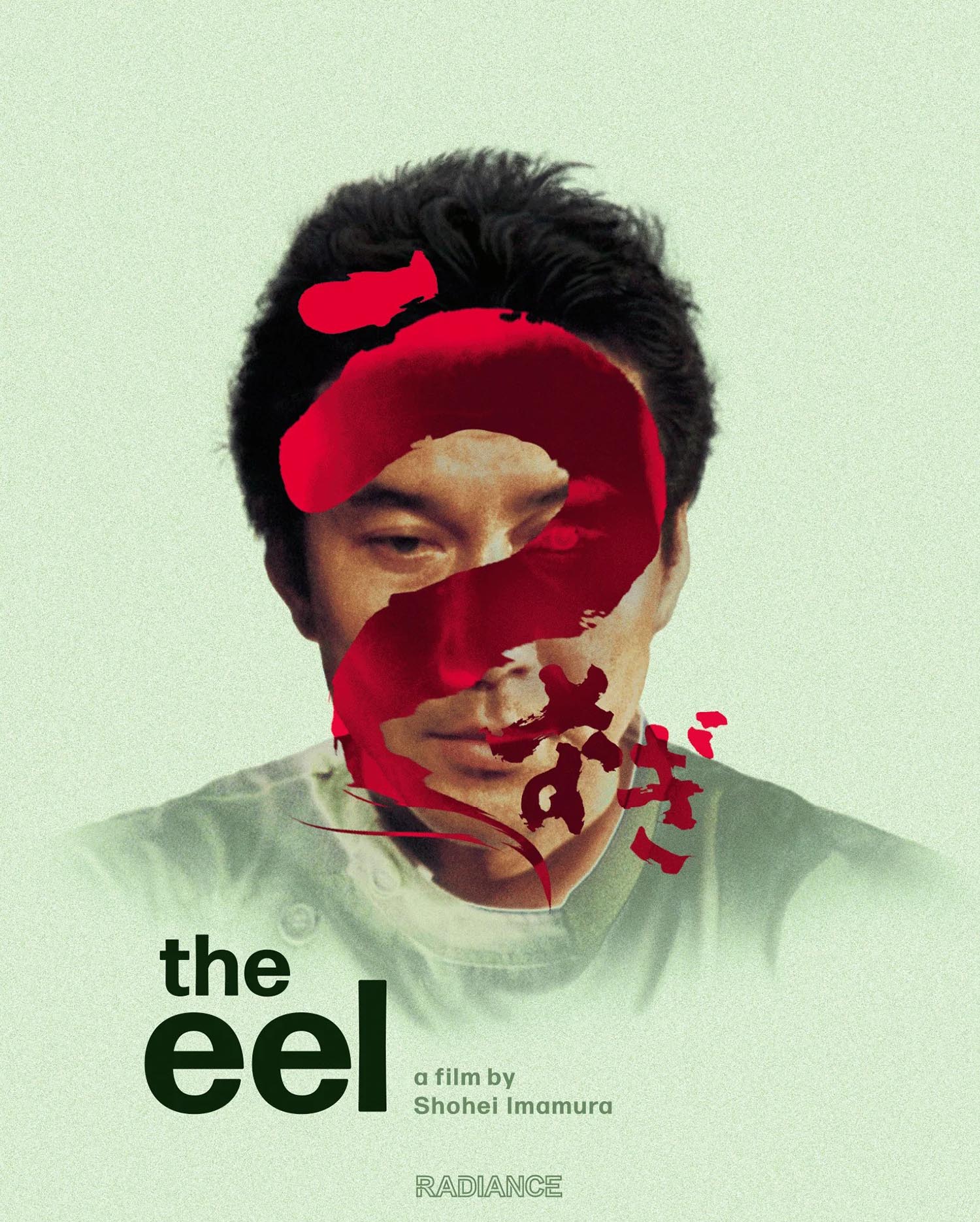
 Like much of Imamura Shôhei’s work, The Eel deals frankly with matters of sex and sexuality, but with an emotional detachment akin to an anthropological study. That detachment is on display from the start, when businessman Yamashita Takuro (Yakusho Kôji) acts on an anonymous note informing him of his wife’s (Terada Chiho) affair and sneaks home one evening to catch her in the act. In a scene scored only to the faint chirping of insects, Yamashita spies on the lovers with an aloof curiosity before calmly heading off to grab a knife and murder the pair. Only the spray of arterial blood that splatters the camera lens jolts the scene from its reverie.
The film jumps to eight years later as Yamashita leaves prison on parole, toting an eel from the facility’s pond that the warden allowed him to keep as a pet for good behavior. While the warden privately notes his disquiet that such a model prisoner and citizen could be capable of cold-blooded murder, he’s scarcely the only person who readily accepts the taciturn, polite ex-con as Yamashita rebuilds his life by opening a barber shop in a small seaside town.
The man’s easygoing personality draws others into his orbit, from an oddly philosophical fisherman (Satô Makoto) to Keiko (Shimizu Misa), a suicidal woman who becomes attached to him after he saves her life. At first, it seems that something about Yamashita’s strange energy attracts similarly odd ducks, but slowly the film starts to suggest that perhaps Japan is filled with such people, lost souls scuttling around the empty spaces of the densely populated nation.
The film’s characters are marked an uneasy contrast between outward placidity and inward confusion that also matches the setting. The area where Yamashita moves is charming, but Komatsubara Shigeru’s cinematography is defined by the washed-out color palette of so much ’90s Japanese cinema—a reminder of the heavy pollution of an industrial boom that was then in its twilight. The profit and productivity is gone, but the corrosive after effects remain.
Similarly, the normalcy that Yamashita attempts to carve out seems to bring out the worst in his new companions, whose resentments deepen at the sight of others compartmentalizing their own flaws. Yamashita must contend with a local garbageman (Emoto Akira) with whom he served time, and who seeks to ruin him over a perceived lack of contrition for his crimes. Keiko, too, deals with demons from her past, chiefly Dojima (Taguchi Tomorowo), the father of her unborn baby and a gangster seeking to swindle her out of a considerable inheritance. These characters represent a spiritual decay on par with the social stagnation visible all around them.
The Eel netted Imamura his second Palme d’Or, sharing this one with Abbas Kiarostami’s Taste of Cherry. Both films are stories about men so alienated that they threaten to evaporate from the corporeal world, but where the Iranian auteur’s film fits within his awareness of a many-layered reality, Imamura’s is a continuation of his pervading interest in the effect of Japanese stoicism and elaborate social customs on the primal emotions they repress.
The Eel is as aloof as Imamura’s other films, but in a curious twist, it’s Yamashita’s detachment and ability to compartmentalize that trigger something in those around him who are afraid to confront the parts of themselves that they bury for the sake of politesse. Unlike some of Imamura’s earlier, bleaker work, though, The Eel hints at a path forward for its characters, one that seems them overcoming baser instincts not by denying their existence but by making peace with them and striving toward making a better future, however humble it may be.
Image/Sound
Radiance’s disc includes both Imamura Shôhei’s preferred, slightly longer director’s cut and the original theatrical version, neither of which has been restored. As such, image quality is variable, with some of the exterior daytime shots in particular suffering from a lack of texture and definition. Darker scenes fare better, with the deeper colors only occasionally undermined by crushing artifacts. Still, the overall presentation is frustratingly fuzzy, recalling a video-shot V-Cinema movie from the time period rather than a 35mm theatrical feature. The lossless mono track is free of any issues, with the minimal ambient effects nicely balanced with the dialogue.
Extras
Critic Tony Rayns contributes a half-hour overview of Imamura’s career. He focuses on The Eel in particular, connecting it to recurring visual and thematic touchstones of its maker’s oeuvre. Imamura’s son, Tengan Daisuke, offers personal memories of his father in an interview, and critic Tom Mes contributes a video essay on Japanese cinema in the year 1997, presenting the nation’s industry at a crossroads as it began to climb out of the commercial and critical pit it entered at the start of the decade. The disc’s accompanying booklet contains an interview with Imamura conducted at the time of the film’s release, as well as a reprinted 2019 review by French critic Andrea Grunert that homes in on the surrealist and symbolic use of the pet eel.
Overall
A late-period classic from one of one of the Japanese New Wave’s most singular talents gets a welcome Blu-ray release in the States, but the transfer is woefully inconsistent.
Since 2001, we've brought you uncompromising, candid takes on the world of film, music, television, video games, theater, and more. Independently owned and operated publications like Slant have been hit hard in recent years, but we’re committed to keeping our content free and accessible—meaning no paywalls or fees.
If you like what we do, please consider subscribing to our Patreon or making a donation.