

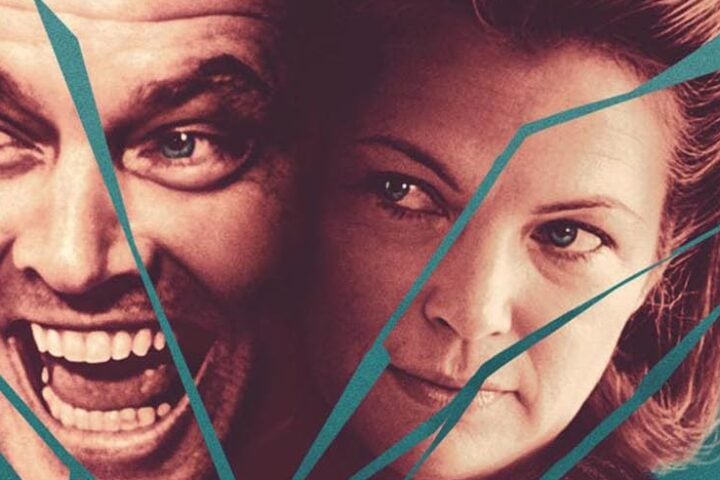
Stanley Kubrick’s The Shining is both a radical distillation of its source novel’s densely stuffed ghosts-and-gore imagery and a conflation of its hidden central theme of the horrors of domestic abuse. The result is a film that, though it ignores almost every major spook-show episode in Stephen King’s novel (nope, no teeming wasp’s nest here), enhances everything that’s legitimately unnerving about it: the sour grin of a desperate middle-aged man contemplating his overwhelming vocational failure, the inability for families to truly forgive even speculatively accidental physical violence, and the eerie juxtaposition of snowbound isolation within a vast architectural agora—a place where you can hide but you can’t run.
As he reveals in a moment of anger late in the film, Jack Torrance (Jack Nicholson) sees himself as a great novelist but has nothing published to his name. He makes ends meet shoveling show and washing cars, silently blaming his stalled dream career on his wife, Wendy (Shelley Duvall), and young, psychic son, Danny (Danny Lloyd). When he stumbles on a temp job as the winter caretaker for a Rocky Mountain resort hotel that, due to the impossibility of clearing the road during snowy season, has to shut down for half a year, he sees an opportunity to, with his wife’s help, keep the hotel’s gears grinding while he spends all his free time in front of the typewriter. Eventually, it becomes increasingly clear that the Overlook Hotel’s gears are apparently spinning out of control, while the cogs in the creative side of Jack’s brain have grinded to a halt.
But themes and plot, as with many Kubrick films, are in service of the filmic form, not vice versa. In other words, themes in The Shining arise due to Kubrick’s almost fastidious concentration on form. Some sources say that this is still the film that holds Kubrick’s record for most takes on a single shot, though the numbers and the shot in question vary. According to the commentary track by Steadicam operator Garrett Brown and film scholar John Baxter, recorded for the 2001 DVD release of the film, it’s over 140 takes on a two-shot of the conversation over ice cream between Lloyd’s Danny and Scatman Crothers’s Dick Hallorann.
Owing a massive debt to the still-new Steadicam device, The Shining’s gliding, prowling cinematography (by John Alcott) gives off the impression of momentum even as the three main characters are stalling out, letting tedium and seclusion open up all their festering familial resentments. One early sequence places Wendy and Danny within the bowels of the Overlook’s overtly Jungian hedge maze. Jack, frustrated and spending all his writing time in the hotel lobby throwing a tennis ball against the wall, strolls over to a model of the maze. A point-of-view shot of Jack’s overhead gaze tracks in slowly until you notice that the two tiny figures of Wendy and Danny are wandering at the center of the shot. It’s a memorable summary image for their situation—even given a foreshadowing moment of seeming omniscience, Jack can’t free himself from his family any more than his family can escape the sprawling maze—and it’s punctuated by the fact that it is one of the only trick shots in the entire film.
The carefully organized, seamlessly edited tracking shots and the complex musical textures of György Ligeti and Krzysztof Penderecki don’t even offer room to breathe, and the disorientation causes the mind to grasp for gravity. One of my favorite analyses of The Shining goes on at great length about how the entire film is an extended metaphor for the systematic slaughter of Native Americans. I don’t know what’s scarier: that the key to unlocking the misery of generations along the nation’s Trail of Tears is a highball glass filled with bourbon (accompanied by muttering about “white man’s burden,” as Jack muses to Lloyd, the ghost bartender), that Kubrick would expect audiences to pay attention to the logo on a can of cleanser as a crucial metaphor, or that the entire well-supported analysis actually makes a damned lot of sense.
It’s the experience more so than the actual content of The Shining that radiates cold, anti-humanly indifferent terror. But Kubrick does hedge his bets by building in ambiguities, winding up in the film’s final question mark of a shot—so wholly different from the sunny ending of the novel that you can sort of empathize with King when he speaks out against Kubrick’s adaptation.
Having conflated the sadistic struggle between a man and his family into a horrific epic tragedy, Kubrick ultimately slaps the film back into a reversal of 2001: A Space Odyssey’s coda, swapping accelerated evolution in favor of a regression so primordially violent that it disrupts the fabric of time. In that sense, the film’s chronological Mobius warp places it outside of the context of something like Robert Wise’s The Haunting and more in line with Alain Resnais’s Last Year in Marienbad (itself a pretty terrifying film, at least on the surface). Like Resnais’s gothic nightmare, Kubrick’s The Shining dwells at the outer limits of what can be thought of as a genre film, stretching the definition, filling it out, leaving it richer in its wake.
Since 2001, we've brought you uncompromising, candid takes on the world of film, music, television, video games, theater, and more. Independently owned and operated publications like Slant have been hit hard in recent years, but we’re committed to keeping our content free and accessible—meaning no paywalls or fees.
If you like what we do, please consider subscribing to our Patreon or making a donation.


Of this film’s many egregious errors, one of its most outstanding is the characterisation of Torrance who, in the novel, becomes gradually more unhinged. In the film, he starts bonkers… and has nowhere left to go. It is no wonder that King dislikes this adaptation.