
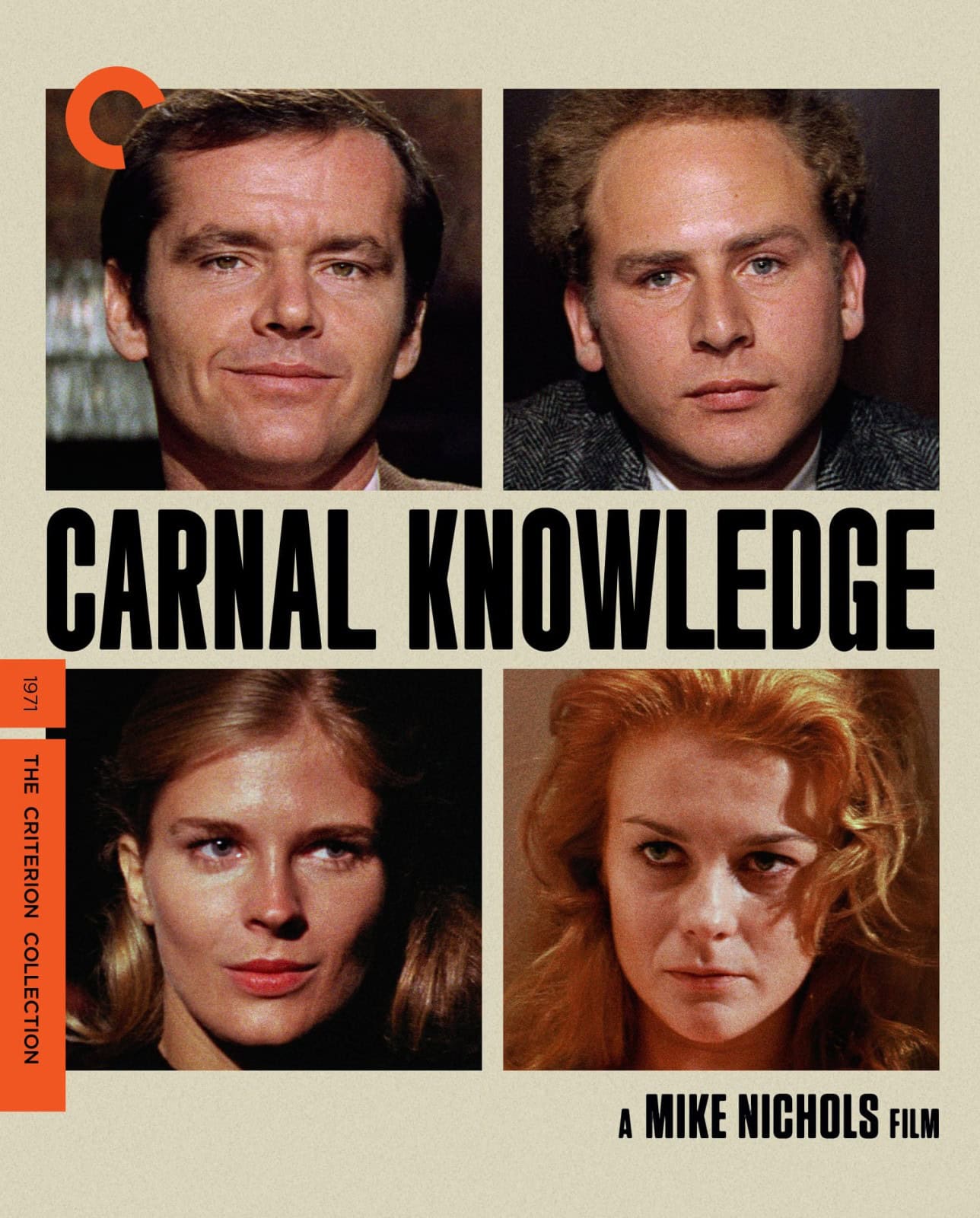
 Released during the rise of second-wave feminism in the 1970s, Mike Nichols’s Carnal Knowledge is a fascinating cultural artifact. While the masculine fear of female dominance was prevalent in the noirs of the 1940s and ’50s, few, if any, American films before Nichols’s dramedy turned their focus so intensely toward the inner workings of men’s minds in relation to women and sex.
Taking as its subject the wounded male ego, Carnal Knowledge traces the friendship between and sexual exploits of Jonathan (Jack Nicholson) and Sandy (Art Garfunkel) from their college years in the late ’40s through to their middle-age years in the early ’70s. Written by cartoonist and author Jules Fieffer, the film is fiercely attuned to the feelings of men reckoning with the knowledge that they’re not as dominant in the culture as they once were.
From deflowering Sandy’s girlfriend and future wife, Susan (Candice Bergen), to emotionally abusing his longtime girlfriend, Bobbie (Ann-Margaret), Jonathan is driven by his narcissism, self-loathing, and undying need for control, all of which he desperately weaponizes when the women in his life get too close to him. He moves in on Susan, then makes her out to be a harlot for sleeping with both him and Sandy. Later, he all but forces Bobbie to quit her job, only to then endlessly complain that she doesn’t do enough all day at home.
Jonathan’s self-defeating behavior is at the core of Carnal Knowledge’s thesis on American malehood. Sandy, who can never seem to make up his mind on his own, stands in stark contrast to his friend, who’s always the star of the show. The film is nothing if not thorough in its unpacking of Jonathan’s neuroses and misogynistic tendencies, but the intensity of this focus is such that it can feel as if the short shrift has been afforded to Susan and Bonnie.
Given the extent of Jonathan’s oppressiveness, it’s perhaps inevitable that everyone around him feels defined in relation to him. But this limited perspective grows increasingly more suffocating as the film proceeds. Carnal Knowledge certainly has a lot to say about the abhorrent, socially ingrained ways that men think about women, but it’s so locked into its protagonist’s deeply sexist worldview that it comes to share his blinkered view of those around him.
Image/Sound
Criterion’s 4K HDR presentation meets the company’s typically high standards, with strong contrast and image detail in even the darkest of scenes. The whites are a tad closer to cream than pure white, but otherwise, the colors are vibrant and flesh tones naturalistic. As for the audio, for a film with a lot of talking, the dialogue is suitably clean and resonant.
Extras
In a newly recorded audio commentary, playwright and filmmaker Neil LaBute talks about the influence that Mike Nichols’s film has had on his work. He discusses elements of the screenplay, but his most valuable contributions come through his analysis of Carnal Knowledge’s aesthetics. The other new extra is a very compelling new conversation between critics Mark Harris and Dana Stevens, who provide essential context around the film’s release and discuss its sneaky feminism and clever and discomforting use of reaction and direct-to-camera shots.
A 2011 Q&A with Ivan Reitman and Nichols allows for the latter to address the controversial release of the film in 1971, including Pauline Kael’s brutal review. There’s also a fantastic interview with film-editing historian Bobbie O’Steen, whose husband edited Carnal Knowledge, that touches on the use of transitions throughout the film and how they convey both the passing of time and the changing attitudes of the characters. Rounding out the package is a podcast with screenwriter Jules Feiffer and a beautiful 40-page booklet including an archival piece from American Cinematographer on Carnal Knowledge’s visual style along with an essay by scholar Moira Weigel, who unpacks and wrestles with the film’s sexual politics.
Overall
Mike Nichols’s divisive fourth feature gets a gorgeous new 4K transfer and a slate of diverse and informative extras courtesy of the Criterion Collection.
Since 2001, we've brought you uncompromising, candid takes on the world of film, music, television, video games, theater, and more. Independently owned and operated publications like Slant have been hit hard in recent years, but we’re committed to keeping our content free and accessible—meaning no paywalls or fees.
If you like what we do, please consider subscribing to our Patreon or making a donation.






I have the Powerhouse/Indicator 4K release of Carnal Knowledge, and although I can’t do a direct comparison with the Criterion version, I believe that the general opinion is that it is superior to Criterion’s version. And, there is a fade-to-white leading in to Nicholson’s slide show that is NOT on the Criterion and should be, but is definitely on the Powerhouse.